

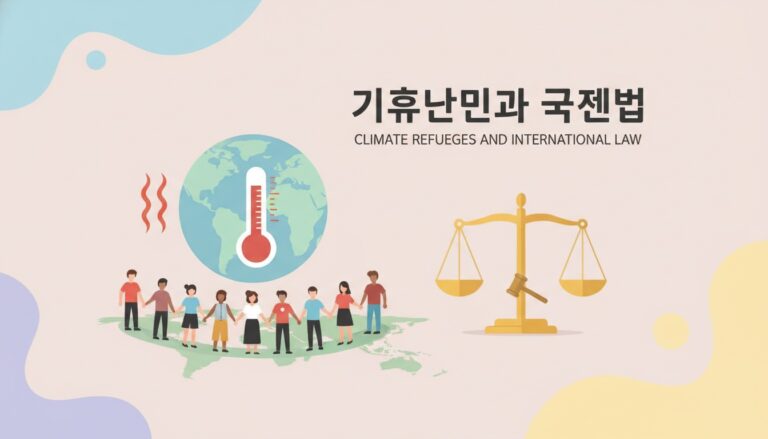
Climate Crisis! 🌍 Discussing ‘Climate Refugees’ in Korean like a Pro
1. Introduction
Annyeonghaseyo! It’s your favorite Korean tutor, [Daily Hangul]! 👋✨
Today, we are going to learn something very smart and important. Have you been watching the news lately? Or maybe you’ve seen Korean movies like The Host (괴물) or dramas dealing with social issues?
Today’s topic is about “Climate Refugees” (기후 난민). It sounds difficult, right? Don’t worry! I will teach you the easiest way to talk about this serious topic. By the end of this post, you will be able to express your opinion on global issues in Korean! Let’s level up! 🚀
2. Key Expressions (핵심 표현)
Here are 3 key words you need to know to sound like a native speaker when discussing the news!
1️⃣ 기후 난민 (Climate Refugee)
- Pronunciation: [Gihu nanmin]
- Meaning: Climate Refugee
- Detail: ‘기후’ means climate, and ‘난민’ means refugee. You can use this word when talking about people losing their homes due to environmental changes.
- 💡 Pronunciation Tip: The word 난민 is pronounced clearly as written. Make sure to pronounce the ‘n’ (ㄴ) sounds distinctly!
2️⃣ 국제법 (International Law)
- Pronunciation: [Guk-jje-beop]
- Meaning: International Law
- Detail: ‘국제’ means international, and ‘법’ means law. In news debates, people often ask if the law protects these refugees.
- 💡 Pronunciation Tip: Watch out! Although it is written as ‘Guk-je-beop’, the ‘je’ (제) sound becomes strong/tense (jj) because of the ‘k’ (ㄱ) sound before it. So say it like [Guk-jje-beop]!
3️⃣ 인정하다 (To recognize / To acknowledge)
- Pronunciation: [Injeonghada]
- Meaning: To recognize / To admit
- Detail: This is a very common verb. You use it when asking, “Does the law recognize them as refugees?” (난민으로 인정해요?)
3. Real Conversation (실전 대화)
Let’s see how Minsu and Jia talk about the news. Try reading it out loud! 🗣️
Minsu: 뉴스 봤어? 기후 문제가 정말 심각해.
(Nyuseu bwasseo? Gihu munjega jeongmal simgakae.)
Did you see the news? The climate problem is really serious.
Jia: 맞아. 요즘 기후 난민이 늘고 있대.
(Maja. Yojeum gihu nanmin-i neulgo itdae.)
That’s right. I heard climate refugees are increasing these days.
Minsu: 그 사람들을 국제법으로 도울 수 있어?
(Geu saramdeureul gukjjebeop-euro doul su isseo?)
Can we help them with international law?
Jia: 아직 어려워. 법이 그들을 인정해야 해.
(Ajik eoryeowo. Beobi geudeureul injeonghaeya hae.)
It’s still difficult. The law needs to recognize them.
4. Culture Tip & K-Drama Context 🎬
Did you know?
Korea is very serious about the environment! 🇰🇷♻️ You might have noticed in Korean reality shows that people separate their trash (recycling) very strictly.
Recently, in Korean dramas and news, the topic of “Global Responsibility” is trending. If you use the word “심각해” (It’s serious) when talking about the weather or environment, Koreans will think, “Wow, your Korean is very natural and sophisticated!” 👍
Also, the grammar “~아/어야 해” (have to/must) used in the dialogue (인정해야 해) is essential when you want to express your strong opinion or moral duty!
5. Wrap-up & Quiz (마무리 및 연습 문제)
Great job today! You tackled a difficult topic like a pro. Now you can understand news headlines a little better! 🎓
Let’s check your memory! (Fill in the blanks)
- People who lose their homes due to climate change are called ______.
(기후 ____) -
To say “It is serious” in Korean, you say: ______.
(심각해 / 행복해) -
“International Law” is pronounced as [Guk-____-beop].
(je / jje)
[Answers / 정답]
1. 난민 (Nanmin)
2. 심각해 (Simgakae)
3. jje (The sound becomes strong!)
See you next time! Annyeong! 👋❤️
Frequently Asked Questions (FAQ)
Q: What does ""심각해"" mean in Korean and how do you pronounce it?
A: In Korean, ""심각해"" is pronounced [It's serious] and means: when talking about the weather or environment, Koreans will think,
Q: What does ""~아/어야 해"" mean in Korean and how do you pronounce it?
A: In Korean, ""~아/어야 해"" is pronounced [have to/must] and means: used in the dialogue (인정







