

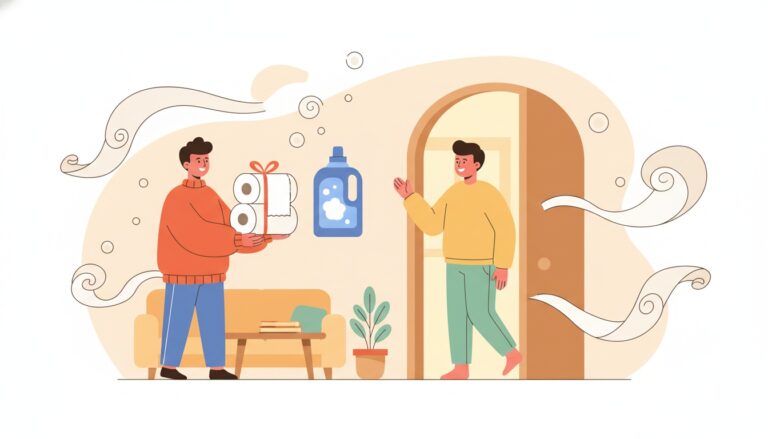
Best Housewarming Gifts in Korea! 🎁
1. Introduction
Hello, K-Culture fans! 👋 This is Daily Hangul, here to upgrade your Korean skills!
Have you ever been invited to a Korean friend’s house? In Korea, visiting a new home is a very special event called ‘Jipdeuri (집들이)’.
If you watch K-Dramas, you might have seen a scene where a guest brings… Toilet Paper to a party! 🧻 Wait, what? Why toilet paper? Is it a joke?
Today, we will learn how to choose the perfect gift for a Korean host and the beautiful meanings behind them. Let’s get started! 🚀
2. Key Expressions
1️⃣ 집들이 (Jipdeuri)
- Pronunciation: [Jip-deu-ri]
- English Meaning: Housewarming party
- Explanation: This is a combination of 집 (house) + 들 (entering) + 이 (noun suffix). It literally means “entering a new house.”
- 💡 Pronunciation Tip: When saying 집 (Jip), close your lips tight at the end. The ‘p’ sound is not fully released. Then, the ‘d’ in 들이 (deuri) sounds slightly stronger, almost like ‘tteuri’ because of the preceding ‘p’ sound.
2️⃣ 휴지 (Hyuji)
- Pronunciation: [Hyu-ji]
- English Meaning: Toilet paper / Tissue
- Explanation: This is the most classic housewarming gift! 🧻 It symbolizes the wish that “everything in your life will unroll easily and smoothly,” just like toilet paper unrolls.
- 💡 Pronunciation Tip: The ‘Hyu’ sound is like the English word ‘Hue’. Make sure to pronounce the ‘ji’ clearly, not ‘zi’.
3️⃣ 세제 (Seje)
- Pronunciation: [Se-je]
- English Meaning: Detergent
- Explanation: Another classic gift! 🧼 The bubbles from the detergent symbolize wealth and good luck rising quickly and abundantly.
- 💡 Pronunciation Tip: Both ‘Se’ and ‘je’ are short vowels. Don’t drag the sound.
4️⃣ 초대해 줘서 고마워요 (Chodaehae jwoseo gomawoyo)
- Pronunciation: [Cho-dae-hae jwo-seo go-ma-wo-yo]
- English Meaning: Thank you for inviting me.
- Explanation: This is a polite and perfect phrase to say when you enter the host’s house.
- 💡 Pronunciation Tip: In 고마워요 (gomawoyo), the ‘wo’ sound is rounded. Try to say it smoothly like a wave!
3. Real-life Conversation 🗣️
Situation: Alex visits Minji’s new apartment for a housewarming party.
👩 Minji: 어서 와, 알렉스! (Eoseo wa, Alex!)
(Welcome, Alex!)
🧑 Alex: 민지 씨, 초대해 줘서 고마워요. (Minji-ssi, chodaehae jwoseo gomawoyo.)
(Minji, thank you for inviting me.)
👩 Minji: 와 주셔서 제가 더 감사하죠. (Wa jusyeoseo jega deo gamsahajyo.)
(I’m more thankful that you came.)
🧑 Alex: 이거 집들이 선물이에요. 여기 휴지 샀어요. (Igeo jipdeuri seonmurieyo. Yeogi hyuji sasseoyo.)
(This is a housewarming gift. I bought toilet paper here.)
👩 Minji: 우와! 센스쟁이! 고마워요. (Uwa! Senseu-jaengi! Gomawoyo.)
(Wow! You have great sense! Thank you.)
4. Culture Tip & Drama Scene 🎬
🇰🇷 Why Toilet Paper and Detergent?
In Korean culture, gifts often have symbolic meanings related to luck and prosperity.
* Toilet Paper: Just as the paper unrolls easily, we wish the host’s problems to be solved easily.
* Detergent: Just as bubbles foam up, we wish the host’s wealth to grow big!
📺 Drama Scene:
In the famous drama “Reply 1988 (응답하라 1988)”, you can see neighbors bringing these items when visiting each other. Even in modern dramas like “Crash Landing on You”, these traditions are mentioned or shown as a sign of wishing good luck!
Nowadays, young Koreans also give scented candles, diffusers, or fruit, but toilet paper remains the funny and traditional King of Gifts! 👑
5. Wrap-up & Quiz 📝
Today we learned about Korean housewarming culture and gifts. Next time you visit a Korean friend, bring a roll of toilet paper and see them smile! 😄
Let’s check what you learned!
Q1. Fill in the blank:
In Korea, giving toilet paper means you want the host’s problems to ______ easily.
Q2. True or False?
‘Jipdeuri’ (집들이) means a birthday party.
Q3. Which item symbolizes wealth rising like bubbles?
A) Fruit B) Detergent (Seje)
✅ Answers:
1. Unroll (or Solve)
2. False (It means Housewarming party)
3. B
Frequently Asked Questions (FAQ)
Q: What does "이" mean in Korean and how do you pronounce it?
A: In Korean, "이" is pronounced [noun suffix] and means: . It literally means "entering a new house."
Q: What does "집" mean in Korean and how do you pronounce it?
A: In Korean, "집" is pronounced [Jip] and means: , close your lips tight at the end. The 'p' sound is not fully released. Then, the 'd' in
Q: What does "들이" mean in Korean and how do you pronounce it?
A: In Korean, "들이" is pronounced [deuri] and means: sounds slightly stronger, almost like 'tteuri' because of the preceding 'p' sound.
Q: What does "고마워요" mean in Korean and how do you pronounce it?
A: In Korean, "고마워요" is pronounced [gomawoyo] and means: , the 'wo' sound is rounded. Try to say it smoothly like a wave!







