

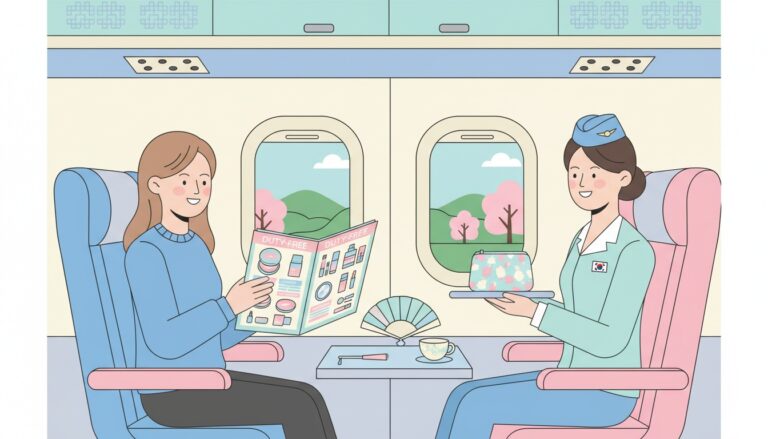
Shopping in the Sky! Requesting Duty-Free ✈️🛍️
1. Introduction
Annyeonghaseyo! (Hello!) It’s your favorite Korean tutor, Daily Hangul, here to upgrade your Korean skills! 🌟
Are you planning a trip to Korea? One of the best parts of the flight is looking through the Duty-Free Catalog! Whether you want to buy exclusive K-Beauty products or a last-minute gift for your friend, knowing how to ask for the catalog and order items is essential.
Have you seen scenes in K-Dramas where the main character buys a luxury lipstick or a cute accessory on the plane to look perfect upon arrival? Today, we will learn how to do exactly that! Let’s get ready to shop in the sky! ✈️💸
2. Key Expressions
Here are the 3 most useful phrases for in-flight shopping!
1️⃣ 면세품 카탈로그 있어요?
- Pronunciation: [Myeon-se-pum ka-tal-lo-gu i-sseo-yo?]
- English Meaning: Do you have the duty-free catalog?
- Details:
- 면세품 (Myeonsepum) means “duty-free goods.”
- 있어요? (Isseoyo?) means “Do you have?” or “Is there?” You can use this structure for anything! (e.g., “Water isseoyo?”)
- 💡 Pronunciation Tip:
- Linking Sound: When saying 있어요, the bottom consonant
ㅆ(ss) moves to the empty circleㅇin the next block. So, instead of [it-eo-yo], it sounds like [i-sseo-yo]. It flows much smoother!
- Linking Sound: When saying 있어요, the bottom consonant
2️⃣ 이거 주세요.
- Pronunciation: [I-geo ju-se-yo.]
- English Meaning: Please give me this. / I’ll take this.
- Details:
- 이거 (Igeo) means “this.”
- 주세요 (Juseyo) means “please give me.” This is the Magic Word in Korean! You can point at anything in the catalog and say this.
- 💡 Pronunciation Tip:
- Soft J: The
ㅈin 주세요 is a soft ‘j’ sound, like ‘j’ in ‘juice’, not a hard ‘z’. Say it gently!
- Soft J: The
3️⃣ 카드로 계산할게요.
- Pronunciation: [Ka-deu-ro gye-san-hal-ge-yo.]
- English Meaning: I will pay with a card.
- Details:
- 카드 (Kadeu) is “card” (credit card).
- 계산할게요 (Gyesanhalgeyo) means “I will calculate/pay.”
- Most flights accept credit cards for duty-free items!
3. Real-life Dialogue
Let’s see how this works in a real situation on the plane!
Situation: You want to buy a cosmetic set from the catalog.
🧑✈️ Flight Attendant (A)
👤 You (B)
B: 저기요, 면세품 카탈로그 있어요?
(Excuse me, do you have the duty-free catalog?)
A: 네, 여기 있습니다.
(Yes, here it is.)
(After looking at the catalog)
B: 이거 주세요. 이 립스틱 세트요.
(I’ll take this. This lipstick set.)
A: 네, 알겠습니다. 결제는 어떻게 하시겠어요?
(Okay. How would you like to pay?)
B: 카드로 계산할게요.
(I will pay with a card.)
4. Culture Tip & K-Drama Vibes 🎬
🇰🇷 K-Beauty in the Sky!
Did you know that Korean airlines often sell exclusive K-Beauty sets that you can’t find on the ground? In many K-Dramas, you might see characters giving gifts wrapped in airline duty-free bags. It’s considered a sensible and high-quality gift!
Also, when speaking to flight attendants, we always use polite language (ending in -yo or -nida). Using “Hey!” or informal language is a big No-No! 🙅♀️ Always smile and say “Juseyo” (Please give me).
5. Wrap-up & Quiz
Great job today! Now you are ready to shop for amazing Korean products while flying to Seoul! 🛍️
Let’s check what we learned:
Q1. How do you say “Please give me this” in Korean?
A) Igeo isseoyo?
B) Igeo juseyo.
Q2. Fill in the blank: “Do you have _____?” = “_____ isseoyo?”
(Hint: Duty-free catalog)
Q3. True or False?
When pronouncing
Frequently Asked Questions (FAQ)
Q: What does "면세품" mean in Korean and how do you pronounce it?
A: In Korean, "면세품" is pronounced [Myeonsepum] and means: means "duty-free goods."
Q: What does "있어요?" mean in Korean and how do you pronounce it?
A: In Korean, "있어요?" is pronounced [Isseoyo?] and means: means "Do you have?" or "Is there?" You can use this structure for anything! (e.g., "Water isseoyo?")
Q: What does "이거" mean in Korean and how do you pronounce it?
A: In Korean, "이거" is pronounced [Igeo] and means: means "this."
Q: What does "주세요" mean in Korean and how do you pronounce it?
A: In Korean, "주세요" is pronounced [Juseyo] and means: means "please give me." This is the







