

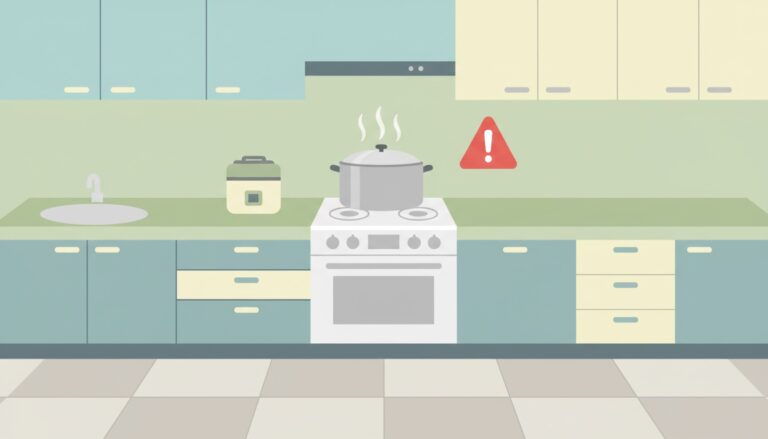
Ouch! 🔥 Essential Korean Phrases for Cooking Safety
1. Introduction
Hello, K-Culture lovers! 🌟 It’s Daily Hangul, your friendly guide to mastering Korean!
Today, we are stepping into the kitchen! 🍳 Have you ever watched a K-drama where the main character tries to cook for their crush but accidentally touches a hot pot? And then they quickly touch their earlobes? (We’ll talk about this later! 😉)
Cooking Korean food like Ramyeon or Kimchi-jjigae is fun, but safety comes first! Today, we will learn how to warn your friends about hot cooking tools so everyone stays safe. Let’s turn up the heat on your Korean skills! 🔥
2. Core Expressions
Here are the 3 most important phrases to keep your kitchen safe!
1. 뜨거워요! (It’s hot!)
- Pronunciation: [Tteugeowoyo]
- Meaning: It’s hot!
- Explanation: This is the most basic adjective to describe something hot to the touch (not the weather). You can shout this when someone is about to touch a hot pot.
- 💡 Pronunciation Tip: Focus on the double consonant ‘ㄸ’ (Tt). It requires more tension in your tongue than a regular ‘T’. Imagine you are holding your breath for a split second before saying “Teu”.
2. 조심하세요 (Please be careful)
- Pronunciation: [Josimhaseyo]
- Meaning: Please be careful.
- Explanation: You will hear this everywhere in Korea. It’s a polite way to tell someone to watch out. You can use it in the kitchen, on the street, or at a construction site!
- 💡 Pronunciation Tip: The ‘yo’ (요) at the end makes it polite. If you are talking to a very close friend, you can just say “Josimhae” (조심해).
3. 만지지 마세요 (Please don’t touch it)
- Pronunciation: [Manjiji maseyo]
- Meaning: Please don’t touch it.
- Explanation: “Manjida” means to touch. “-ji maseyo” is a polite command meaning “Please do not…”. Combine them, and you save a finger from getting burned! 🚫
3. Real Conversation
Let’s see how Min-su and Sarah handle a hot situation in the kitchen while making Ramyeon! 🍜
Situation: Sarah reaches for the lid of a boiling pot.
Min-su: 잠깐만요! 그거 뜨거워요! 🛑
(Jamkkanmanyo! Geugeo tteugeowoyo!)
Wait! That is hot!
Sarah: 아, 진짜요? 몰랐어요.
(A, jinjjayo? Mollasseoyo.)
Oh, really? I didn’t know.
Min-su: 냄비가 아주 뜨거워요. 조심하세요.
(Naembiga aju tteugeowoyo. Josimhaseyo.)
The pot is very hot. Please be careful.
Sarah: 고마워요, 민수 씨!
(Gomawoyo, Min-su ssi!)
Thank you, Min-su!
4. Culture Tip & Drama Scene 📺
Why do Koreans touch their earlobes? 👂
In many K-dramas, when a character burns their finger on a hot pot lid or a grilled piece of meat, they immediately grab their earlobes! Have you seen this?
This is a real Korean habit! It is commonly believed that the earlobe is the coldest part of the body, so touching it helps cool down the burnt finger quickly. Next time you see this scene in a drama, you’ll know exactly what’s happening! (But running cold water is medically better! 💧)
5. Wrap-up & Quiz
Great job today! Now you can protect your friends in the kitchen. Remember, safety is the most important ingredient! 👨🍳👩🍳
📝 Mini Quiz
- How do you say “It’s hot!” in Korean? (Fill in the blank)
______워요! -
True or False: “Josimhaseyo” means “Let’s eat.”
( O / X ) -
If you want to say “Don’t touch,” you say “Manjiji ______.”
a) maseyo
b) juseyo
Answer Key:
1. 뜨거 (Tteugeo)
2. X (It means “Please be careful”)
3. a (maseyo)
See you next time! 안녕! 👋
Frequently Asked Questions (FAQ)
Q: What does "조심하세요 (Please be careful)" mean in Korean and how do you pronounce it?
A: In Korean, "조심하세요 (Please be careful)" is pronounced [Josimhaseyo] and means: Please be careful.
Q: What does "만지지 마세요 (Please don't touch it)" mean in Korean and how do you pronounce it?
A: In Korean, "만지지 마세요 (Please don't touch it)" is pronounced [Manjiji maseyo] and means: Please don't touch it.







