

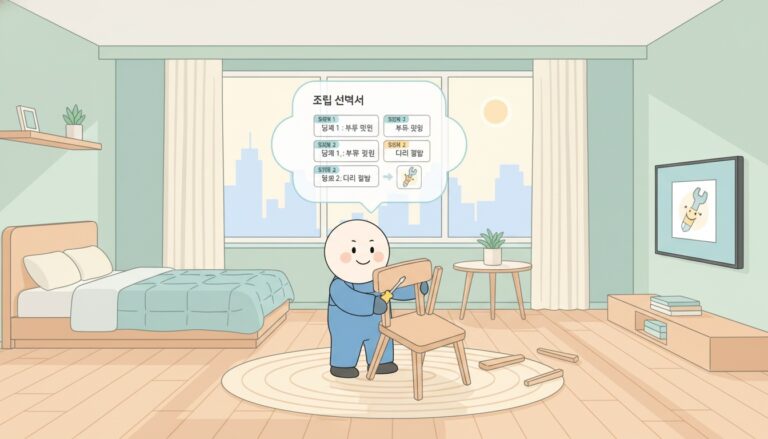
Master DIY: Easy Korean for Furniture Assembly! 🛠️
1. Introduction
Hello, K-Culture fans! It’s your friendly tutor, Daily Hangul! 😊
Have you ever watched a K-Drama where the main character moves into a rooftop apartment (Oktapbang) and struggles to build their own furniture? Or maybe you plan to live in Korea and order a cute table from ‘Coupang’?
Don’t panic when you see the instruction manual! Today, we will learn simple yet essential Korean words to help you understand furniture assembly instructions. Let’s build some confidence (and furniture) together! 💪
2. Key Expressions
Here are 4 must-know words for any DIY situation!
1) 조립하다 (Joriphada)
- Meaning: To assemble / To build
- Pronunciation: [Jo-rip-ha-da]
- Detail: This is the most important verb. You will see “조립 설명서” (Assembly Manual) on the cover of the booklet.
- 💡 Pronunciation Tip: When ㅂ (b/p) meets ㅎ (h), the sound becomes stronger, like a ‘p’ sound. So it sounds like [Joripada].
2) 넣다 (Neota)
- Meaning: To put in / To insert
- Pronunciation: [Neo-ta]
- Detail: Used when the manual tells you to insert a screw or a wooden dowel into a hole.
- 💡 Pronunciation Tip: The ㅎ (h) at the bottom is silent, but it makes the following ㄷ (d) sound like a strong ‘t’. Say it sharply: [Neota].
3) 돌리다 (Dollida)
- Meaning: To turn / To rotate
- Pronunciation: [Dol-li-da]
- Detail: You need this action for screws! “오른쪽으로 돌리세요” means “Turn it to the right.”
- 💡 Pronunciation Tip: The double ㄹ (ll) should be pronounced clearly and fluidly, like the ‘l’ in ‘lily’.
4) 완성 (Wanseong)
- Meaning: Complete / Finished
- Pronunciation: [Wan-seong]
- Detail: You shout this when you are done! It’s often used as an exclamation in variety shows when a mission is finished.
- 💡 Pronunciation Tip: Make sure the ‘ng’ (ㅇ) sound at the end is soft, like in ‘song’.
3. Real-life Dialogue
Let’s see how friends Minji and Jason assemble a chair together.
Minji: 설명서 봤어? 먼저 다리를 조립하자.
(Seolmyeongseo bwasseo? Meonjeo darireul joriphaja.)
Did you see the manual? Let’s assemble the legs first.
Jason: 알겠어. 이 구멍에 나사를 넣어?
(Algesseo. I gumeong-e nasareul neoeo?)
Okay. Do I put the screw into this hole?
Minji: 응, 그리고 오른쪽으로 돌려.
(Eung, geurigo oreunjjog-euro dollyeo.)
Yes, and turn it to the right.
Jason: 와, 의자 완성!
(Wa, uija wanseong!)
Wow, the chair is complete!
4. Culture Tip & Drama Scene 📺
🏠 Jip-kkumi-gi (House Decorating)
In Korea, “Jip-kkumi-gi” (Decorating the house) is a huge trend among young people living alone. Because many live in small studios (One-room), they love buying affordable, self-assembly furniture to make their space cozy.
🎬 Drama Context:
In the drama “Because This Is My First Life”, you often see characters organizing their space. If you hear someone say “다 했다!” (Da haetda!) after building something, it means “I did it all!” or “Finished!” – a great phrase to use alongside “완성” (Wanseong)!
5. Wrap-up & Quiz
Today we learned how to become a DIY master in Korean! Don’t be afraid of the manual next time. 😉
📝 Mini Quiz
1. How do you say “To assemble” in Korean?
(A) Yorihada (B) Joriphada
- True or False: “Wanseong” means “To start”.
(A) True (B) False
⬇️ Answers
1. (B) Joriphada
2. (B) False (It means “Complete”)
See you next time! Annyeong! 👋
Frequently Asked Questions (FAQ)
Q: What does "넣다 (Neota)" mean in Korean and how do you pronounce it?
A: In Korean, "넣다 (Neota)" is pronounced [Neo-ta] and means: To put in / To insert
Q: What does "돌리다 (Dollida)" mean in Korean and how do you pronounce it?
A: In Korean, "돌리다 (Dollida)" is pronounced [Dol-li-da] and means: To turn / To rotate
Q: What does "완성 (Wanseong)" mean in Korean and how do you pronounce it?
A: In Korean, "완성 (Wanseong)" is pronounced [Wan-seong] and means: Complete / Finished






