

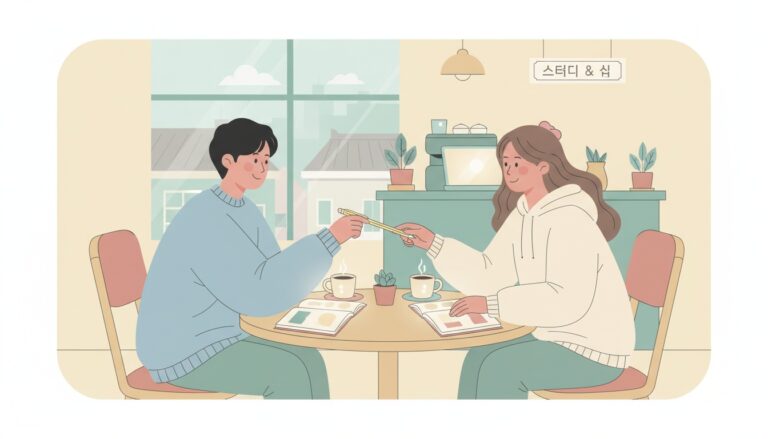
Can I Borrow This? 🖊️ Korean Possessives & Borrowing Items
1. Intro: Oops! I forgot my wallet! 😱
안녕하세요! (Hello!) It’s your friendly Korean tutor, [Daily Hangul]! 👋
Have you ever been to a cafe in Seoul and realized your phone battery is at 1%? Or maybe you’re in a classroom and forgot your pen? In K-Dramas, these are the exact moments where romance begins! 💕
Today, we will learn how to ask “Is this yours?” and “Can I borrow this?” using Korean Possessives. Mastering this will help you survive in Korea and maybe even make a new friend! Let’s get started! 🚀
2. Key Expressions: Mine, Yours, and Ours ✨
Here are 3 essential expressions to talk about ownership and borrowing.
1. 제 / 내 (My)
- Korean: 제 / 내
- Pronunciation: [Je] / [Nae]
- English Meaning: My (Polite / Casual)
- Detail:
- 제 (Je) is the polite form. Use this with strangers or seniors (e.g., “제 펜이에요” = It’s my pen).
- 내 (Nae) is the casual form. Use this with close friends (e.g., “내 거야” = It’s mine).
2. ~의 (Possessive Particle)
- Korean: ~의
- Pronunciation: [ui] (But often sounds like [e])
- English Meaning: ‘s (indicates possession)
- Detail: You attach this after a name or noun to show ownership.
- Ex: 민지의 가방 (Minji’s bag).
3. 빌려주세요 (Please lend me)
- Korean: 빌려주세요
- Pronunciation: [Billyeojuseyo]
- English Meaning: Please lend me / Can I borrow?
- Detail: This is a magic phrase! Just add the object before it.
- Ex: 우산 좀 빌려주세요 (Please lend me an umbrella).
💡 Pronunciation Tip!
The letter ‘의’ is officially romanized as [ui]. However, when it is used as a possessive particle (meaning “‘s”), native Koreans pronounce it as [e] (에) because it’s easier!
* 민지의 (Minji-ui) sounds like [Minji-e].
3. Real-life Dialogue: At a Cafe ☕
Imagine you are at a cafe with your Korean friend, Minji. You need to charge your phone.
(A: You / B: Minji)
A: 민지야, 이거 네 충전기야?
(Minji-ya, igeo ne chungjeongi-ya?)
Minji, is this your charger?
B: 응, 내 거야. 왜?
(Eung, nae geo-ya. Wae?)
Yeah, it’s mine. Why?
A: 나 배터리가 없어. 좀 빌려줄 수 있어?
(Na baeteri-ga eopseo. Jom billyeojul su isseo?)
I have no battery. Can you lend it to me?
B: 그럼! 여기 있어.
(Geureom! Yeogi isseo.)
Sure! Here it is.
4. Cultural Tip & Drama Scene 🎬
🇰🇷 The “Our” (우리) Culture
In English, you say “My mom” or “My house.” But in Korea, you will often hear “우리 엄마 (Our mom)” or “우리 집 (Our house)”, even if you are the only child!
This comes from the Korean culture of collectivism. Using “Woori” (Our) shows affection and a sense of belonging. So, if your favorite K-Pop idol says “Our country (우리 나라)”, they are showing love for Korea!
Drama Scene: In Reply 1988, notice how neighbors always share things and say “This is our alley.” Sharing is caring in Korea! 🥰
5. Wrap-up & Quiz 📝
Today we learned how to express ownership with 제/내 (My) and ask to borrow items with 빌려주세요. Now you are ready to borrow a charger or an umbrella in Korea without fear!
Let’s check your understanding!
Q1. Which one is the Polite way to say “My”?
(A) 내 (Nae)
(B) 제 (Je)
Q2. How do Koreans usually pronounce the possessive particle ‘의’?
(A) [ui] like ‘We’
(B) [e] like ‘Eh’
Q3. Complete the sentence: “Please lend me a pen.”
= 펜 좀 ( __________ ).
Drop your answers in the comments! See you next time! 안녕! 👋
Answers:
1. (B) 제
2. (B) [e]
3. 빌려주세요 (billyeojuseyo)
Frequently Asked Questions (FAQ)
Q: What does "~의 (Possessive Particle)" mean in Korean and how do you pronounce it?
A: In Korean, "~의 (Possessive Particle)" is pronounced [ui] and means: 's (indicates possession)
Q: What does "빌려주세요 (Please lend me)" mean in Korean and how do you pronounce it?
A: In Korean, "빌려주세요 (Please lend me)" is pronounced [Billyeojuseyo] and means: Please lend me / Can I borrow?







