

1. Introduction
Annyeonghaseyo! (안녕하세요!) Welcome back to [Daily Hangul], your friendly guide to mastering Korean! 👋✨
Have you ever been invited to a party but couldn’t go? Or maybe someone asked for a favor you couldn’t do? In English, a simple “No” might work, but in Korea, politeness is everything! 🇰🇷
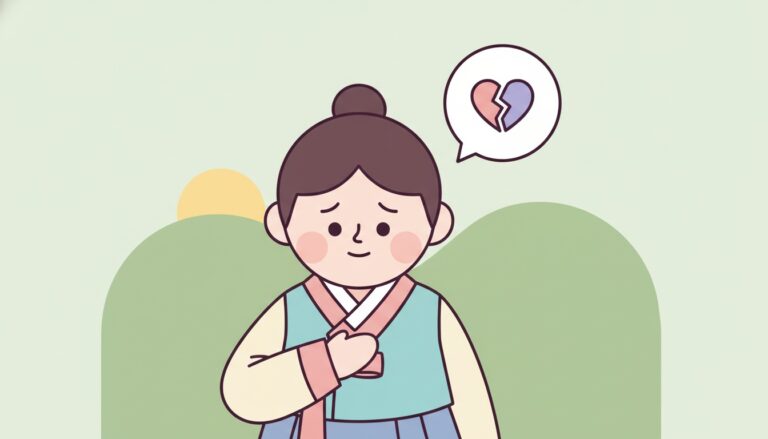
Simply saying “No” (Aniyo) can sound too cold or direct. To sound like a native (and a nice person!), you need to “cushion” the bad news. You’ll often see this in K-Dramas: the main character looks sad, sighs, and uses specific phrases to show they really wish they could say yes. 🥺
Today, let’s learn how to deliver regrettable news gently and politely. Let’s level up! 🚀
2. Key Expressions
Here are 3 essential phrases to soften the blow when delivering bad news.
1. 죄송하지만… (Joesonghajiman…)
- Pronunciation: [Joe-song-ha-ji-man]
- Meaning: I am sorry, but…
- Detail: This is the magic starter! Before you say you can’t do something, you start with this. It signals to the listener, “Bad news is coming, but I respect you.”
- 💡 Pronunciation Tip: The ‘J’ in ‘Joe’ is soft. Pronounce every syllable clearly. It’s not ‘Joesong-hajiman’, but flows like ‘Joesong-hajiman’.
2. 어떡하죠? (Eotteokhajyo?)
- Pronunciation: [Eo-tteo-ka-jyo]
- Meaning: What should I do? / Oh no…
- Detail: This is super useful! It literally means “What do I do?” but it’s used to express, “I really want to help/go, but I can’t, and I feel terrible about it.” It shows empathy.
- 💡 Pronunciation Tip: Watch out for sound blending! The bottom
ㄱ(k) in떡meets theㅎ(h) in하. Together they make a strong K sound (ㅋ). So it sounds like [Eotteokajyo].
3. 아쉽게도… (Aswipgedo…)
- Pronunciation: [A-swip-ge-do]
- Meaning: Unfortunately / Regrettably
- Detail: Use this when you want to emphasize that the situation is a pity. It shows that you are sad about the result too.
3. Real Conversation
Let’s see how to decline an invitation to a movie without hurting feelings! 🎬
Situation: Minji invites Jason to see a movie tomorrow.
Minji: 제이슨 씨, 내일 같이 영화 볼까요? 🍿
(Jason-ssi, naeil gachi yeonghwa bolkkayo?)
[Jason, shall we watch a movie together tomorrow?]
Jason: 아, 죄송하지만 내일은 약속이 있어요. 😓
(Ah, joesonghajiman naeireun yaksogi isseoyo.)
[Ah, I’m sorry but I have plans tomorrow.]
Jason: 정말 가고 싶은데 어떡하죠?
(Jeongmal gago sipeunde eotteokhajyo?)
[I really want to go, what should I do?]
Minji: 괜찮아요! 다음 기회에 같이 가요. 😊
(Gwaenchannayo! Daeum gihoee gachi gayo.)
[It’s okay! Let’s go together next opportunity.]
4. Culture Tip & K-Drama Vibes 📺
The Art of the Indirect “No”
In Korean culture, maintaining group harmony (Kibun) is vital. Direct rejection can cause someone to “lose face.” That’s why you rarely hear a flat “No” (Aniyo) in social requests.
Instead, Koreans provide a reason (even a vague one) and express regret. By saying “Eotteokhajyo?” (What should I do?), you are shifting the blame to the situation, not your willingness. It implies, “My heart says yes, but the situation says no!”
Next time you watch a K-Drama, notice how characters hesitate and look down before declining. That hesitation is part of the language! 😉
5. Wrap-up & Quiz
Today we learned how to be polite even when saying no! Remember, a little “cushion” goes a long way in Korea.
📝 Mini Quiz!
- Fill in the blank:
Frequently Asked Questions (FAQ)
Q: What does "어떡하죠? (Eotteokhajyo?)" mean in Korean and how do you pronounce it?
A: In Korean, "어떡하죠? (Eotteokhajyo?)" is pronounced [Eo-tteo-ka-jyo] and means: What should I do? / Oh no...
Q: What does "아쉽게도... (Aswipgedo...)" mean in Korean and how do you pronounce it?
A: In Korean, "아쉽게도... (Aswipgedo...)" is pronounced [A-swip-ge-do] and means: Unfortunately / Regrettably







