

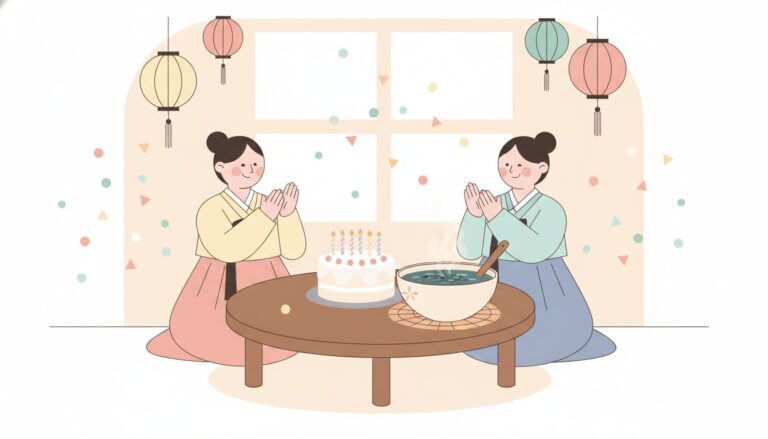
Let’s Party! Inviting Friends to Your Birthday 🎂
Annyeonghaseyo! (안녕하세요!) 👋 It’s your favorite Korean tutor, Daily Hangul, here to upgrade your Korean skills!
Today, we are preparing for a very special day—your Birthday (Saengil)! 🎉 In K-Dramas, you often see friends gathering at a nice restaurant or a karaoke room (Noraebang) to celebrate, right?
Imagine you are the main character today. How do you ask your friends to join you? Don’t worry about formalities; today we are talking to close friends! Let’s learn the coolest and most natural ways to invite your besties! Let’s go! (Gaja! 🚀)
3 Key Expressions for Invitations
1. 시간 있어? (Sigan isseo?)
- Pronunciation: [Sigan isseo?]
- English Meaning: Do you have time?
- Detail: Before inviting someone, you usually check their availability. This is a casual way to ask friends. If you are talking to someone older, you would say “Sigan isuseyo?” (시간 있으세요?).
- 💡 Pronunciation Tip: Watch out for the Liaison (Linking Sound)! When the final consonant ‘ㄴ’ (n) in ‘Sigan’ meets the vowel ‘이’ (i) in ‘isseo’, the sound carries over. It sounds more like [Si-ga-ni-sseo].
2. 내 생일이야 (Nae saengil-iya)
- Pronunciation: [Nae saengil-iya]
- English Meaning: It’s my birthday.
- Detail: ‘Nae’ means ‘My’ (casual), and ‘Saengil’ means ‘Birthday’. Ending with ‘-iya’ makes it a casual statement of fact.
- 💡 Pronunciation Tip: ‘Saeng-il’ can be tricky. Try to pronounce ‘ng’ in ‘Saeng’ clearly from your throat, like the ‘ng’ in ‘Sing‘.
3. 파티에 올래? (Pati-e ollae?)
- Pronunciation: [Pati-e ollae?]
- English Meaning: Do you want to come to the party?
- Detail: ‘-(u)llae?’ is a very common grammar point used to ask for the listener’s intention or will softly. It’s friendlier than a direct command.
- 💡 Pronunciation Tip: ‘Pati’ is a loanword from ‘Party’, but in Korean, there is no ‘R’ sound and no ‘F’ sound. It is pronounced with a crisp ‘T’ sound: [Pa-ti].
4. 꼭 와! (Kkok wa!)
- Pronunciation: [Kkok wa!]
- English Meaning: You must come!
- Detail: This is a cute and emphatic way to say “Please come.” You will hear this constantly in dramas when characters make plans.
- 💡 Pronunciation Tip: The double consonant ‘ㄲ’ (Kk) is a Tense Sound. You need to build up air pressure in your throat and release it sharply, like a very strong ‘K’ without a breath of air. Tense up your throat!
Real Conversation: Planning the Party 🗣️
Let’s see how Min-su invites his friend Kelly to his birthday bash!
Min-su: 켈리, 이번 주 토요일에 시간 있어?
(Kelly, ibeon ju toyoil-e sigan isseo?)
Kelly, do you have time this Saturday?
Kelly: 응, 시간 있어. 왜?
(Eung, sigan isseo. Wae?)
Yeah, I have time. Why?
Min-su: 그날 내 생일이야. 우리 집 파티에 올래?
(Geunal nae saengil-iya. Uri jip pati-e ollae?)
It’s my birthday that day. Do you want to come to a party at my house?
Kelly: 정말? 와! 생일 축하해! 당연히 가야지.
(Jeongmal? Wa! Saengil chukhahae! Dangyeonhi gayaji.)
Really? Wow! Happy Birthday! Of course, I should go.
Min-su: 고마워. 맛있는 거 많이 만들 거야. 꼭 와!
(Gomawo. Masinneun geo mani mandeul geoya. Kkok wa!)
Thanks. I’m going to make lots of delicious food. You must come!
🇰🇷 Culture Tip & K-Drama Moment
“Did you eat Seaweed Soup?” (미역국 먹었어?)
If you watch K-Dramas, you’ve definitely seen characters drinking a dark green soup on their birthday. This is Miyeok-guk (Seaweed Soup).
In Korea, mothers eat this soup after giving birth to recover. So, eating it on your birthday is a way to honor your mother and thank her for bringing you into the world. If you invite Korean friends to your party, serving Miyeok-guk will make them think, “Wow, you are a real Korean expert!” 😲👍
Wrap-up & Quiz 📝
Today we learned how to invite friends casually! Don’t be shy—try texting your Korean friend these phrases today!
Pop Quiz! (Fill in the blanks)
- “Do you have time?”
-> _____ 있어? (_____ isseo?) -
“You must come!”
-> __ 와! (__ wa!)
[Answers]
1. 시간 (Sigan)
2. 꼭 (Kkok)
See you next time! Annyeong! 👋
Frequently Asked Questions (FAQ)
Q: What does "시간 있어? (Sigan isseo?)" mean in Korean and how do you pronounce it?
A: In Korean, "시간 있어? (Sigan isseo?)" is pronounced [Sigan isseo?] and means: Do you have time?
Q: What does "내 생일이야 (Nae saengil-iya)" mean in Korean and how do you pronounce it?
A: In Korean, "내 생일이야 (Nae saengil-iya)" is pronounced [Nae saengil-iya] and means: It's my birthday.
Q: What does "파티에 올래? (Pati-e ollae?)" mean in Korean and how do you pronounce it?
A: In Korean, "파티에 올래? (Pati-e ollae?)" is pronounced [Pati-e ollae?] and means: Do you want to come to the party?
Q: What does "꼭 와! (Kkok wa!)" mean in Korean and how do you pronounce it?
A: In Korean, "꼭 와! (Kkok wa!)" is pronounced [Kkok wa!] and means: You must come!






