

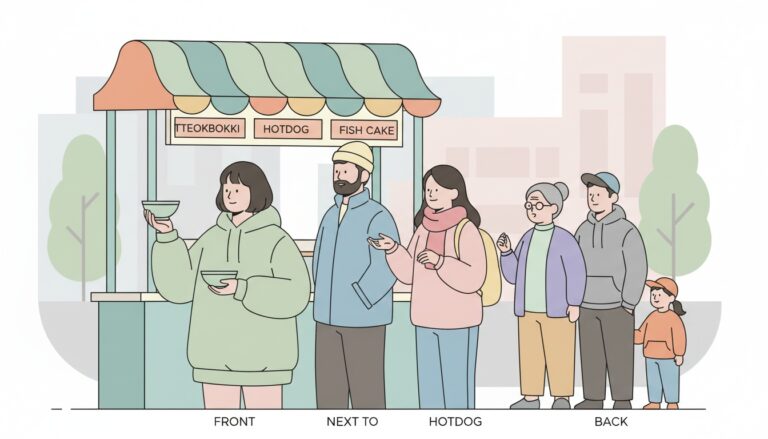
Am I in Front or Back? Mastering Lines in Korea! 🚶♂️🚶♀️
Hello, K-Culture lovers! 👋 Welcome back to Daily Hangul, your best friend for learning Korean!
Have you ever visited a famous restaurant in Seoul or tried to buy merchandise at a K-Pop concert? Then you know that waiting in line is a huge part of the experience! We even call it “Open Run” (오픈런) when people race to line up before a store opens. 🏃💨
Today, we will learn essential Location Expressions to help you survive in these lines. No more confusion about where to stand! Let’s get started! 🚀
📍 Key Expressions: Where am I?
Here are the magic words to describe your position relative to others.
1. 앞 (Ap)
- English: Front / In front of
- Pronunciation: [Ap]
- Usage: Use this when someone is ahead of you.
- Example: 내 앞에 (Nae ap-e) = In front of me.
2. 뒤 (Dwi)
- English: Back / Behind
- Pronunciation: [Dwi]
- Usage: Use this when someone is behind you.
- Example: 제 뒤에 서세요. (Je dwi-e seoseyo.) = Please stand behind me.
3. 옆 (Yeop)
- English: Side / Next to
- Pronunciation: [Yeop]
- Usage: Use this when someone is standing right by your side.
- Example: 친구가 옆에 있어요. (Chingu-ga yeop-e isseoyo.) = My friend is next to me.
4. 여기 줄이에요? (Yeogi jurieyo?)
- English: Is this the line?
- Pronunciation: [Yeogi jurieyo]
- Usage: The most useful phrase! Ask this whenever you see people standing around.
💡 Pronunciation Tip (Sound Linking)
Korean sounds love to flow together! When a location word ends with a consonant (like 앞 and 옆) and is followed by the particle ‘에’ (-e), the sound moves over.
- 앞에 (In front) is written as Ap-e, but pronounced [A-pe] (아페).
- 옆에 (Next to) is written as Yeop-e, but pronounced [Yeo-pe] (여페).
Try saying it smoothly: “A-pe, Yeo-pe!” 🎵
🗣️ Real Conversation: At a Famous Bagel Shop
Imagine you arrived at a trendy bagel shop in Gangnam. There are so many people!
Min-ji: 실례합니다, 여기 줄이에요?
(Sillyehamnida, yeogi jurieyo?)
(Excuse me, is this the line?)
Staff: 네, 맞아요. 제 뒤로 오세요.
(Ne, majayo. Je dwi-ro oseyo.)
(Yes, that’s right. Please come behind me.)
Min-ji: 아, 감사합니다! 제 친구는 어디 있죠?
(Ah, gamsahamnida! Je chingu-neun eodi itjjo?)
(Ah, thank you! Where is my friend?)
Staff: 친구분은 앞에 계세요.
(Chingu-bun-eun ap-e gyeseyo.)
(Your friend is in front [of us].)
🎭 Culture Tip & K-Drama Moment
“Wait, is that a paper list?” 📝
In many K-Dramas, you might see characters waiting in long lines for a famous tonkatsu place. While standing in line is common, nowadays, many hot spots use a “Waiting System” (웨이팅 시스템) on a tablet at the entrance. You input your phone number and wait elsewhere!
But if you are at a Street Food (Gilgeori-eumsik) stall or a pop-up store, the old-school “Standing in line (Jul-seogi)” is still the rule. Knowing “Ap” (Front) and “Dwi” (Back) is essential to avoid cutting in line (saechigi)! 😉
📝 Mini Quiz
Let’s check if you are ready to queue in Korea! Fill in the blanks.
- You want to ask if this is the line.
“_______ 줄이에요?” (_______ jurieyo?) -
Please stand behind me.
“제 ______에 서세요.” (Je ______-e seoseyo.) -
My friend is next to me.
“친구가 ______에 있어요.” (Chingu-ga ______-e isseoyo.)
[Answers]
1. 여기 (Yeogi) 2. 뒤 (Dwi) 3. 옆 (Yeop)
Great job today! 🎉 Now you can confidently find your spot in any line in Korea. practice these words next time you are queuing up! See you in the next lesson! Annyeong! 👋❤️
Frequently Asked Questions (FAQ)
Q: What does "앞 (Ap)" mean in Korean and how do you pronounce it?
A: In Korean, "앞 (Ap)" is pronounced [Ap] and means: a key conversational Korean expression covered in this lesson.
Q: What does "뒤 (Dwi)" mean in Korean and how do you pronounce it?
A: In Korean, "뒤 (Dwi)" is pronounced [Dwi] and means: a key conversational Korean expression covered in this lesson.
Q: What does "옆 (Yeop)" mean in Korean and how do you pronounce it?
A: In Korean, "옆 (Yeop)" is pronounced [Yeop] and means: a key conversational Korean expression covered in this lesson.
Q: What does "여기 줄이에요? (Yeogi jurieyo?)" mean in Korean and how do you pronounce it?
A: In Korean, "여기 줄이에요? (Yeogi jurieyo?)" is pronounced [Yeogi jurieyo] and means: a key conversational Korean expression covered in this lesson.







