

🏛️ Legal K-Dramas: The Power of Court Interpreters!
Hello, K-Culture lovers! 👋 It’s your favorite Korean tutor, Daily Hangul!
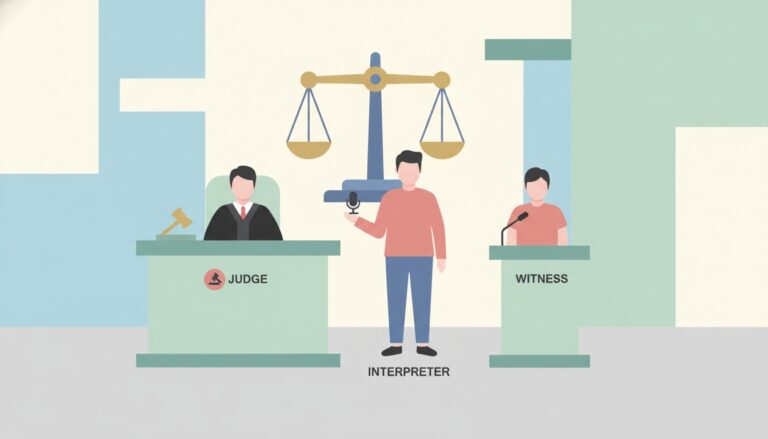
Do you love watching legal K-Dramas like Extraordinary Attorney Woo (이상한 변호사 우영우), Vincenzo (빈센조), or Law School? 📺 Sometimes, you see a person standing between the judge and a foreigner, speaking two languages fluently. That is the Court Interpreter!
Even if you are a beginner, knowing these words will help you understand the intense moments in court scenes. Today, we are going to learn about the Role of Court Interpreters and Ethical Neutrality in a super easy way! Let’s dive in! 🚀
📚 Core Expressions
Here are 4 key expressions you will hear in a Korean courtroom scene!
1. 법정 [Beop-jeong]
- English: Court / Courtroom
- Meaning: This is the place where trials happen. It’s the main stage for our drama!
- 💡 Pronunciation Tip: The ‘j’ sound in jeong becomes stronger (tensed) because of the ‘p’ (b) sound before it. Say it like [Beop-Jjeong]!
2. 통역사 [Tong-yeok-sa]
- English: Interpreter
- Meaning: The person who translates spoken language. In court, they are the “voice” of the foreigner.
- 💡 Pronunciation Tip: Connect the sounds smoothly. Tong + yeok sounds like [Tong-nyeok] due to liaison rules!
3. 중립 [Jung-nip]
- English: Neutrality
- Meaning: This is very important! An interpreter must not take sides. They must stay in the middle, helping A and B understand each other without bias.
- 💡 Pronunciation Tip: This is a bit tricky! It sounds like [Jung-nip] (nasalization).
4. 정확하게 [Jeong-hwak-ha-ge]
- English: Accurately / Exactly
- Meaning: In court, changing even one word is dangerous! You must speak “exactly” as it was said.
💬 Real Conversation: Watching a Drama
Let’s imagine Minji and Alex are watching a legal K-Drama together.
Minji: 저 사람 누구야? 말을 정말 잘해!
(Jeo saram nuguya? Mareul jeongmal jalhae!)
Who is that person? They speak really well!
Alex: 아, 저 사람은 통역사야.
(Ah, jeo sarameun tongyeoksaya.)
Ah, that person is an interpreter.
Minji: 변호사 편이야?
(Byeonhosa pyeoniya?)
Are they on the lawyer’s side?
Alex: 아니, 중립을 지켜야 해.
(Ani, jungnipeul jikyeoya hae.)
No, they must keep neutrality.
Minji: 정말 어렵겠다.
(Jeongmal eoryeopgetda.)
That must be really hard.
Alex: 응, 말을 정확하게 옮겨야 해.
(Eung, mareul jeonghwakhage omgyeoya hae.)
Yes, they have to transfer the words accurately.
🎬 Culture Tip & Drama Scene
“I swear to tell the truth!” ✋
In Korean courts, before a witness or an interpreter starts their job, they must take an oath (선서, Seonseo). They stand up, raise their right hand, and read a paper out loud.
For interpreters, the Code of Ethics is strict. In K-Dramas, you might see a dramatic scene where a bad interpreter tries to change the words to help a villain, but the hero catches them! That’s when you shout: “정확하게 통역하세요!” (Translate accurately!) 😡
Next time you watch a legal drama, look for the person helping the communication. That is the bridge of justice! ⚖️
📝 Wrap-up & Quiz
Today we learned how to talk about the cool job of court interpreters!
Let’s check your memory! (Answers at the bottom)
- What is “Interpreter” in Korean?
(A) Byeonhosa (B) Tongyeoksa -
Fill in the blank: An interpreter must stay in the middle. They need ______.
( 중_ / Jung-nip ) -
(O/X) In a Korean court, it is okay for the interpreter to help the person they like.
Good job today! Keep practicing, and you will understand K-Dramas without subtitles soon! See you next time! Annyeong! 👋❤️
Answers: 1. (B), 2. 중립 (Jungnip), 3. X (They must be neutral!)
Frequently Asked Questions (FAQ)
Q: What does "법정 [Beop-jeong]" mean in Korean and how do you pronounce it?
A: In Korean, "법정 [Beop-jeong]" is pronounced [Tip: The 'j' sound in jeong becomes stronger (tensed] and means: This is the place where trials happen. It's the main stage for our drama!
Q: What does "통역사 [Tong-yeok-sa]" mean in Korean and how do you pronounce it?
A: In Korean, "통역사 [Tong-yeok-sa]" is pronounced [Tip: Connect the sounds smoothly. Tong + yeok sounds like [Tong-nyeok] and means: The person who translates spoken language. In court, they are the "voice" of the foreigner.
Q: What does "중립 [Jung-nip]" mean in Korean and how do you pronounce it?
A: In Korean, "중립 [Jung-nip]" is pronounced [Tip: This is a bit tricky! It sounds like [Jung-nip] and means: This is very important! An interpreter must not take sides. They must stay in the middle, helping A and B understand each other without bias.
Q: What does "정확하게 [Jeong-hwak-ha-ge]" mean in Korean and how do you pronounce it?
A: In Korean, "정확하게 [Jeong-hwak-ha-ge]" is pronounced [see lesson guide] and means: In court, changing even one word is dangerous! You must speak "exactly" as it was said.







