

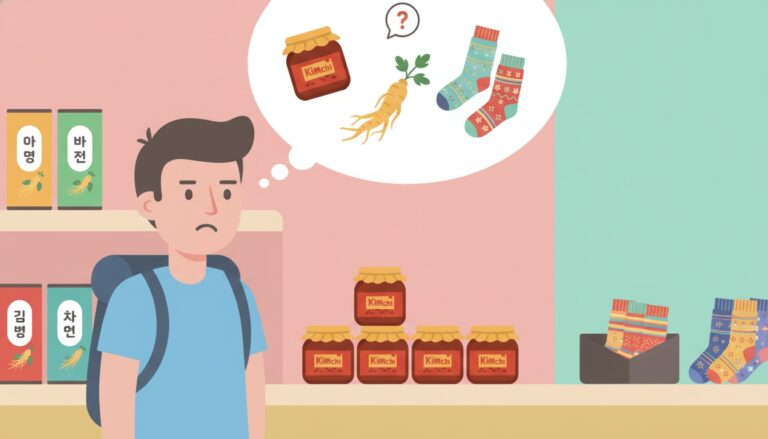
🎁 Best Korean Souvenirs! Who should we buy for?
2. Intro
Hello, everyone! This is Daily Hangul, here to upgrade your Korean skills! 😊
When you travel to Korea, shopping for souvenirs (기념품, Gineompum) is a must-do activity! But standing in a shop in Insadong or Myeongdong, you might wonder, “Who should I buy this for?” or “Is this good for my boss?”
Today, we will learn how to suggest opinions and agree or disagree politely when deciding on gifts. These expressions are super useful not just for shopping, but for making any plans with friends! You’ll often see K-drama characters using these phrases when they are discussing plans or picking out a gift for their crush. 😍 Let’s get started!
3. Key Expressions
Here are 4 key expressions to help you decide who to buy gifts for!
1️⃣ ~는/은 어때요? (How about…?)
- Pronunciation: [~neun/eun eottaeyo?]
- Meaning: How about ~?
- Explanation: This is the most common way to make a suggestion. You put the person or item before this phrase. If the noun ends in a vowel, use 는; if it ends in a consonant, use 은.
- 💡 Pronunciation Tip: When saying 어때요 (eottaeyo), emphasize the double consonant ‘ㄸ’ (tt) strongly! It sounds firmer than a soft ‘d’ or ‘t’.
2️⃣ 좋아요! (Good! / I agree!)
- Pronunciation: [Joayo!]
- Meaning: Good! / I like it!
- Explanation: Use this when you agree with a suggestion. It’s short, enthusiastic, and polite.
- 💡 Pronunciation Tip: The letter ㅎ (h) in 좋 is silent when followed by a vowel! So, instead of Joh-a-yo, it sounds like [Jo-a-yo].
3️⃣ 글쎄요… (Well… / I’m not sure…)
- Pronunciation: [Geulsseyo…]
- Meaning: Well… / I’m not sure…
- Explanation: Koreans rarely say “No” directly because it can seem rude. Instead, use 글쎄요 to show you are unsure or slightly disagree. It’s a very magical ‘soft refusal’ word!
- 💡 Pronunciation Tip: Stretch the end slightly (yo…) to sound softer and more thoughtful.
4️⃣ ~을/를 사요. (Let’s buy ~ / Buy ~)
- Pronunciation: [~eul/leul sayo.]
- Meaning: Let’s buy ~.
- Explanation: A simple polite ending to propose the action of buying.
- 💡 Pronunciation Tip: Connect the object particle (을/를) with the noun smoothly.
4. Real Dialogue
Situation: Alex and Mina are in a souvenir shop in Seoul, deciding on gifts.
Alex: 이 김은 어때요?
(I gim-eun eottaeyo?)
[How about this seaweed?]
Mina: 좋아요! 가격도 싸요.
(Joayo! Gagyeok-do ssayo.)
[Good! The price is cheap too.]
Alex: 그럼, 회사 동료들은 어때요?
(Geureom, hoesa dongryo-deul-eun eottaeyo?)
[Then, how about (for) co-workers?]
Mina: 글쎄요… 동료들은 커피를 더 좋아해요.
(Geulsseyo… Dongryo-deul-eun keopi-reul deo joahaeyo.)
[Well… co-workers like coffee more.]
Alex: 아, 그래요? 그럼 커피를 사요!
(Ah, geuraeyo? Geureom keopi-reul sayo!)
[Ah, really? Then let’s buy coffee!]
5. Culture Tip & K-Drama Vibes 🇰🇷
🎁 The Art of “Gineompum” (Souvenirs)
In Korea, it’s common to buy small gifts for close friends and colleagues after a trip. You don’t need to buy expensive things!
- Popular Items: Gim (Seaweed snacks), Socks (Cute character socks are famous!), and Sheet Masks.
- K-Drama Moment: Have you seen scenes where the protagonist returns from a trip and hands out small snacks to everyone in the office? That’s the Korean spirit of sharing called Jeong (정)!
Using “글쎄요…” (Well…) instead of “Aniyo” (No) makes you sound very native and polite, just like a considerate character in a drama refusing a date gently! 😉
6. Wrap-up & Quiz
Today we learned how to suggest gifts and agree/disagree! Remember, being polite is key in Korean culture.
📝 Mini Quiz
Fill in the blanks with the correct expression.
- A: BTS 앨범 ______? (How about a BTS album?)
B: ______! (Good!) -
A: 이 모자 살까요? (Shall we buy this hat?)
B: ______, 너무 커요. (Well… it’s too big.)
Answer Key:
1. 은 어때요? / 좋아요
2. 글쎄요
Keep practicing, and see you next time! Annyeong! 👋







