

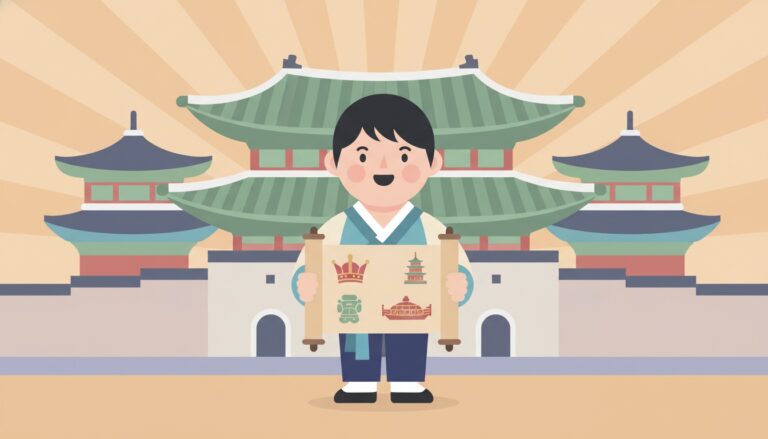
Bringing Korean History to Life! 🇰🇷📜
1. Introduction
Hello, K-culture fans! It’s your favorite Korean tutor, Daily Hangul (매일한글)! 👋
Do you love watching historical K-dramas (Sageuk) like The Red Sleeve or Kingdom? Have you ever visited a palace in Seoul and wanted to tell your friends all about it?
Today, we are going to tackle a slightly intellectual but very exciting topic: “Planning a Public History Project.”
Don’t worry! We won’t use difficult academic words. Instead, we will learn how to say “Let’s make a story” and “It’s important,” which you can use when planning a trip or a project with Korean friends. Let’s become history storytellers today! 🚀
2. Core Expressions
Here are 4 useful expressions to help you talk about history and projects!
1. 역사 (History)
- Pronunciation: [Yeoksa]
- English Meaning: History
- Detail: This is the essential word for today! Whether you are talking about the Joseon Dynasty or your personal history, you use this word.
- 💡 Pronunciation Tip: The ㄱ (k) sound in the first syllable stops abruptly before the ㅅ (s) starts. It’s crisp! Yeok-sa.
2. 이야기 (Story / Narrative)
- Pronunciation: [Iyagi]
- English Meaning: Story, Narrative
- Detail: In Public History, “narrative” is key. In Korean, we simply say 이야기. It feels friendly and engaging, just like telling a bedtime story.
- 💡 Pronunciation Tip: Connect the vowels smoothly. I-ya-gi.
3. 박물관 (Museum)
- Pronunciation: [Bangmulgwan]
- English Meaning: Museum
- Detail: Public history often happens here!
- 💡 Pronunciation Tip: Important! Even though it is written as ‘Bak-mul-gwan’, the ㄱ (k) sound meets the ㅁ (m) sound and changes to an ㅇ (ng) sound (Nasalization). So, say it like [Bang-mul-gwan].
4. 만들어요 (Let’s make / We make)
- Pronunciation: [Mandeureoyo]
- English Meaning: Let’s make / We make
- Detail: Used when you are planning to create something, like a video, a poster, or a presentation.
- 💡 Pronunciation Tip: The bottom ㄹ (l) in ‘들’ moves over to the empty ‘어’ sound. So it sounds like [Man-deu-reo-yo].
3. Real-life Dialogue
Let’s see how Minji and Paul plan a small history project for their blog!
Minji: 우리 역사 프로젝트 뭐 할까?
(Uri yeoksa peurojekteu mwo halkka?)
[What shall we do for our history project?]
Paul: 음, 세종대왕 이야기를 만들어요.
(Eum, Sejongdaewang iyagi-reul mandeureoyo.)
[Hmm, let’s make a story about King Sejong.]
Minji: 오, 좋은 생각이야! 재미있겠다.
(O, joeun saenggagiya! Jaemiitgetda.)
[Oh, good idea! That sounds fun.]
Paul: 그럼 내일 박물관에 가자!
(Geureom naeil bangmulgwan-e gaja!)
[Then let’s go to the museum tomorrow!]
4. Culture Tip & K-Drama Moment 🎬
🏯 The Magic of ‘Sageuk’ (Historical Dramas)
In Korea, Public History is very popular thanks to Sageuk (사극). Dramas make history easy and fun, just like we are doing today!
When you visit Gyeongbokgung Palace in Seoul, you’ll see many people wearing Hanbok (traditional clothes). This is a form of participating in history! If you create a video or blog about your visit, you are doing a “Public History Project” yourself! You are sharing the 이야기 (story) of Korea with the world. 🌏
5. Wrap-up & Quiz
Today we learned how to plan a simple history storytelling project. You are now ready to visit a museum and talk about it!
📝 Mini Quiz
1. How do you say “History” in Korean?
(A) Hakgyo (B) Yeoksa
- True or False: 박물관 is pronounced [Bak-mul-gwan].
(A) True (B) False -
Fill in the blank: Let’s make a story! = 이야기를 _______.
(A) 먹어요 (Meogeoyo) (B) 만들어요 (Mandeureoyo)
Answer Key:
1. (B) Yeoksa
2. (B) False (It is pronounced [Bang-mul-gwan]!)
3. (B) 만들어요 (Mandeureoyo)
Frequently Asked Questions (FAQ)
Q: What does "이야기 (Story / Narrative)" mean in Korean and how do you pronounce it?
A: In Korean, "이야기 (Story / Narrative)" is pronounced [Iyagi] and means: Story, Narrative
Q: What does "박물관 (Museum)" mean in Korean and how do you pronounce it?
A: In Korean, "박물관 (Museum)" is pronounced [Bangmulgwan] and means: Museum
Q: What does "만들어요 (Let's make / We make)" mean in Korean and how do you pronounce it?
A: In Korean, "만들어요 (Let's make / We make)" is pronounced [Mandeureoyo] and means: Let's make / We make







