

Hello! I’m Daily Hangul! 👋
Hello, K-Culture fans! Welcome to [Daily Hangul], where your Korean skills level up every day! 🚀
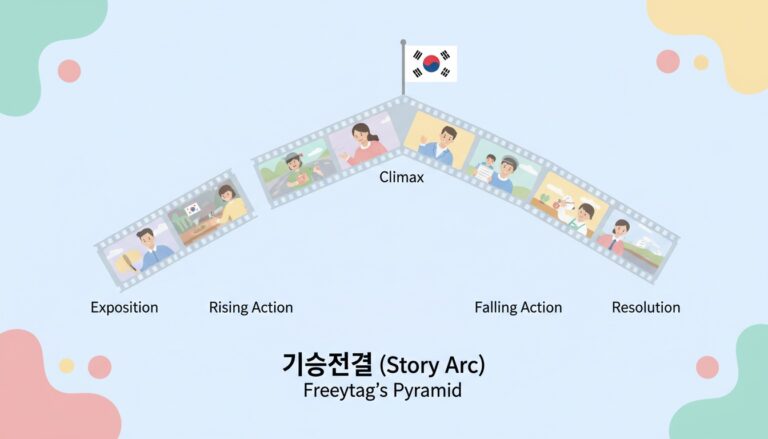
Do you love watching K-Dramas like Squid Game or The Glory? Every great drama follows a specific structure, often called “Freytag’s Pyramid.” Today, we aren’t learning boring theory. Instead, we will learn the essential Korean words to describe the flow of a story!
After this lesson, you can tell your Korean friends exactly which part of the drama made your heart race! Let’s dive in! 🍿
3 Key Expressions to Master K-Stories 📚
Here are the must-know words to describe the plot of your favorite movie or book.
1. 이야기 (Story)
- Pronunciation: [Iyagi]
- Meaning: Story / Narrative
- Explanation: This is the most basic word. You use it to talk about the plot in general. It covers everything from the introduction to the end.
- 💡 Pronunciation Tip: In Korean, ‘ㅇ’ at the start of a syllable is silent. So it sounds like ‘Ee-ya-gi’. Make sure to pronounce each syllable clearly!
2. 반전 (Twist)
- Pronunciation: [Banjeon]
- Meaning: Plot Twist / Reversal
- Explanation: K-Dramas are famous for this! This represents the Climax or the shocking moment in the story structure where everything changes.
- 💡 Pronunciation Tip: The ‘eo’ in ‘jeon’ sounds like the ‘u’ in ‘cup’. It is not ‘joon’. It is [Ban-jeon].
3. 결말 (Ending)
- Pronunciation: [Gyeolmal]
- Meaning: Ending / Conclusion
- Explanation: This is the final part of the pyramid (Resolution). Was it a happy ending or a sad ending? You use this word to discuss the finale.
- 💡 Pronunciation Tip: When ‘ㄹ’ (l) is at the end of a syllable, keep your tongue touching the roof of your mouth. It sounds soft, like the ‘l’ in ‘leaf’.
🗣️ Real Conversation: Discussing a Drama
Situation: Minji and Paul are talking about a popular drama that finished yesterday.
Minji: 어제 드라마 봤어? 이야기가 너무 재미있었어!
(Eoje deurama bwasseo? Iyagi-ga neomu jaemiisseosseo!)
Did you watch the drama yesterday? The story was so interesting!
Paul: 응! 처음에 조금 지루했는데, 나중에 반전이 대박이었어.
(Eung! Cheoeume jogeum jiruhaenneunde, najunge banjeon-i daebagieosseo.)
Yeah! It was a bit boring at the start, but the twist later was awesome.
Minji: 맞아. 나는 결말도 마음에 들었어.
(Maja. Naneun gyeolmal-do maeume deureosseo.)
Right. I liked the ending too.
Paul: 나도! 진짜 완벽한 드라마야.
(Nado! Jinjja wanbyeokan deuramaya.)
Me too! It’s a truly perfect drama.
🇰🇷 Culture Tip & Drama Scene
“Yeollin Gyeolmal” (Open Ending) 🤯
Have you ever finished a K-Drama and felt confused because the story didn’t finish clearly? In Korea, we call this 열린 결말 (Yeollin Gyeolmal), which translates to “Open Ending.”
While Freytag’s Pyramid usually suggests a clear resolution, many Korean writers love to leave things open to the viewer’s imagination. Knowing this phrase is very useful when you want to complain about a confusing finale to your Korean friends!
📝 Wrap-up & Quiz
Today we learned how to describe the narrative arc in Korean!
1. Iyagi (Story)
2. Banjeon (Twist)
3. Gyeolmal (Ending)
Let’s practice! (Fill in the blanks)
- The _______ of this movie is very sad. (Hint: Ending)
-> 이 영화의 [ ]은/는 너무 슬퍼요. - I like a story with a shocking _______. (Hint: Twist)
-> 나는 충격적인 [ ]이/가 있는 이야기를 좋아해요.
[Answers]
1. 결말 (Gyeolmal)
2. 반전 (Banjeon)
See you next time! Annyeong! 👋
Frequently Asked Questions (FAQ)
Q: What does "이야기 (Story)" mean in Korean and how do you pronounce it?
A: In Korean, "이야기 (Story)" is pronounced [Iyagi] and means: Story / Narrative
Q: What does "반전 (Twist)" mean in Korean and how do you pronounce it?
A: In Korean, "반전 (Twist)" is pronounced [Banjeon] and means: Plot Twist / Reversal
Q: What does "결말 (Ending)" mean in Korean and how do you pronounce it?
A: In Korean, "결말 (Ending)" is pronounced [Gyeolmal] and means: Ending / Conclusion







