

1. Title
Prices Up! 📈 Smart Korean Retirement Planning
2. Introduction
Hello! It’s your friendly Korean tutor Daily Hangul! 😊
Have you noticed that your favorite gimbap or coffee is getting a bit more expensive lately? In Korea, we talk about this all the time these days! Even in K-Dramas, you often see characters sighing while looking at their bills, worrying about their future.
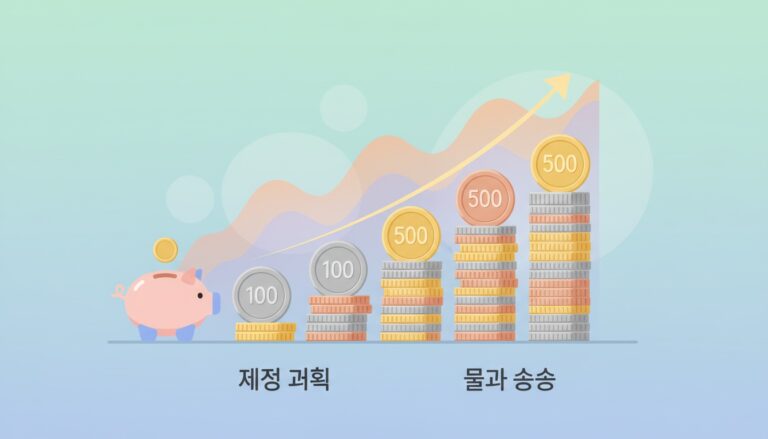
Today, we are going to tackle a slightly serious but super important topic: Retirement Planning amidst Inflation. Don’t worry, I’ll make it easy and fun! Learning these expressions will help you understand Korean news and have deeper conversations with your Korean friends. Let’s get started! 🚀
3. Key Expressions
Here are 4 essential expressions to talk about money and the future.
1. 물가가 오르다 (Prices go up)
- Pronunciation: [Mulga-ga oreuda]
- English: Prices are rising / Inflation
- Explanation: ‘물가 (Mulga)’ means the general price level of goods, and ‘오르다 (oreuda)’ means to rise or go up. You use this when everything seems more expensive than before.
- 💡 Pronunciation Tip: In ‘오르다’, the ‘r’ sound is a distinct flap sound. It sounds a bit between an ‘l’ and an ‘r’.
2. 노후 준비 (Preparation for old age)
- Pronunciation: [Nohu junbi]
- English: Retirement planning / Preparing for old age
- Explanation: ‘노후 (Nohu)’ refers to one’s old age or retirement years. ‘준비 (junbi)’ is preparation. This is a keyword for anyone planning their life after work.
- 💡 Pronunciation Tip: The ‘h’ in ‘Nohu’ can be pronounced softly. Sometimes it sounds almost like ‘No-u’ in fast speech.
3. 아끼다 (To save / To economize)
- Pronunciation: [Akkida]
- English: To save (money), to cherish, to spare
- Explanation: This verb is used when you try to spend less money. It implies being frugal or cutting back on expenses.
- 💡 Pronunciation Tip: Pay attention to the double consonant ‘ㄲ (kk)’. It requires a tense, strong sound at the back of your throat, without letting air out.
4. 큰일이다 (It’s a big trouble)
- Pronunciation: [Keunirida]
- English: It’s a big problem / We are in trouble
- Explanation: You hear this constantly in K-Dramas! Use it when you are worried about a situation, like rising prices or not having enough savings.
- 💡 Pronunciation Tip: This involves a sound change called ‘nasalization’. It is written as ‘Keun-il’, but pronounced as [Keun-nil]. The ‘n’ sound doubles!
4. Real Conversation
Let’s see how Minji and Jason talk about lunch prices and their future.
Minji: 와, 비빔밥이 만 원이 넘어요? 물가가 너무 올랐어요.
(Wa, bibimbap-i man won-i neomeoyo? Mulga-ga neomu ollasseoyo.)
Wow, Bibimbap is over 10,000 won? Prices have gone up so much.
Jason: 맞아요. 월급은 그대로인데… 정말 큰일이에요.
(Majayo. Wolgeub-eun geudaeroinde… jeongmal keunirieyo.)
Right. My salary is the same… it’s really a big trouble.
Minji: 우리도 이제 노후 준비를 다시 해야 할 것 같아요.
(Urido ije nohu junbi-reul dasi haeya hal geot gatayo.)
I think we need to redo our retirement planning now.
Jason: 네, 오늘부터 커피값부터 아껴요!
(Ne, oneulbuteo keopigap-buteo akkyeoyo!)
Yes, let’s save on coffee money starting today!
5. Culture Tip & K-Drama Scene 🎬
Have you heard of “Jjan-tech” (짠테크)?
In Korea, there is a trendy slang word called ‘Jjan-tech’ (짠테크). It combines the word ‘Jjada’ (salty/stingy) and ‘Tech’ (financial technology). It refers to the extreme frugality young Koreans practice to fight inflation and save for their ‘Nohu’ (old age).
If you see a character in a drama bringing a packed lunch instead of eating out, or walking instead of taking a taxi to save money, they are doing Jjan-tech! Using this word will make you sound like a local expert! 😎
6. Wrap-up & Quiz
Today we learned how to express worries about inflation and discuss retirement plans. It’s a serious topic, but talking about it is the first step to being prepared!
📝 Mini Quiz
Fill in the blanks with the correct words we learned today.
- Everything is so expensive! ________ is rising. (__________가 오르고 있어요.)
- I need to spend less money. I have to ________ money. (돈을 _________야 해요.)
- I am worried about my life after 60. I need __________. (__________가 필요해요.)
(Scroll down for answers!)
…
…
…
✅ Answers:
1. 물가 (Mulga)
2. 아껴 (Akkyeo) / 아끼다 (Akkida)
3. 노후 준비 (Nohu junbi)
Frequently Asked Questions (FAQ)
Q: What does "노후 준비 (Preparation for old age)" mean in Korean and how do you pronounce it?
A: In Korean, "노후 준비 (Preparation for old age)" is pronounced [Nohu junbi] and means: a key conversational Korean expression covered in this lesson.
Q: What does "아끼다 (To save / To economize)" mean in Korean and how do you pronounce it?
A: In Korean, "아끼다 (To save / To economize)" is pronounced [Akkida] and means: a key conversational Korean expression covered in this lesson.
Q: What does "큰일이다 (It’s a big trouble)" mean in Korean and how do you pronounce it?
A: In Korean, "큰일이다 (It’s a big trouble)" is pronounced [Keunirida] and means: a key conversational Korean expression covered in this lesson.







