

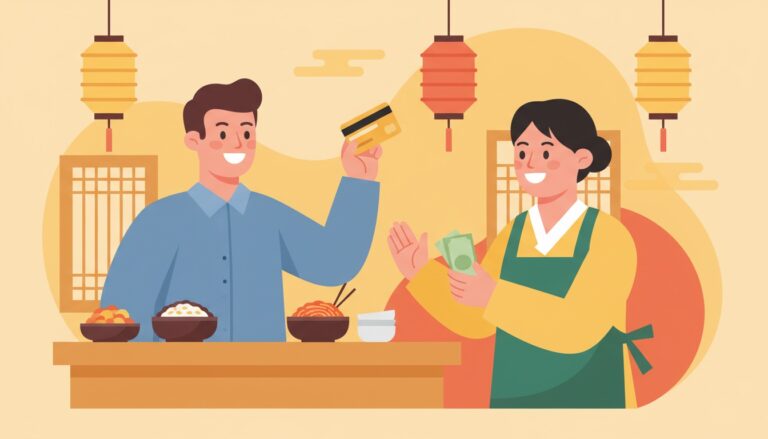
1. Intro: Put Your Wallet Away! 😊
Hello! It’s your friendly Korean tutor, Daily Hangul (매일한글)! 👋
Have you ever finished a delicious meal in Seoul, reached for your wallet to leave a tip, and suddenly felt confused? “Wait, do people tip in Korea?”
If you watch K-Dramas 📺, you might notice that characters just pay the bill and leave. They never calculate 15% or 20% extra! Why? Because Korea has a ‘No Tipping’ culture!
Today, let’s learn how to handle the bill like a local and express gratitude without using extra cash. Ready? Let’s go! 🚀
2. Core Expressions: Paying & Tipping 🗣️
Here are the essential phrases you need when paying for your meal.
1. 팁은 필요 없어요.
- Pronunciation: [Tibeun piryo eopseoyo]
- Meaning: No tip is needed.
- Detail: In Korea, the price on the menu is the final price. Service is included! If you try to leave money on the table, the staff might run after you thinking you forgot your change! 🏃♂️💨
- 💡 Pronunciation Tip: ‘팁(Tip)’ is a loanword from English! ‘필요(Piryo)’ means need. When you say ‘없어요(Eopseoyo)’, the ‘ps’ sound flows into the next vowel, sounding smooth.
2. 봉사료 포함인가요?
- Pronunciation: [Bongsaryo pohamingayo?]
- Meaning: Is the service charge included?
- Detail: ‘봉사료(Bongsaryo)’ means service charge. You might use this at high-end hotels or luxury restaurants where a 10% service charge is sometimes added to the bill automatically.
3. 잘 먹었습니다!
- Pronunciation: [Jal meogeotseumnida]
- Meaning: I ate well! / Thank you for the meal!
- Detail: Since we don’t tip with money, we tip with words! This is the magical phrase to show your appreciation to the chef or staff as you leave. It’s better than cash! ❤️
- 💡 Pronunciation Tip: The ‘ㄹ(l)’ in ‘잘(Jal)’ should be soft. ‘먹었습니다(meogeotseumnida)’ sounds formal and polite. The ‘ss’ usually sounds like a ‘t’ when it’s at the bottom (batchim).
4. 영수증 주세요.
- Pronunciation: [Yeongsujeung juseyo]
- Meaning: Please give me the receipt.
- Detail: Useful if you need to check the bill or keep a record of your travel expenses.
3. Real Conversation: At a BBQ Restaurant 🥩
Situation: Jason finishes his Korean BBQ and goes to the counter to pay.
Jason: 여기 계산해 주세요. (Check, please.)
Staff: 네, 5만 원입니다. (Yes, it is 50,000 won.)
Jason: (Takes out cash and tries to give extra) 여기 팁이에요. (Here is a tip.)
Staff: 아, 아니에요! 팁은 필요 없어요. 괜찮습니다! (Oh, no! No tip is needed. It’s okay!)
Jason: 정말요? 몰랐어요. (Really? I didn’t know.)
Staff: 네, 맛있게 드셨나요? (Yes, did you enjoy the meal?)
Jason: 네, 아주 맛있었어요. 잘 먹었습니다! (Yes, it was very delicious. Thank you for the meal!)
4. Culture Tip & K-Drama Vibes 🎭
🚫 Why no tipping?
In Korea, excellent service is considered a standard part of the job, not something extra you pay for. In fact, offering a tip to an elder or a proud restaurant owner can sometimes be misunderstood as pity or rude!
🎬 K-Drama Moment
In dramas like Itaewon Class, you see customers paying at the counter (usually near the exit), not at the table. They bow, say “Jal meogeotseumnida,” and leave. That polite bow is the real currency of respect in Korea! 🙇♂️
5. Wrap-up & Quiz 📝
Don’t stress about math after your meal! Just pay the bill and say a warm “Thank you.” That makes you a perfect guest in Korea. 🥰
Pop Quiz!
- True or False: You should leave 10% cash on the table at a normal Korean restaurant.
(Answer: ______) -
Fill in the blank: To say “Thank you for the meal,” you say: “_____ meogeotseumnida!”
(Answer: ______)
Answers:
1. False (No tipping!)
2. Jal (잘)
See you next time! 안녕! 👋
Frequently Asked Questions (FAQ)
Q: What does "봉사료 포함인가요?" mean in Korean and how do you pronounce it?
A: In Korean, "봉사료 포함인가요?" is pronounced [Bongsaryo pohamingayo?] and means: Is the service charge included?
Q: What does "잘 먹었습니다!" mean in Korean and how do you pronounce it?
A: In Korean, "잘 먹었습니다!" is pronounced [Jal meogeotseumnida] and means: I ate well! / Thank you for the meal!
Q: What does "영수증 주세요." mean in Korean and how do you pronounce it?
A: In Korean, "영수증 주세요." is pronounced [Yeongsujeung juseyo] and means: Please give me the receipt.







