

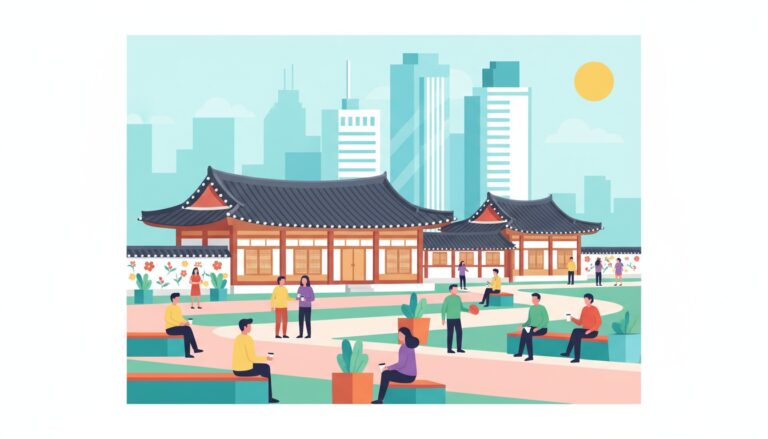
From Space to Place: Discussing Urban Design in Korean
Hello! This is Maeil Hangul, here to upgrade your Korean skills to the next level!
Today, we’re moving beyond everyday conversation and into a more specialized topic: architecture and urban design. Ever wondered how a simple street in Seoul transforms into a vibrant, must-visit hotspot? The secret is ‘장소 만들기’ (Placemaking). Lately in Korea, there’s a huge emphasis on regenerating old parts of the city not just by building new things, but by creating spaces with unique identities that people love. This is a crucial topic if you’re interested in Korean culture, society, or working in related professional fields. Let’s build our vocabulary!
Core Expressions
Here are some key terms you’ll need to discuss this topic like a pro.
1. 장소 만들기 (Jangso mandeulgi)
* Pronunciation [Romanization]: [Jangso mandeulgi]
* English Meaning: Placemaking
* Detailed Explanation: This is a direct translation of ‘placemaking.’ It’s a concept in urban planning that focuses on the human-centric approach of creating public spaces. It’s not just about constructing buildings (공간 – ‘space’), but about fostering a unique character and sense of community (장소 – ‘place’). It emphasizes designing spaces that promote people’s health, happiness, and well-being.
* 💡 Pronunciation Tip: In ‘만들기’ (mandeulgi), the ‘ㄹ’ (l) sound at the end of a syllable followed by a consonant like ‘ㄱ’ (g) is very subtle. It’s a light ‘l’ sound that almost gets absorbed. Practice making the ‘l’ sound with the tip of your tongue briefly touching the back of your top teeth before moving to the ‘g’ sound.
2. 도시 재생 (Dosi jaesaeng)
* Pronunciation [Romanization]: [Dosi jaesaeng]
* English Meaning: Urban Regeneration
* Detailed Explanation: This refers to the revitalization of declining urban areas. It’s different from ‘재개발’ (jaegaebal – redevelopment), which often implies completely tearing down old areas to build new apartments. ‘도시 재생’ focuses on preserving the existing history and character of a place while improving its infrastructure and injecting new life, often through cultural or community-led projects.
* 💡 Pronunciation Tip: The ‘ㅅ’ (s) in ‘생’ (saeng) is pronounced as a tensed sound, similar to ‘ss’. This is because it’s a Sino-Korean word. So, it sounds closer to [jaessaeng] than [jaesaeng].
3. ~을/를 중심으로 (~eul/reul jungsim-euro)
* Pronunciation [Romanization]: [~eul/reul jungsim-euro]
* English Meaning: Centered around~ / Focusing on~
* Detailed Explanation: This is a vital pattern for explaining the core focus of a plan or project. You attach it to a noun to indicate that the action revolves around that noun. It’s a formal and articulate way to structure your arguments in a discussion or presentation.
* Example: 주민 참여를 중심으로 프로젝트를 진행해야 합니다. (The project must proceed with a focus on resident participation.)
* 💡 Pronunciation Tip: The particle ‘으로’ (euro) is used after a noun ending in a consonant (except ‘ㄹ’). Notice the smooth connection between ‘심’ (sim) and ‘으’ (eu): [jung-si-meu-ro].
4. 활성화를 도모하다 (Hwalseonghwa-reul domohada)
* Pronunciation [Romanization]: [Hwalseonghwa-reul domohada]
* English Meaning: To promote/seek revitalization
* Detailed Explanation: This is a rather formal and advanced phrase used in reports, news, and academic discussions. ‘활성화’ means ‘vitalization’ or ‘activation,’ and ‘도모하다’ means ‘to plan, to seek, to promote.’ It’s the perfect phrase for discussing policy goals, such as revitalizing a local economy or cultural scene.
* 💡 Pronunciation Tip: The ‘ㅎ’ (h) in ‘화’ (hwa) can be very soft after the ‘성’ (seong) syllable. Also, when ‘를’ (reul) follows ‘화’ (hwa), the sounds flow together smoothly: [hwal-sseong-hwa-reul].
Example Dialogue
Let’s see how these expressions are used in a real conversation.
A: 최근 성수동이 ‘힙한’ 장소로 떠오른 비결이 뭐라고 생각하세요?
(What do you think is the secret behind Seongsu-dong recently emerging as a ‘hip’ place?)
B: 제 생각에는 성공적인 도시 재생 사례라고 봐요. 낡은 공장들을 없애는 대신, 그 고유의 정체성을 살리는 장소 만들기 전략이 주효했죠.
(I see it as a successful case of urban regeneration. Instead of getting rid of the old factories, the placemaking strategy that preserved its unique identity was effective.)
A: 맞아요. 예술가와 소상공인을 중심으로 지역 상권 활성화를 도모한 것이 인상 깊었어요.
(That’s right. It was impressive how they sought to promote the revitalization of the local commercial district, centered around artists and small business owners.)
B: 덕분에 대기업 중심의 재개발과는 다른, 지속가능한 발전을 보여준 것 같아요.
(Thanks to that, I think it has shown a different, more sustainable development compared to redevelopment led by large corporations.)
Culture Tip & Trend Analysis
In Korea, ‘Placemaking’ isn’t just an academic term; it’s a visible trend. Areas like Mullae-dong in Seoul, once home to ironworks, are now famous for their unique blend of steel workshops and artist studios. This is a prime example of 도시 재생 (urban regeneration). Instead of erasing the past, the city and its people chose to build upon it. The strategy often involves creating ‘pedestrian-friendly’ streets (보행 친화 거리) and supporting local creators. When you visit these places, you’ll notice that the focus is on the human experience—small, unique cafes, independent galleries, and public art installations. This shift from car-centric, efficiency-first development to human-centric, experience-focused design is a key aspect of modern Korean urban philosophy.
Let’s Practice!
Ready to test your knowledge? Fill in the blanks with the expressions we learned today.
- 이 프로젝트는 지역 주민들의 의견을 ___________ 진행될 예정입니다. (The project will proceed focusing on the opinions of the local residents.)
- 낙후된 구도심의 경제 ___________ 위해 새로운 정책이 필요합니다. (A new policy is needed to promote the revitalization of the economy in the underdeveloped old town center.)
Share your answers in the comments below! Try making your own sentence using 장소 만들기 or 도시 재생. We’d love to see it!
Frequently Asked Questions (FAQ)
Q: What does "'장소 만들기'" mean in Korean and how do you pronounce it?
A: In Korean, "'장소 만들기'" is pronounced [Placemaking] and means: . Lately in Korea, there's a huge emphasis on regenerating old parts of the city not just by building new things, but by creating spaces with unique identities that people love. This is a crucial topic if you're interested in Korean culture, society, or working in related professional fields. Let's build our vocabulary!
Q: What does "도시 재생" mean in Korean and how do you pronounce it?
A: In Korean, "도시 재생" is pronounced [urban regeneration] and means: . Instead of erasing the past, the city and its people chose to build upon it. The strategy often involves creating 'pedestrian-friendly' streets (보행 친화 거리) and supporting local creators. When you visit these places, you'll notice that the focus is on the human experience—small, unique cafes, independent galleries, and public art installations. This shift from car-centric, efficiency-first development to human-centric, experience-focused design is a key aspect of modern Korean urban philosophy.







