

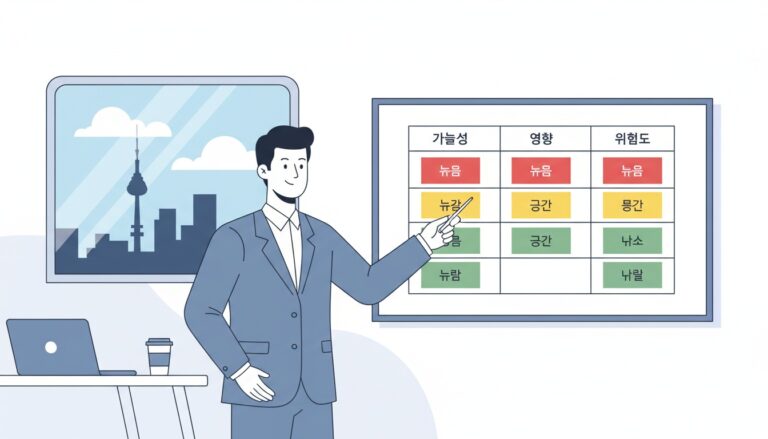
From ‘어떡하지?’ to ‘문제없어!’: Advanced Korean for Project Risk Analysis
Hello! Welcome to Maeil Hangul, here to upgrade your Korean skills to the executive level!
Ever been in a meeting and felt like you were swimming in business jargon? Today, we’re tackling a crucial topic for anyone in a professional setting: Project Risk Analysis. Mastering this will not only make you sound like a seasoned pro but will also help you navigate the complexities of any project. In the fast-paced Korean work environment, where thorough preparation (철저한 준비) is highly valued, being able to discuss and manage risks is a game-changing skill. Let’s dive into the vocabulary that separates the interns from the team leaders!
Core Professional Expressions
Here are the key terms you need to know to discuss project risks like a native speaker.
1. 정성적 리스크 분석 (Qualitative Risk Analysis)
- Pronunciation [Romanization]: Jeongseong-jeok Riseukeu Bunseok
- English Meaning: Qualitative Risk Analysis
- Detailed Explanation: This is the process of prioritizing identified risks for further analysis or action by assessing their probability of occurrence and impact. It’s subjective and relies on the team’s expertise. Think of it as categorizing risks into ‘high,’ ‘medium,’ and ‘low’ priority. It’s usually the first step in risk assessment.
- 💡 Pronunciation Tip: The particle ‘의’ (ui) can be tricky. When used as a possessive marker, as in ‘리스크의 영향’ (riseukeu-ui yeonghyang – the risk’s impact), it is often pronounced as [에/e] in conversation. So, you’ll sound more natural saying [리스크에 영향 / riseukeu-e yeonghyang].
2. 정량적 리스크 분석 (Quantitative Risk Analysis)
- Pronunciation [Romanization]: Jeongnyang-jeok Riseukeu Bunseok
- English Meaning: Quantitative Risk Analysis
- Detailed Explanation: This is the next level. It involves numerically analyzing the effect of identified risks on overall project objectives. This is where you bring in the numbers—calculating potential financial losses, time delays, etc. It’s about data, not just judgment.
- 💡 Pronunciation Tip: Notice the sound change in ‘정량’ (jeong-ryang). Due to nasal assimilation (비음화), the ‘ㄹ’ (r/l) sound following a final consonant ‘ㅇ’ (ng) changes to ‘ㄴ’ (n). Therefore, it’s pronounced [정냥/jeong-nyang], not ‘jeong-ryang’. This small change makes a big difference in fluency!
3. 리스크 관리 대장 (Risk Register)
- Pronunciation [Romanization]: Riseukeu Gwalli Daejang
- English Meaning: Risk Register
- Detailed Explanation: This is the master document for all risk management activities. The word ‘대장’ (daejang) means ‘ledger’ or ‘register’ and is used for many official logs in Korean companies. This document lists all identified risks, the results of your analysis (both qualitative and quantitative), and the proposed response plans.
- 💡 Pronunciation Tip: The consonant ‘ㅈ’ in ‘대장’ (daejang) is a tense consonant (된소리). It should be pronounced with more force than a simple English ‘j’, almost like ‘jj’. This creates a sharper, more distinct sound: [대짱/daejjang].
4. 잠재적 영향 (Potential Impact)
- Pronunciation [Romanization]: Jamjae-jeok Yeonghyang
- English Meaning: Potential Impact
- Detailed Explanation: This is a crucial phrase used to describe the possible consequences of a risk. ‘잠재적’ (jamjae-jeok) means ‘potential’ or ‘latent’, and ‘영향’ (yeonghyang) means ‘impact’ or ‘influence’. You’ll use this constantly when evaluating risks in both qualitative and quantitative terms.
- 💡 Pronunciation Tip: A key feature of Korean pronunciation is liaison (연음). The final consonant of a syllable block moves to the next syllable if it starts with a vowel. In ‘잠재적 영향’ (jamjae-jeok yeonghyang), the final ‘ㄱ’ (k) of ‘적’ moves over, making the pronunciation [잠재저경향/jamjaejeogyeonghyang]. It flows together as one smooth phrase.
Example Dialogue
Let’s see these terms in a realistic conversation between a Team Leader (팀장님) and an Assistant Manager (김대리).
- A (팀장님): 김대리, 신규 앱 출시 프로젝트의 리스크 분석은 어떻게 진행되고 있나요?
(Gim Daeri, how is the risk analysis for the new app launch project progressing?) - B (김대리): 네, 팀장님. 우선 정성적 리스크 분석을 통해 발생 가능성과 잠재적 영향이 높은 항목들을 식별했습니다. 이 내용은 리스크 관리 대장에 정리해 두었습니다.
(Yes, Team Leader. First, through qualitative risk analysis, we’ve identified items with high probability and potential impact. I’ve organized this information in the risk register.) - A (팀장님): 좋습니다. 그럼 식별된 핵심 리스크에 대해서는 정량적 리스크 분석도 진행해서 예산과 일정에 미칠 영향을 수치로 예측해 주세요.
(Excellent. For the key risks identified, please proceed with a quantitative risk analysis to numerically predict the impact on our budget and schedule.) - B (김대리): 알겠습니다. 바로 분석해서 다음 주까지 보고드리겠습니다.
(Understood. I will analyze it immediately and report back by next week.)
Culture Tip & In-Depth Analysis
In the Korean corporate world, the concept of ‘미리미리 준비하기’ (preparing well in advance) is paramount. A detailed 리스크 관리 대장 (Risk Register) is not just paperwork; it’s a testament to a project manager’s competence and foresight. While the ‘빨리빨리’ (ppalli-ppalli) culture emphasizes speed, it’s balanced by an expectation of thoroughness. Presenting a well-thought-out risk analysis demonstrates that you are not just fast, but also meticulous and reliable—qualities that are highly respected in any Korean organization.
Let’s Review & Practice!
We’ve covered some heavy-duty business Korean today! You learned the difference between 정성적 and 정량적 분석, the importance of the 리스크 관리 대장, and how to discuss 잠재적 영향.
Now, test yourself!
- Fill in the blank: To prioritize risks based on expert judgment without using complex calculations, you should first conduct a __________. (정성적 리스크 분석 / 정량적 리스크 분석)
-
Sentence Building: Imagine a potential server delay is a risk for your project. How would you log this in your risk register? Try writing a simple Korean sentence using ‘잠재적 영향’ and ‘리스크 관리 대장’.
Great job today! Try using one of these advanced terms in a comment below. We’d love to see you put your skills to the test!
Frequently Asked Questions (FAQ)
Q: What does "정성적 리스크 분석 (Qualitative Risk Analysis)" mean in Korean and how do you pronounce it?
A: In Korean, "정성적 리스크 분석 (Qualitative Risk Analysis)" is pronounced [Romanization] and means: Qualitative Risk Analysis
Q: What does "정량적 리스크 분석 (Quantitative Risk Analysis)" mean in Korean and how do you pronounce it?
A: In Korean, "정량적 리스크 분석 (Quantitative Risk Analysis)" is pronounced [Romanization] and means: Quantitative Risk Analysis
Q: What does "리스크 관리 대장 (Risk Register)" mean in Korean and how do you pronounce it?
A: In Korean, "리스크 관리 대장 (Risk Register)" is pronounced [Romanization] and means: Risk Register
Q: What does "잠재적 영향 (Potential Impact)" mean in Korean and how do you pronounce it?
A: In Korean, "잠재적 영향 (Potential Impact)" is pronounced [Romanization] and means: Potential Impact






