

Hello! Welcome to Maeil Hangul, your go-to source for upgrading your Korean skills!
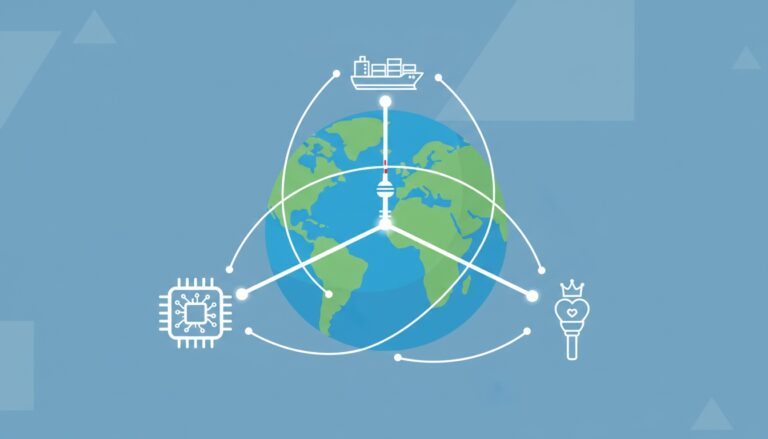
Today, we’re diving into a topic you’ll hear in news reports, business meetings, and academic discussions: Globalization. This isn’t just a buzzword; it’s a key concept for understanding the modern world. Especially in Korea, a country deeply connected to the global economy and culture, being able to discuss globalization is a massive advantage. We’ll move beyond simple vocabulary and equip you with the sophisticated language needed for high-level conversations.
Core Expressions for Global Discourse
Let’s master the terms that will make you sound like an expert.
1. 세계화 (Segyehwa)
* Pronunciation [Romanization]: Segyehwa
* English Meaning: Globalization
* Detailed Explanation: This is the foundational term. It’s a combination of 세계 (segye), meaning ‘world’, and the suffix -화 (-hwa), which means ‘-ization’ or ‘to become’. It’s used broadly to discuss the integration of economies, politics, and cultures across the globe. While it often refers to economic integration, in Korea, it’s also frequently used to talk about the global spread of Korean culture (Hallyu).
* 💡 Pronunciation Tip: The ‘ㅘ’ (wa) sound in ‘화’ (hwa) is a combination of ‘ㅗ’ (o) and ‘ㅏ’ (a). Make sure to pronounce it as one smooth syllable, not two separate vowels. The ‘h’ sound (ㅎ) should be a light, airy puff of sound.
2. 상호의존성 (Sangho-uijonseong)
* Pronunciation [Romanization]: Sangho-uijonseong
* English Meaning: Interdependence
* Detailed Explanation: This is a more academic term perfect for C1 learners. Let’s break it down: 상호 (sangho) means ‘mutual’, 의존 (uijon) means ‘dependence’, and -성 (-seong) is a suffix meaning ‘-ness’ or ‘-ity’. It perfectly describes the core concept of globalization: how countries have become mutually reliant on each other economically and politically.
* 💡 Pronunciation Tip: The vowel ‘의’ (ui) can be tricky. When it’s not in the first syllable of a word, as in ‘의존’, it is often pronounced simply as [이/i]. Therefore, while the standard pronunciation is [상호의존성], you will very often hear it pronounced as [상호이존썽/sangho-ijonsseong] in natural speech. The final ‘성’ is also pronounced with a tensed ‘ㅆ’ sound [썽/sseong].
3. 무역 장벽을 허물다 (Muyeok jangbyeogeul heomulda)
* Pronunciation [Romanization]: Muyeok jangbyeogeul heomulda
* English Meaning: To break down/demolish trade barriers
* Detailed Explanation: This is a powerful phrasal verb used when discussing free trade. 무역 (muyeok) is ‘trade’, 장벽 (jangbyeok) is a ‘barrier’ or ‘wall’, and 허물다 (heomulda) means ‘to demolish’ or ‘tear down’. This phrase is central to conversations about Free Trade Agreements (자유무역협정 – Jayu Muyeok Hyeopjeong, or FTA).
* 💡 Pronunciation Tip: In ‘장벽을’ [장벼글/jangbyeogeul], the final consonant ‘ㄱ’ (k) of ‘벽’ links to the following vowel ‘을’, a process called liaison (연음). It’s not ‘jangbyeok-eul’ but a smoother ‘jang-byeo-geul’.
4. 공급망 (Gonggeummang)
* Pronunciation [Romanization]: Gonggeummang
* English Meaning: Supply Chain
* Detailed Explanation: A highly relevant term in recent years. It combines 공급 (gonggeup), meaning ‘supply’, and 망 (mang), meaning ‘network’. It refers to the entire network involved in producing and distributing goods, from raw materials to the final customer. Discussions about 공급망 disruptions have been all over Korean news.
* 💡 Pronunciation Tip: Notice the spelling is ‘gonggeup-mang’, but the pronunciation is [공금망/gonggeummang]. This is due to nasalization. When a final consonant like ‘ㅂ’ (p) is followed by a nasal consonant like ‘ㅁ’ (m), the ‘ㅂ’ sound changes to ‘ㅁ’ to make pronunciation easier. This is a key rule to sound more natural.
Example Dialogue
Here’s how these terms might appear in a conversation between two colleagues watching the news.
A: 요즘 국제 뉴스만 보면 세계화의 단점이 더 부각되는 것 같아요.
(Yojeum gukje nyuseuman bomyeon segyehwaui danjeomi deo bugakdoeneun geot gatayo.)
A: Watching international news these days, it seems the downsides of globalization are being highlighted more.
B: 맞아요. 한 나라의 문제가 바로 다른 나라에 영향을 미치니까요. 국가 간의 상호의존성이 너무 깊어졌어요.
(Majayo. Han naraui munjega baro dareun nara-e yeonghyang-eul michinikkayo. Gukga ganui sangho-uijonseong-i neomu gipeojyeosseoyo.)
B: Exactly. A problem in one country immediately affects others. The interdependence between nations has become too deep.
A: 특히 글로벌 공급망이 한번 무너지니 회복이 정말 어렵네요.
(Teuki geullobeol gonggeummang-i hanbeon muneojini hoebogi jeongmal eoryeomneyo.)
A: Especially when the global supply chain collapses, recovery is incredibly difficult.
B: 그래서 일부 국가들은 다시 무역 장벽을 세우려는 움직임도 보이고 있죠.
(Geuraeseo ilbu gukgadeureun dasi muyeok jangbyeogeul seuryeoneun umjigimdo boigo itjyo.)
B: That’s why some countries are even showing signs of wanting to build up trade barriers again.
Culture Tip & Trend Analysis
In Korea, the concept of 세계화 (Segyehwa) took on a special meaning starting in the 1990s as a national slogan to encourage international competitiveness. Today, the conversation has shifted. While Koreans are proud of the cultural side of globalization, with K-Pop and K-dramas’ global success, they are also keenly aware of the economic vulnerabilities it brings. The term 공급망 (gonggeummang) became a household word during the 2021 urea solution crisis (요소수 대란), when a shortage of a single chemical from China nearly paralyzed the country’s logistics network. Understanding this context shows you’re not just learning words, but also the cultural and economic realities behind them.
Let’s Practice!
Time to put your knowledge to the test. Try completing this sentence with one of the words we learned today.
- 자유무역협정(FTA)의 가장 큰 목표는 국가 간의 _________을/를 허물어 자유로운 교역을 촉진하는 것이다.
(The main goal of a Free Trade Agreement (FTA) is to promote free trade by breaking down _________ between countries.)
Ready for a challenge? Try writing your own sentence using 상호의존성 or 공급망 and share it in the comments below. We’d love to see what you come up with!
Frequently Asked Questions (FAQ)
Q: What does "세계" mean in Korean and how do you pronounce it?
A: In Korean, "세계" is pronounced [segye] and means: , meaning 'world', and the suffix
Q: What does "-화" mean in Korean and how do you pronounce it?
A: In Korean, "-화" is pronounced [-hwa] and means: , which means '-ization' or 'to become'. It's used broadly to discuss the integration of economies, politics, and cultures across the globe. While it often refers to economic integration, in Korea, it's also frequently used to talk about the global spread of Korean culture (Hallyu).
Q: What does "상호" mean in Korean and how do you pronounce it?
A: In Korean, "상호" is pronounced [sangho] and means: means 'mutual',
Q: What does "의존" mean in Korean and how do you pronounce it?
A: In Korean, "의존" is pronounced [uijon] and means: means 'dependence', and







