

Hello! Welcome to [Maeil Hangul], your key to unlocking the deeper nuances of the Korean language!
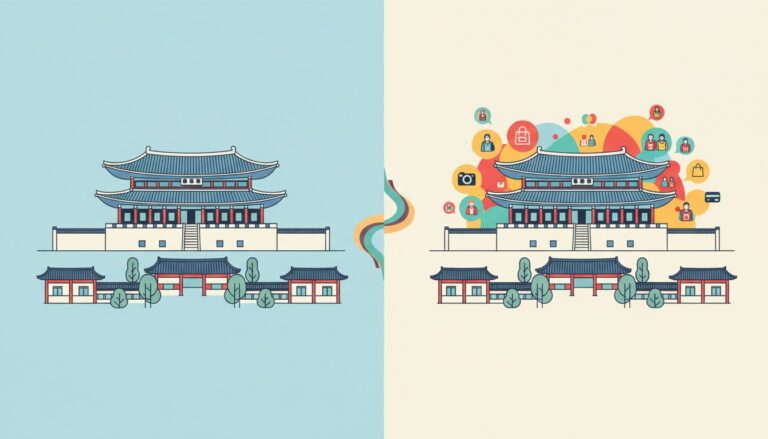
Today, we’re moving beyond everyday conversation to tackle a sophisticated topic: how tourism shapes and reshapes cultural identity. This is perfect for when you want to discuss social issues, read academic articles, or simply understand the complex dynamics at play in modern Korea. These days in Korea, there’s a huge debate about how the influx of tourists, drawn by everything from K-pop to historical dramas, is affecting the country’s authentic cultural heritage. Let’s dive into the vocabulary you need to analyze this phenomenon like a native speaker!
Core Expressions for In-Depth Analysis
Here are some essential terms for discussing the multifaceted impact of tourism.
1. 양날의 검 (Yangnal-ui geom)
* English Meaning: A double-edged sword
* Detailed Explanation: This is a metaphorical idiom used to describe something that has both significant positive and negative effects. It’s a highly useful, sophisticated expression for formal writing and discussions when you want to present a balanced argument about the pros and cons of tourism.
* 💡 Pronunciation Tip: The particle ‘의’ (ui) has multiple pronunciations. When used as a possessive marker like here, it’s often pronounced as [에/e], making the phrase sound like [양나레 검/yangnal-e geom] in natural, fast speech. While pronouncing it as [ui] is not wrong, [e] will make you sound much more fluent.
2. 고유성 (Goyuseong)
* English Meaning: Inherent uniqueness; authenticity; individuality
* Detailed Explanation: Derived from the Hanja characters 固有性, this noun refers to the unique, intrinsic characteristics of a person, object, or culture. In discussions about tourism, it’s often used to talk about the ‘authenticity’ of a cultural experience or heritage site that might be threatened by commercialization.
* 💡 Pronunciation Tip: This word is pronounced as written. Focus on giving each syllable equal stress, as is typical in Korean: [고.유.성/go.yu.seong]. Avoid the English tendency to stress one syllable more than others.
3. 상업화되다 (Sangeophwadoeda)
* English Meaning: To become commercialized
* Detailed Explanation: This verb combines ‘상업’ (commerce) with the suffix ‘-화되다’ (to become/be -ized). It’s used to describe the process where cultural traditions, places, or practices are changed or exploited for profit, often losing their original meaning. It carries a slightly negative connotation.
* 💡 Pronunciation Tip: The ‘ㅂ’ (b) in ‘업’ (eop) links to the next syllable, softening to a ‘p’ sound before ‘화’ (hwa). The pronunciation is [상어퐈되다/sangeopwadoeda]. This consonant assimilation is key to a natural flow.
4. 재조명되다 (Jaejomyeongdoeda)
* English Meaning: To be re-highlighted; to be put back in the spotlight
* Detailed Explanation: ‘재’ (re-) + ‘조명’ (lighting/spotlight) + ‘-되다’ (to become). This verb describes something that receives new attention or is seen in a new light, often after being forgotten or overlooked. Tourism can ‘re-highlight’ forgotten local histories or crafts.
* 💡 Pronunciation Tip: The pronunciation is quite literal: [재조명되다/jaejomyeongdoeda]. However, in compound words, Koreans often insert a very subtle pause or glottal stop between the prefix and the main word, so think of it as [재-조명되다] to get the rhythm right.
Example Dialogue
Let’s see these words in action. Two university students are discussing a recent trip.
A: 전주 한옥마을에 다녀왔는데, 생각보다 너무 상업화되어서 좀 실망했어. 전통 가옥의 고유성이 많이 사라진 느낌이었어.
(A: I went to Jeonju Hanok Village, but I was a bit disappointed because it has become more commercialized than I expected. I felt that the inherent uniqueness of the traditional houses has faded a lot.)
B: 맞아, 그게 바로 관광 산업의 양날의 검이지. 한편으로는 덕분에 잊혀가던 한옥의 가치가 재조명된 긍정적인 면도 있잖아.
(B: Right, that’s the double-edged sword of the tourism industry. On the other hand, there’s a positive aspect in that the value of Hanok, which was being forgotten, has been re-highlighted thanks to it.)
Cultural Tip & Trend Analysis
In Korea, the debate over authenticity is very real. For example, areas like Ikseon-dong in Seoul were once quiet, traditional neighborhoods. Now, thanks to social media, they are major tourist hotspots. While this has revitalized the area economically, many critics argue that the original residential character—its 고유성—has been lost to cafes and shops, a classic case of 상업화. Conversely, filming locations for historical K-dramas like ‘Mr. Sunshine’ have caused old, provincial sites to be 재조명되다, bringing in revenue and sparking interest in local history. This constant tension makes tourism a true 양날의 검 in modern Korea.
Wrap-up and Practice
Today, we learned four sophisticated terms—양날의 검, 고유성, 상업화되다, and 재조명되다—to help you analyze the complex effects of tourism on culture.
Your Turn!
* Using at least two of the expressions we learned today, write one sentence in the comments below answering this question: “Do you think the benefits of tourism for a country’s cultural heritage outweigh the drawbacks?”
We can’t wait to read your insightful opinions!







