

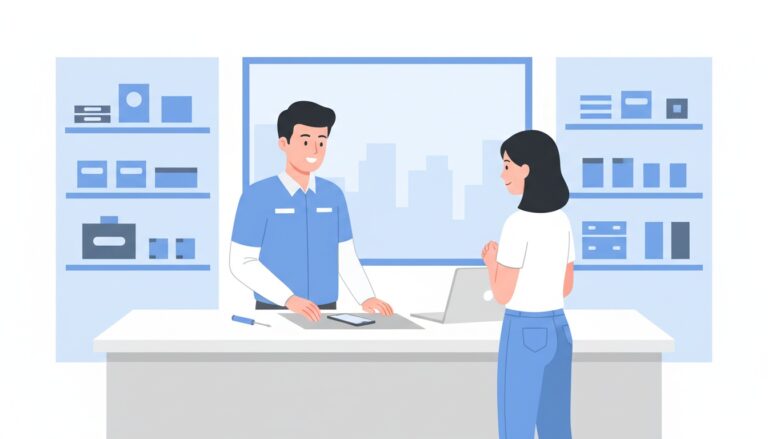
Hello! This is Maeil Hangul, here to upgrade your Korean skills!
Ever had your phone screen crack or your laptop suddenly die while in Korea? It’s a stressful situation, but don’t worry! Today, we’ll learn the essential Korean phrases for requesting a repair estimate. Knowing these expressions will make you feel confident and in control. Especially in Korea, where everyone is so connected, being able to get your electronics fixed quickly is a real superpower. Let’s get you prepared!
Core Expressions You Need to Know
Here are the key phrases to master when you visit a service center.
1. 수리를 맡기고 싶어요. (Surireul matgigo sipeoyo.)
* English Meaning: I’d like to leave this for repair.
* Detailed Explanation: This is the perfect opening sentence. ‘수리’ (suri) means ‘repair,’ and ‘맡기다’ (matgida) is a useful verb meaning ‘to entrust’ or ‘to leave something in someone’s care.’ This phrase is polite and clearly states your purpose for visiting.
* 💡 Pronunciation Tip: The verb ‘맡기고’ is pronounced [matkkigo]. The final consonant ‘ㅌ’ (t) in ‘맡’ strengthens the sound of the following ‘ㄱ’ (g), turning it into the tense sound ‘ㄲ’ (kk). It’s a common sound change rule called ‘tensing’ or ‘된소리되기’.
2. 견적 먼저 받아볼 수 있을까요? (Gyeonjeok meonjeo badabol su isseulkkayo?)
* English Meaning: Can I get an estimate first?
* Detailed Explanation: This is a crucial phrase for protecting your consumer rights! ‘견적’ (gyeonjeok) means ‘estimate.’ Before agreeing to a repair, it’s wise to ask for the estimated cost. This phrase is polite and indirect, making it suitable for any formal service situation.
* 💡 Pronunciation Tip: In ‘받아볼’ (badabol), the ‘ㄷ’ (d) sound in ‘받’ can sound very soft, almost like a light ‘d’. Focus on linking the sounds smoothly: [ba-da-bol].
3. 수리 비용이 얼마나 나올까요? (Suri biyong-i eolmana naolkkayo?)
* English Meaning: About how much will the repair cost be?
* Detailed Explanation: This is a more direct way to ask about the cost. ‘수리 비용’ (suri biyong) literally means ‘repair cost/fee.’ You can use this interchangeably with the phrase above, or after you’ve received the initial estimate to confirm the price.
* 💡 Pronunciation Tip: The word ‘비용이’ is pronounced [biyongi]. The final consonant ‘ㅇ’ (ng) of ‘비용’ is silent when it’s the first consonant of a syllable, but it’s a nasal ‘ng’ sound when it’s a final consonant (받침). Here, it links smoothly to the vowel ‘ㅣ’ (i).
4. 수리하는 데 얼마나 걸릴까요? (Surihaneun de eolmana geollilkkayo?)
* English Meaning: How long will the repair take?
* Detailed Explanation: Time is money! ‘얼마나 걸릴까요?’ (eolmana geollilkkayo?) is the standard way to ask ‘How long will it take?’. You can use this for anything, from repairs to waiting for a bus. It’s an incredibly versatile phrase.
* 💡 Pronunciation Tip: In ‘걸릴까요’ [geollilkkayo], the ‘ㄹㄹ’ is a clear ‘L’ sound. Make sure to touch the tip of your tongue to the roof of your mouth just behind your teeth to make the sound distinct.
Example Dialogue at a Service Center
Let’s see these phrases in action!
- A: 고객 (Customer)
- B: 기사님 (Technician)
A: 안녕하세요. 휴대폰 액정이 깨져서 왔는데, 수리를 맡기고 싶어요.
(Annyeonghaseyo. Hyudaepon aekjeong-i kkaejyeoseo wanneunde, surireul matgigo sipeoyo.)
(Hello. I came because my phone screen is broken. I’d like to leave it for repair.)
B: 네, 이쪽으로 주세요. 점검해 보겠습니다. … 아, 액정을 교체해야겠네요.
(Ne, ijjogeuro juseyo. Jeomgeomhae bogetseumnida. … A, aekjeong-eul gyochehaeyagenneyo.)
(Yes, please give it here. I’ll inspect it. … Ah, the screen needs to be replaced.)
A: 그러면 수리 비용이 얼마나 나올까요? 견적 먼저 받아볼 수 있을까요?
(Geureomyeon suri biyong-i eolmana naolkkayo? Gyeonjeok meonjeo badabol su isseulkkayo?)
(In that case, how much will the repair cost be? Can I get an estimate first?)
B: 네, 잠시만요. 교체 비용은 15만 원입니다.
(Ne, jamsimanyo. Gyoche biyong-eun siboman won-imnida.)
(Yes, one moment. The replacement cost is 150,000 won.)
A: 알겠습니다. 수리하는 데 얼마나 걸릴까요?
(Algetseumnida. Surihaneun de eolmana geollilkkayo?)
(I see. How long will the repair take?)
B: 한 시간 정도 걸립니다.
(Han sigan jeongdo geollimnida.)
(It will take about one hour.)
Culture Tip: The Speed of Korean Service
You’ve probably heard of Korea’s ‘빨리빨리’ (ppalli-ppalli), or ‘hurry, hurry,’ culture. This extends to customer service, especially repairs! Major companies like Samsung and LG have official service centers that are famous for their speed and efficiency. It’s common to get a phone screen replaced in just an hour. So, when you ask, “얼마나 걸릴까요?” don’t be surprised if the answer is much faster than you expect! This efficiency is a point of pride and a key part of the Korean consumer experience.
Let’s Practice!
Time to check your understanding. Fill in the blank with the correct phrase we learned today.
- Your laptop isn’t working, and you want to know the price before agreeing to the repair. What do you say?
- 노트북 수리하기 전에, ______ 먼저 받고 싶어요.
- (Before repairing the laptop, I’d like to receive a(n) ______ first.)
Great job today! You’re now ready to handle any repair situation in Korea with confidence. Try using one of today’s phrases to make a sentence in the comments below!







