

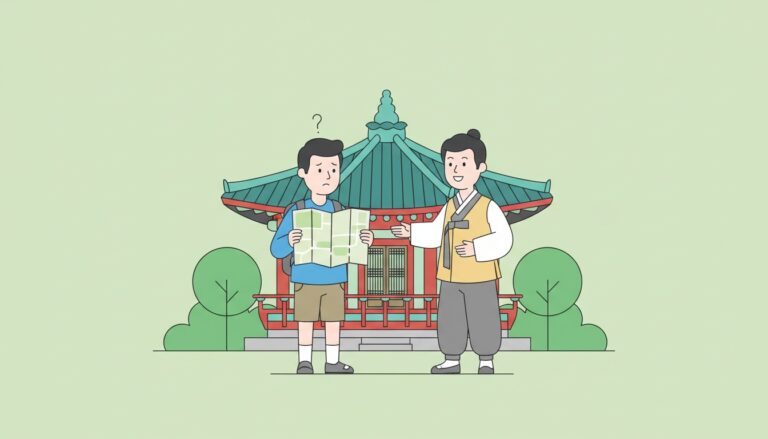
Lost in a K-Drama? How to Ask for Directions in Korean!
Hello! Welcome to [Maeil Hangeul], here to upgrade your Korean skills!
Have you ever been wandering through a beautiful park in Korea, maybe even one you saw in a K-drama, and suddenly realized… you need to find the restroom? Don’t panic! Today, we’re going to learn the essential Korean phrases for asking for directions. It’s super useful, and with the recent trend of visiting filming locations from popular dramas, you’ll be navigating parks like a local in no time!
Core Expressions You Need to Know
Here are the key phrases that will save the day!
1. 저기요 (Jeogiyo)
* Pronunciation [Romanization]: Jeogiyo
* English Meaning: Excuse me.
* Detailed Explanation: This is the most common and natural way to get someone’s attention on the street or in a public place. It’s polite and friendly, perfect for asking a stranger for help. Think of it as the Korean version of “Excuse me, can you help me for a second?”
* 💡 Pronunciation Tip: The ‘ㅓ’ (eo) vowel sounds like the ‘o’ in ‘song’ or the ‘u’ in ‘sun’. It’s a relaxed sound made in the back of your mouth.
2. 화장실이 어디에 있어요? (Hwajangsiri eodie isseoyo?)
* Pronunciation [Romanization]: Hwajangsiri eodie isseoyo?
* English Meaning: Where is the restroom?
* Detailed Explanation: This is your golden sentence! Let’s break it down: 화장실 (hwajangsil) means ‘restroom’, -이 (i) is a subject particle, 어디에 (eodie) means ‘where’, and 있어요 (isseoyo) means ‘is there’. You can swap 화장실 for any other place, like 지하철역 (jihacheollyeok – subway station) or 카페 (kape – cafe).
* 💡 Pronunciation Tip: Notice the pronunciation is [Hwajangsiri], not [Hwajangsil-i]. This is a very common Korean pronunciation rule called ‘linking sound’ or ‘연음 (yeoneum)’. When a consonant at the end of a syllable is followed by a vowel, it moves over to the next syllable. So, the ‘ㄹ(l)’ sound naturally links with ‘이(i)’ to make the ‘리(ri)’ sound.
3. 쭉 가세요 (Jjuk gaseyo)
* Pronunciation [Romanization]: Jjuk gaseyo
* English Meaning: Go straight.
* Detailed Explanation: A very common phrase you’ll hear when getting directions. 쭉 (jjuk) is an adverb that means ‘straight’ or ‘continuously’. 가세요 (gaseyo) is the polite imperative form of 가다 (gada – to go).
* 💡 Pronunciation Tip: The ‘ㅉ’ (jj) is a ‘tense consonant’. To make this sound, make a ‘j’ sound but with more tension in your tongue and a puff of air. It’s stronger and sharper than the regular ‘ㅈ’ (j).
4. 오른쪽으로 가세요 (Oreunjjogeuro gaseyo)
* Pronunciation [Romanization]: Oreunjjogeuro gaseyo
* English Meaning: Go to the right.
* Detailed Explanation: Essential for any turn! 오른쪽 (oreunjjok) means ‘right side’. The particle -(으)로 (-euro) indicates direction, meaning ‘to’ or ‘toward’. To say “Go to the left,” you just swap 오른쪽 with 왼쪽 (oenjjok).
* 💡 Pronunciation Tip: Just like with 쭉, the ㅉ in 쪽 (jjok) is a tense sound. Practice saying 오른쪽 (oreunjjok) with a sharp, clear ‘jjok’ at the end.
Example Conversation
Imagine you are in Seoul Forest, a popular park and K-drama filming spot!
- A: 저기요. 실례지만, 화장실이 어디에 있어요?
(Jeogiyo. Sillyejiman, hwajangsiri eodie isseoyo?)
Excuse me. Pardon me, but where is the restroom? - B: 아, 저기 카페 보이죠? 저 카페 앞에서 오른쪽으로 가세요. 그러면 바로 보여요.
(A, jeogi kape boijyo? Jeo kape apeseo oreunjjogeuro gaseyo. Geureomyeon baro boyeoyo.)
Ah, you see that cafe over there? Go to the right in front of that cafe. Then you’ll see it right away. - A: 네, 감사합니다!
(Ne, gamsahamnida!)
Okay, thank you!
Culture Tip & Trend Deep Dive
Navigating Korean Parks Like a Pro!
Parks in Korea are major social hubs. You’ll see couples on dates, families having picnics, and friends enjoying ‘치맥’ (chimaek – chicken and beer). Recently, with dramas like ‘Lovely Runner’ featuring scenes by the Han River, these public spaces are more popular than ever. Knowing how to ask for directions isn’t just a survival skill; it’s your key to fully enjoying the local culture. Don’t be shy! Koreans are generally very friendly and willing to help a lost foreigner. Using a polite phrase like ‘저기요’ will always get you a kind response.
Let’s Practice!
Time to check your understanding!
- How would you ask, “Excuse me, where is the subway station?”
(Hint: Subway station = 지하철역 [jihacheollyeok]) -
A friend tells you: “왼쪽으로 쭉 가세요.” What should you do?
a) Go straight and then turn left.
b) Go straight to the left.
c) Go straight to the right.
Leave your answers and try making your own direction-asking sentence in the comments below! We’d love to see them!







