

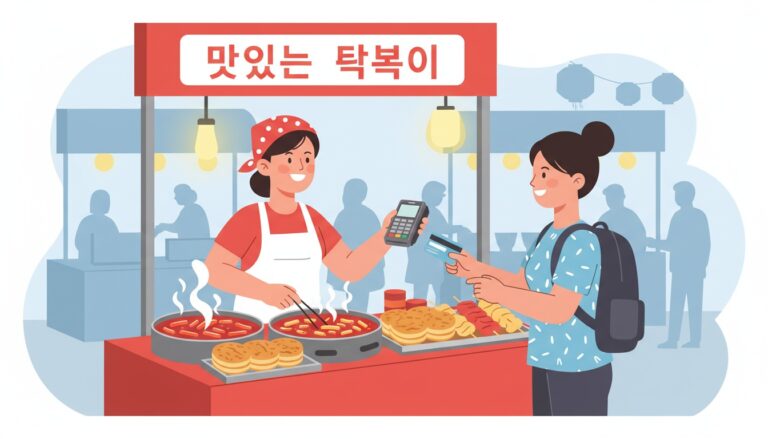
No Cash? No Problem! How to Pay for Street Food in Korea
Hello! Welcome to [Maeil Hangul], here to upgrade your Korean skills!
Ever found yourself in front of a delicious-looking tteokbokki (떡볶이) stall in Korea, only to realize you have no cash? Don’t worry! Today, we’re going to learn a super useful phrase that will save you in many situations. Recently, Korea has become a mostly ‘cashless society,’ and you’d be surprised how many street food vendors now accept credit cards. Let’s learn how to ask so you can enjoy all the amazing food worry-free!
Core Expressions
Here are the key phrases you need to know!
1. 카드 돼요? (Kadeu dwaeyo?)
* Pronunciation [Romanized]: Kadeu dwaeyo?
* English Meaning: Can I pay by card? / Do you accept cards?
* Detailed Explanation: This is the magic phrase! ‘카드 (kadeu)’ means ‘card,’ and ‘돼요 (dwaeyo)?’ is a versatile expression meaning ‘Is it okay?’ or ‘Is it possible?’. It’s polite yet casual, making it perfect for street vendors, cafes, and small shops.
* 💡 Pronunciation Tip: The ‘돼 (dwae)’ sound can be tricky. It’s a quick glide from ‘ㅗ (o)’ to ‘ㅐ (ae),’ almost like ‘dwae’ in ‘dwindle.’ Practice saying it as one smooth syllable, not two separate sounds like ‘do-ae’.
2. 현금만 돼요. (Hyeongeum-man dwaeyo.)
* Pronunciation [Romanized]: Hyeon-geum-man dwae-yo.
* English Meaning: We only accept cash. / Cash only.
* Detailed Explanation: This is a common response you might hear if they don’t accept cards. ‘현금 (hyeongeum)’ means ‘cash,’ and the particle ‘-만 (-man)’ means ‘only.’ So, it literally translates to ‘Only cash is okay.’
* 💡 Pronunciation Tip: Pay attention to the first syllable ‘현 (hyeon)’. The ‘ㅎ (h)’ is a soft, airy sound, like the ‘h’ in ‘hue.’ Don’t make it a hard ‘h’ sound.
3. 얼마예요? (Eolmayeyo?)
* Pronunciation [Romanized]: Eol-ma-ye-yo?
* English Meaning: How much is it?
* Detailed Explanation: Before you pay, you need to know the price! ‘얼마 (eolma)’ means ‘how much,’ and ‘예요 (yeyo)?’ is the polite ‘is it?’. You’ll use this phrase everywhere, not just for food.
* 💡 Pronunciation Tip: This phrase uses a pronunciation rule called linking sound (연음 – yeoneum). The final consonant ‘ㅁ (m)’ from ‘얼마 (eolma)’ links to the next syllable, so you pronounce it smoothly as [eol-ma-ye-yo], not [eol-ma… e-yo].
Example Dialogue
Imagine you’re at a hotteok (호떡 – sweet pancake) stall in Myeongdong.
- A (You): 저기요, 이 호떡 얼마예요? (Jeogiyo, i hotteok eolmayeyo?)
- Excuse me, how much is this hotteok?
- B (Vendor): 하나에 이천 원이에요. (Hana-e icheon won-ieyo.)
- It’s 2,000 won for one.
- A (You): 와, 맛있겠다! 카드 돼요? (Wa, masitgetda! Kadeu dwaeyo?)
- Wow, that looks delicious! Can I pay by card?
- B (Vendor): 네, 여기요. (Ne, yeogiyo.)
- Yes, here you go. (handing you the card reader)
Culture Tip & Trend Deep Dive
While Korea is famous for its high-tech, cashless culture, you’ll find that some traditional markets (시장 – sijang) or very small, older vendors might still be cash-only. So, asking ‘카드 돼요?’ is not only useful but also polite. Young Koreans often don’t even carry physical cards anymore! They use payment apps on their phones like Samsung Pay or Kakao Pay. If you show the vendor your card and ask ‘카드 돼요?’, they will immediately understand and will see you as someone who knows a bit about Korean culture!
Let’s Practice!
Time to check what you’ve learned!
- Fill in the blank: You want to buy some delicious eomuk (어묵 – fish cake skewers). You only have your credit card. What do you ask the vendor?
- 이거 주세요. 혹시 ______? (Please give me this. By any chance, ______?)
- Quiz: The vendor tells you, “죄송해요, 현금만 돼요.” (Joesonghaeyo, hyeongeum-man dwaeyo). What should you do?
- A) Give them your credit card.
- B) Look for an ATM to get cash.
- C) Ask for a discount.
Great job today! You’re now ready to conquer the Korean street food scene. Try leaving a comment below using the phrases you learned! Happy eating!







