

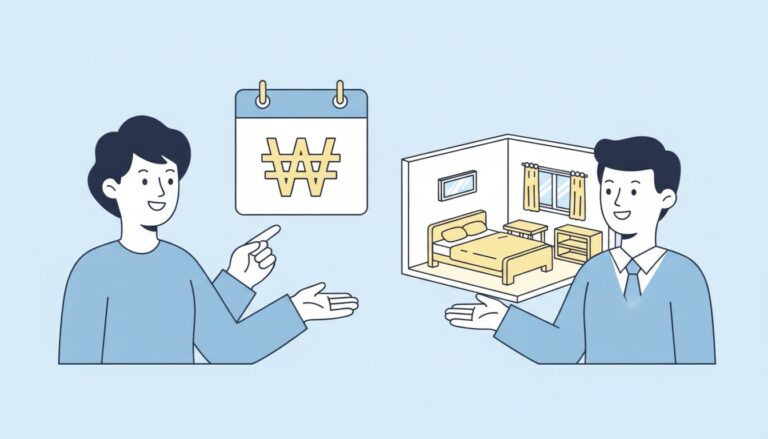
Unlock Your Seoul Home! How to Ask About Rent in Korean
Hello! This is Maeil Hangul, here to upgrade your Korean skills!
Dreaming of living in Korea? Whether you’re a student, a professional, or a K-drama fan wanting to live the dream, you’ll need a place to stay! Today, we’re going to learn the absolute essential phrases for finding a house: how to ask about the monthly rent.
Lately in Korea, finding the perfect ‘자취방’ (jajwibang – a one-room studio for a single person) in trendy neighborhoods like Hongdae or Seongsu is a huge topic among young people. So, let’s learn how to ask the most important question and sound like a pro!
Key Expressions You Must Know
Here are the essential terms for your apartment-hunting adventure.
1. 월세 (Wolse)
* Pronunciation [Romanization]: Wolse
* English Meaning: Monthly Rent
* Detailed Explanation: This is the most common rental system in Korea. It consists of a security deposit and a monthly payment. When you see a property listing, you’ll almost always see it listed with ‘월세’.
* 💡 Pronunciation Tip: The ‘l’ sound in ‘Wol’ (월) is a bit tricky. It’s a ‘light L’ sound, made by touching the tip of your tongue to the roof of your mouth, just behind your front teeth. It’s much softer than a hard English ‘L’.
2. 보증금 (Bojeunggeum)
* Pronunciation [Romanization]: Bojeunggeum
* English Meaning: Security Deposit
* Detailed Explanation: This is a large, one-time payment you give to the landlord before you move in. Don’t worry, you get this entire amount back when your contract ends and you move out (as long as there’s no damage!). It’s a key part of the Korean rental system.
* 💡 Pronunciation Tip: The ‘eu’ sound in ‘geum’ (금) can be new for English speakers. It’s made by saying “oo” but without rounding your lips. Try to say the sound from the back of your throat with your lips in a flat, relaxed line.
3. 월세가 얼마예요? (Wolse-ga eolmayeyo?)
* Pronunciation [Romanization]: Wolse-ga eolmayeyo?
* English Meaning: How much is the monthly rent?
* Detailed Explanation: This is the golden phrase! It’s the most direct and polite way to ask about the rent. You can use ‘얼마예요?’ (eolmayeyo?) to ask for the price of anything, from coffee to clothes.
* 💡 Pronunciation Tip: Notice how ‘얼마예요’ (eolmayeyo) flows together as one unit. The ‘a’ in ‘얼마’ (eolma) and the ‘예’ (ye) in ‘예요’ (yeyo) are pronounced smoothly without a long pause. Practice saying it as one fluid question.
4. 관리비는 포함이에요? (Gwallibineun pohamieyo?)
* Pronunciation [Romanization]: Gwallibineun pohamieyo?
* English Meaning: Are maintenance fees included?
* Detailed Explanation: ‘관리비’ (gwallibi) is the building maintenance fee, which covers things like cleaning, elevator electricity, and security. This is a crucial question because it can be a significant extra cost each month! ‘포함’ (poham) means ‘inclusion’.
* 💡 Pronunciation Tip: In ‘포함이에요’ (pohamieyo), the final consonant ‘ㅁ’ (m) from ‘포함’ (poham) links to the vowel ‘ㅣ’ (i) that follows it. So, it sounds more like [포하미에요 (po-ha-mi-e-yo)]. This very common pronunciation rule is called ‘연음’ (yeon-eum), or linking, and it makes Korean sound much smoother!
Example Dialogue
Let’s see how these phrases work in a real conversation between a potential Renter (A) and a Real Estate Agent (B).
- A: 안녕하세요, 집 보고 연락드렸는데요. 혹시 월세가 얼마예요?
(Annyeonghaseyo, jip bogo yeollakdeuryeonneundeyo. Hoksi wolse-ga eolmayeyo?)
(Hello, I’m calling about the house listing. How much is the monthly rent?) - B: 아, 네. 그 집은 보증금 1000만 원에 월세 70만 원입니다.
(A, ne. Geu jibeun bojeunggeum cheon-man won-e wolse chilsip-man wonimnida.)
(Ah, yes. That place has a deposit of 10 million won and a monthly rent of 700,000 won.) - A: 알겠습니다. 혹시 관리비는 포함이에요?
(Algesseumnida. Hoksi gwallibineun pohamieyo?)
(I see. And are the maintenance fees included?) - B: 아니요, 관리비는 따로 5만 원입니다.
(Aniyo, gwallibineun ttaro o-man wonimnida.)
(No, the maintenance fee is a separate 50,000 won.)
Culture Tip: Wolse vs. Jeonse
In Korea, there are two main rental systems:
* 월세 (Wolse): A security deposit (보증금) + monthly rent payments. This is what we learned today and is the most common system for foreigners and young Koreans.
* 전세 (Jeonse): A very large, single deposit (often 50-80% of the property’s value) with NO monthly rent. You get the entire deposit back at the end of your contract. It’s like a long-term loan to the landlord.
Knowing the difference will make you look like a local expert!
Let’s Practice!
Time to check your understanding!
- Fill in the blank: You want to ask how much the security deposit is. You would say: “________이/가 얼마예요?”
- Make a sentence: How would you ask if the rent (‘월세’) includes the maintenance fee (‘관리비’)?
Great job today! You’re now ready to take the first step in finding your home in Korea. Try using the phrases you learned to make a sentence in the comments below!
Frequently Asked Questions (FAQ)
Q: What does "월세" mean in Korean and how do you pronounce it?
A: In Korean, "월세" is pronounced [Wolse] and means: A security deposit (
Q: What does "전세" mean in Korean and how do you pronounce it?
A: In Korean, "전세" is pronounced [Jeonse] and means: A very large, single deposit (often 50-80% of the property's value) with NO monthly rent. You get the entire deposit back at the end of your contract. It's like a long-term loan to the landlord.






