

What’s Missing? How to Say “I Don’t Have” in Korean (-이/가 없어요)
Hello! Welcome to [Maeil Hangul], here to upgrade your Korean skills!
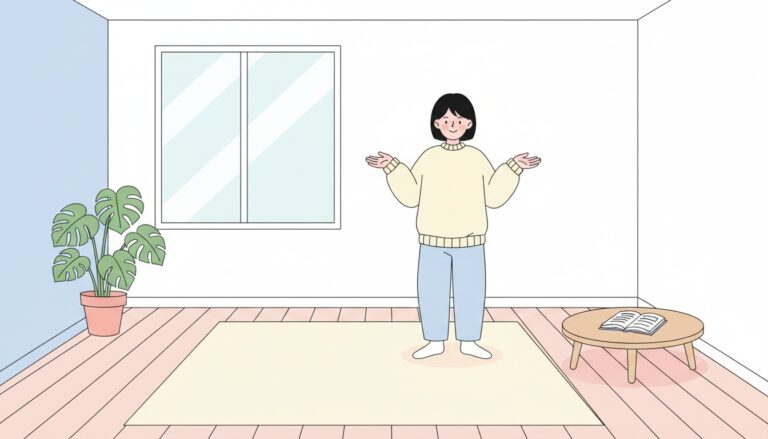
Have you ever wanted to describe your room in Korean, but realized you needed to talk about what isn’t there? Today, we’re going to learn a super essential phrase: -이/가 없어요 (i/ga eopseoyo), which means “to not have” or “there isn’t.” This is perfect for describing your space, telling a shopkeeper what you can’t find, or explaining what you need to buy.
Lately in Korea, “room tours” (룸투어) and showing off a “minimalist life” (미니멀 라이프) are huge trends on social media. So, let’s learn how to describe a simple, clean room like a trendy Korean YouTuber!
Core Expressions You Need to Know
Here are the key phrases for today’s lesson.
1. The Grammar: -이/가 없어요 (i/ga eopseoyo)
- Korean Expression: -이/가 없어요
- Pronunciation [Romanization]: -i/ga eopseoyo
- English Meaning: to not have / there is no…
- Detailed Explanation: This is the polite, standard way to say something doesn’t exist in a location, or that you don’t possess it. It’s the direct opposite of
-이/가 있어요(to have). You attach it to a noun.- Use -이 없어요 after a noun ending in a consonant (like 책상, chaeksang).
- Use -가 없어요 after a noun ending in a vowel (like 의자, uija).
- 💡 Pronunciation Tip: The word 없어요 is pronounced [eop-sseo-yo]. The 받침 (final consonant) ‘ㅂ’ sounds like a ‘p’. The ‘ㅆ’ is a tensed ‘s’ sound, stronger than a single ‘ㅅ’. Practice saying it with a little more force: [eop-sseo-yo]!
2. Example with a Vowel: 침대가 없어요 (chimdaega eopseoyo)
- Korean Expression: 침대가 없어요.
- Pronunciation [Romanization]: Chimdaega eopseoyo.
- English Meaning: I don’t have a bed. / There is no bed.
- Detailed Explanation:
침대(chimdae) means “bed.” Since it ends with the vowel ‘ㅐ’ (ae), we add가 없어요. - 💡 Pronunciation Tip: The ‘ㅊ’ (ch) sound is an aspirated sound, meaning you should feel a little puff of air when you say it. Put your hand in front of your mouth and feel the air when you say [chim-dae]!
3. Example with a Consonant: 책상이 없어요 (chaeksangi eopseoyo)
- Korean Expression: 책상이 없어요.
- Pronunciation [Romanization]: Chaeksangi eopseoyo.
- English Meaning: I don’t have a desk. / There is no desk.
- Detailed Explanation:
책상(chaeksang) means “desk.” Since it ends with the consonant ‘ㅇ’ (ng), we add이 없어요. - 💡 Pronunciation Tip: This is a perfect example of a linking sound rule called 연음 (yeoneum)! Instead of saying
chaeksangandiseparately, the final consonant ‘ㅇ’ (ng) from상moves over to the next syllable. So, it sounds smooth and connected: [chaek-sang-i].
Example Conversation
Let’s see how this works in a real conversation between two friends talking about their rooms.
- A: 지수 씨, 방에 TV 있어요? (Jisu, do you have a TV in your room?)
- Jisu ssi, bang-e TV isseoyo?
- B: 아니요, 저는 TV가 없어요. (No, I don’t have a TV.)
- Aniyo, jeoneun TV-ga eopseoyo.
- A: 정말요? 그럼 컴퓨터는요? (Really? Then what about a computer?)
- Jeongmallyo? Geureom keompyuteoneunyo?
- B: 컴퓨터도 없어요. 저는 미니멀 라이프를 좋아해요. (I don’t have a computer either. I like the minimalist life.)
- Keompyuteodo eopseoyo. Jeoneun minimel laipeureul joahaeyo.
🛋️ Culture Tip: The “Minimalist Life” Trend in Korea
As you saw in the dialogue, 미니멀 라이프 (minimeol laipeu) is a popular lifestyle choice, especially among the Korean MZ generation (Millennials + Gen Z). It’s all about finding happiness by decluttering and owning fewer things (a concept called 비움, bium, which means ‘emptying’).
You’ll see many Korean YouTubers doing 룸투어 (rumtueo – room tour) vlogs where they proudly show their simple, clean spaces. By saying “텔레비전이 없어요 (I don’t have a TV)” or “소파가 없어요 (I don’t have a sofa),” you’re not just stating a fact—you could also be showing off your cool, trendy, minimalist philosophy!
Let’s Practice!
Great job today! You’ve learned the essential phrase -이/가 없어요 to talk about things you don’t have.
Now it’s your turn to try!
- Fill in the blank: How would you say, “I don’t have a chair”? (Hint: chair = 의자, uija)
의자___ 없어요.
- Make a sentence: Look around your room. What is something you don’t have? Try to write a full sentence in Korean!
Leave your answers in the comments below! We are excited to see your Korean sentences. Keep up the great work!
Frequently Asked Questions (FAQ)
Q: What does "The Grammar: -이/가 없어요 (i/ga eopseoyo)" mean in Korean and how do you pronounce it?
A: In Korean, "The Grammar: -이/가 없어요 (i/ga eopseoyo)" is pronounced [Romanization] and means: to not have / there is no...
Q: What does "Example with a Vowel: 침대가 없어요 (chimdaega eopseoyo)" mean in Korean and how do you pronounce it?
A: In Korean, "Example with a Vowel: 침대가 없어요 (chimdaega eopseoyo)" is pronounced [Romanization] and means: I don't have a bed. / There is no bed.
Q: What does "Example with a Consonant: 책상이 없어요 (chaeksangi eopseoyo)" mean in Korean and how do you pronounce it?
A: In Korean, "Example with a Consonant: 책상이 없어요 (chaeksangi eopseoyo)" is pronounced [Romanization] and means: I don't have a desk. / There is no desk.






