

Hello! Welcome back to Maeil Hangul, where we upgrade your advanced Korean skills!
Today, we’re diving into a sophisticated topic that’s crucial for global sustainability: food security. More specifically, we’ll explore the technical vocabulary used to discuss reducing post-harvest loss. Why is this important? In Korea, a global tech leader, the conversation around food waste is evolving from simple recycling to high-tech prevention. Understanding this topic will not only boost your vocabulary but also give you insight into Korea’s current agricultural policies and technological ambitions. Let’s get started!
Core Expressions for Policy & Tech Talk
Here are some key terms you’ll need to discuss this topic like an expert.
1. 수확 후 손실 (Suhwak hu sonsil)
* Pronunciation [Romanization]: Suhwak hu sonsil
* English Meaning: Post-harvest loss
* Detailed Explanation: This is a technical term referring to the degradation in both quantity and quality of food production from the moment of harvest to consumption. It’s a compound noun made of 수확 (suhwak – harvest), 후 (hu – after), and 손실 (sonsil – loss/damage). This term is frequently used in academic papers, government reports, and news articles concerning agriculture and food policy.
* 💡 Pronunciation Tip: In Korean, syllables are often pronounced distinctly. Make sure to clearly articulate each part: 수-확-후-손-실 (Su-hwak-hu-son-sil). The ‘ㅎ’ (h) in ‘확’ and ‘후’ should be clearly aspirated, giving it a light, airy sound.
2. 농산물 유통구조 (Nongsanmul yutonggujo)
* Pronunciation [Romanization]: Nongsanmul yutonggujo
* English Meaning: The distribution structure of agricultural products
* Detailed Explanation: This term describes the entire chain of how agricultural products move from the farm to the consumer, including storage, processing, transportation, and marketing. It’s composed of 농산물 (nongsanmul – agricultural products), 유통 (yutong – distribution), and 구조 (gujo – structure). Inefficiencies in this ‘구조’ are often cited as a primary cause of ‘수확 후 손실’.
* 💡 Pronunciation Tip: This is a long compound word, so the key is smooth linking. Notice the 연음 (yeon-eum) or liaison rule between ‘산 (san)’ and ‘물 (mul)’. The final ‘ㄴ’ (n) sound of ‘산’ links smoothly to ‘물’, making it sound like [농산물/nong-san-mul], not a choppy ‘nong-san / mul’.
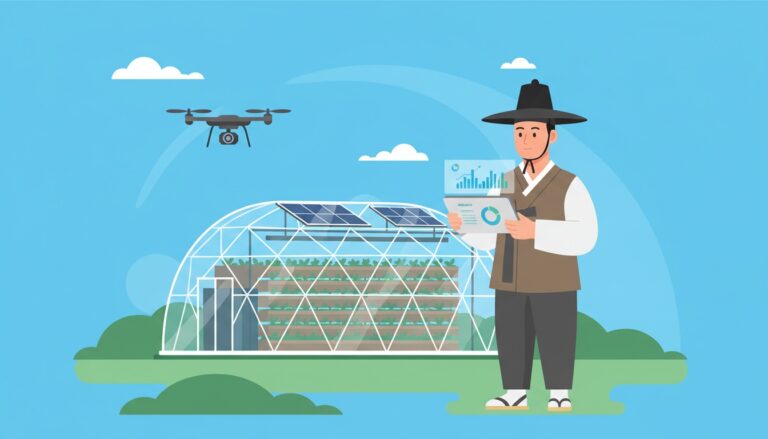
3. 스마트팜 (Seumateupam)
* Pronunciation [Romanization]: Seumateupam
* English Meaning: Smart Farm
* Detailed Explanation: This is a direct borrowing from English. A ‘스마트팜’ is a farm that utilizes advanced information and communication technologies (ICT) like IoT, big data, and AI to create an optimal growing environment. This technology is a key solution to minimizing ‘수확 후 손실’ by precisely controlling temperature, humidity, and even harvest timing.
* 💡 Pronunciation Tip: When English words are adopted into Korean (known as Konglish), they are adapted to Korean phonology. ‘Smart’ becomes 스마트 (seumateu) with an extra vowel sound at the end because Korean syllables cannot end in a ‘t’ consonant sound. Similarly, ‘farm’ becomes 팜 (pam).
4. 저온 저장 기술 (Jeo-on jeojang gisul)
* Pronunciation [Romanization]: Jeo-on jeojang gisul
* English Meaning: Low-temperature storage technology (Cold storage technology)
* Detailed Explanation: This refers to the technology used to preserve perishable goods by keeping them at a low temperature. It’s a combination of 저온 (jeo-on – low temperature), 저장 (jeojang – storage), and 기술 (gisul – technology). This is a fundamental technology for improving the ‘농산물 유통구조’.
* 💡 Pronunciation Tip: Pay attention to the 경음화 (gyeong-eumhwa) or tensification rule in 저장 (jeojang). The initial ‘ㅈ’ (j) sound becomes a tensed, unaspirated sound similar to ‘ㅉ’ (jj). So, the pronunciation is closer to [저짱/jeojjang]. This happens frequently after a syllable ending in a vowel.
Example Dialogue
Let’s see these terms in a conversation between a policy researcher (A) and a journalist (B).
A: 최근 정부 보고서에 따르면, 한국의 수확 후 손실 문제가 여전히 심각하다고 합니다.
(A: According to a recent government report, Korea’s post-harvest loss problem is still serious.)
B: 네, 특히 복잡한 농산물 유통구조가 주요 원인으로 지적되고 있죠. 해결책은 없을까요?
(B: Yes, the complex distribution structure of agricultural products is often pointed out as a major cause. Are there any solutions?)
A: 물론입니다. 정부는 스마트팜 보급을 확대하고, 전국적으로 저온 저장 기술을 적용한 물류센터를 구축하여 이 문제를 해결하려고 노력 중입니다.
(A: Of course. The government is trying to solve this problem by expanding the adoption of smart farms and establishing logistics centers with low-temperature storage technology nationwide.)
B: 기술이 농업의 미래를 바꾸고 있군요. 흥미로운 주제입니다.
(B: So technology is changing the future of agriculture. That’s a fascinating topic.)
Culture & Trend Deep Dive
In Korea, the push for ‘스마트팜’ is not just about reducing waste; it’s a core component of the government’s 디지털 뉴딜 (Digital New Deal) initiative. This policy aims to transform the nation’s economy through digitalization. By investing heavily in smart farming, Korea aims to enhance its food self-sufficiency rate, create high-tech jobs in rural areas, and position itself as a global leader in ‘AgriTech’. Furthermore, there’s a growing consumer movement supporting ‘못난이 농산물’ (ugly agricultural products) – produce that is perfectly edible but cosmetically imperfect. Subscription boxes for this type of produce are gaining popularity, showing a bottom-up approach to tackling food loss that complements the government’s top-down technological solutions.
Let’s Review & Practice!
We’ve covered some advanced vocabulary today related to a very current and important topic in Korea. You learned about 수확 후 손실, the 농산물 유통구조 that causes it, and technological solutions like 스마트팜 and 저온 저장 기술.
Practice Question:
Using at least two of the expressions learned today, write one sentence in Korean explaining how technology can help solve the problem of food waste.
We’d love to see your answers! Leave a comment below with your practice sentence.
Frequently Asked Questions (FAQ)
Q: What does "후" mean in Korean and how do you pronounce it?
A: In Korean, "후" is pronounced [hu - after] and means: , and
Q: What does "손실" mean in Korean and how do you pronounce it?
A: In Korean, "손실" is pronounced [sonsil - loss/damage] and means: . This term is frequently used in academic papers, government reports, and news articles concerning agriculture and food policy.
Q: What does "수-확-후-손-실" mean in Korean and how do you pronounce it?
A: In Korean, "수-확-후-손-실" is pronounced [Su-hwak-hu-son-sil] and means: . The 'ㅎ' (h) in '확' and '후' should be clearly aspirated, giving it a light, airy sound.
Q: What does "유통" mean in Korean and how do you pronounce it?
A: In Korean, "유통" is pronounced [yutong - distribution] and means: , and






