

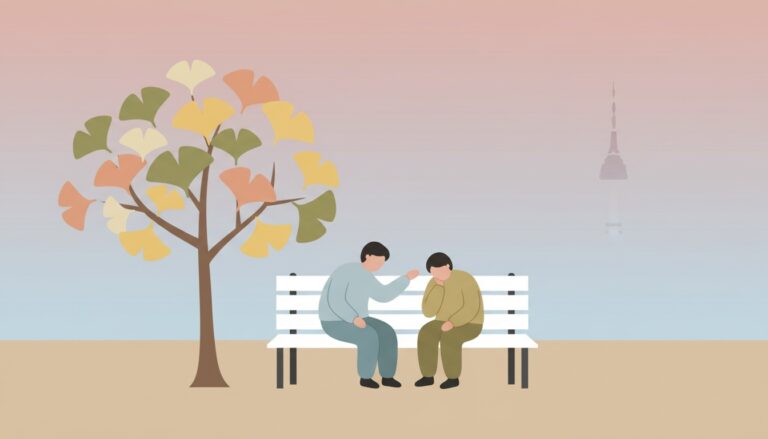
Korea’s Mental Health Maze: Key Phrases for Seeking Support
Hello! Welcome back to Maeil Hangul, your guide to leveling up your Korean!
Today, we’re delving into a topic of growing importance everywhere, including Korea: mental health. Navigating feelings and seeking support in a new language can be challenging, but it’s incredibly important. Recently in Korea, conversations around mental well-being are becoming more open, especially among younger generations, moving away from the old stigma. This post will equip you with the essential vocabulary and cultural context to discuss mental health and access services, making you a more empathetic and well-informed speaker.
Core Expressions for Mental Wellness
Here are some key phrases that will help you navigate conversations about mental health in Korean.
1. 정신과 (jeongsin-gwa)
* Romanization: Jeongsin-gwa
* English Meaning: Psychiatry; a psychiatric clinic/department.
* Detailed Explanation: This is the formal term for the medical field dealing with mental health disorders. While historically there has been a significant stigma attached to visiting a 정신과, perceptions are slowly changing. It’s the place you would go for a medical diagnosis and prescription medication from a psychiatrist (정신과 의사).
* 💡 Pronunciation Tip: The final consonant ‘ㅇ’ (ng) in 정신 (jeongsin) is a nasal sound made at the back of your throat, similar to the ‘-ng’ in the English word ‘singing’. Make sure not to pronounce it like ‘n’.
2. 심리 상담 (simni sangdam)
* Romanization: Simni sangdam
* English Meaning: Psychological counseling; therapy.
* Detailed Explanation: This term has a softer connotation than 정신과 and refers to talk therapy or counseling with a psychologist (심리학자) or counselor (상담사). It’s a more common choice for people dealing with stress, relationship issues, or general emotional difficulties. Many universities and larger companies in Korea now offer 심리 상담 services to students and employees.
* 💡 Pronunciation Tip: In 상담 (sangdam), the ‘ㅅ’ (s) sound is slightly softer than an English ‘s’ and is never buzzed like a ‘z’. The ㄷ (d) is unaspirated, sounding somewhere between an English ‘d’ and ‘t’.
3. 마음이 무겁다 (ma-eumi mugeopda)
* Romanization: Ma-eumi mugeopda
* English Meaning: To have a heavy heart; to be weighed down with worry.
* Detailed Explanation: This is a beautiful idiomatic expression. 마음 means ‘heart’ or ‘mind’, and 무겁다 means ‘to be heavy’. It perfectly captures the feeling of being burdened by sadness, stress, or concern. It’s a very natural and empathetic way to express that you’re going through a tough time.
* 💡 Pronunciation Tip: The pronunciation of 무겁다 is closer to [mugeoptta]. The final ㅂ (b) in the syllable 겁 (geop) is pronounced as a [p] sound, and the following ㄷ (d) becomes a tensed sound, [ㄸ] (tt), due to the preceding consonant. This is a common phonetic rule called ‘tensing’ or ‘fortis’.
4. 스트레스를 풀다 (seuteureseureul pulda)
* Romanization: Seuteureseureul pulda
* English Meaning: To relieve stress.
* Detailed Explanation: A must-know phrase in Korea’s fast-paced society! 스트레스 is a direct loanword from English, and 풀다 means ‘to untie’ or ‘to solve’. So, you are literally ‘untying’ your stress. The opposite, ‘to be stressed,’ is 스트레스를 받다 (batda), which means ‘to receive stress’.
* 💡 Pronunciation Tip: Notice how 스트레스 is pronounced with three syllables: 스-트-레-스 (seu-teu-re-seu). Korean often adds the vowel ‘ㅡ’ (eu) to break up English consonant clusters, like ‘str’.
Example Dialogue
Let’s see how these expressions work in a real conversation between two colleagues, Minjun and Sora.
A (Minjun): 소라 씨, 오늘 안색이 안 좋아 보여요. 무슨 일 있어요? (Sora, you don’t look well today. Is something wrong?)
B (Sora): 아, 민준 씨. 요즘 프로젝트 때문에 스트레스를 너무 많이 받아서요. 마음이 너무 무거워요. (Ah, Minjun. I’ve been getting so much stress from the project lately. I have such a heavy heart.)
A (Minjun): 저런… 너무 힘들면 회사에서 지원하는 심리 상담 한번 받아보는 건 어때요? 저도 작년에 도움이 많이 됐어요. (Oh no… If it’s too hard, how about trying the psychological counseling service the company supports? It helped me a lot last year.)
B (Sora): 정말요? 정신과에 가는 건 좀 부담스러웠는데, 심리 상담은 괜찮을 것 같아요. 좋은 정보 고마워요. (Really? I felt a bit hesitant about going to a psychiatric clinic, but counseling sounds like a good idea. Thanks for the information.)
Culture Tip & Trend Analysis
In Korea, the MZ generation (Millennials + Gen Z) is leading the charge in destigmatizing mental health. On social media and in popular media, you’ll see more discussions about burnout (번아웃), anxiety (불안장애), and the importance of self-care. Popular K-dramas like ‘It’s Okay to Not Be Okay’ and idols openly discussing their struggles have had a massive impact. While seeking help used to be seen as a sign of weakness, it’s now increasingly viewed as a proactive and brave step toward well-being. Knowing these phrases shows not only linguistic competence but also a deep cultural understanding of modern Korea.
Let’s Practice!
Time to check your understanding. Fill in the blank with the most appropriate phrase from today’s lesson.
- When you are feeling overwhelmed and burdened with worries, you can say: “요즘 걱정거리가 많아서 _______. (yojeum geokjeonggeoriga manaseo _______.)”
Great job today! Taking care of your mind is just as important as practicing your Korean. Try making a sentence in the comments about how you like to 스트레스를 풀다! See you next time!







