

Ink & Identity: Debating Body Art in Korean
Hello! Welcome to Maeil Hangul, here to upgrade your Korean skills!
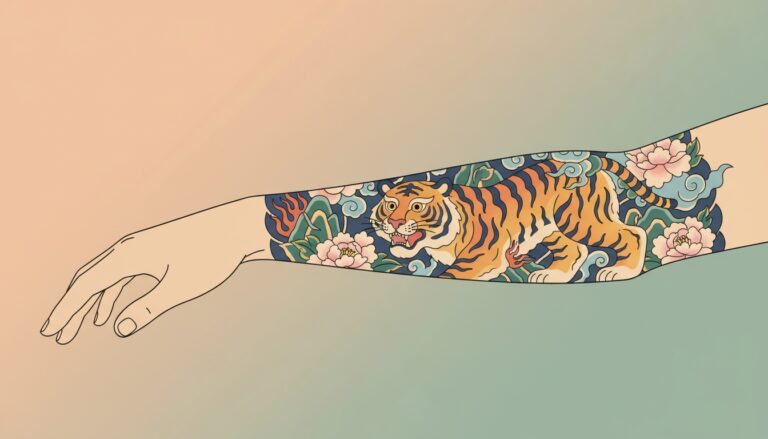
Today, we’re diving into a fascinating and sophisticated topic: body modification as art. Have you ever wondered how to express complex opinions on aesthetics in Korean? This post will equip you with the advanced vocabulary to discuss whether tattoos and piercings are a form of artistic expression. Lately in Korea, as more celebrities and idols proudly display their tattoos, the conversation around this topic has become more public than ever. Let’s learn how to join that debate!
Core Expressions for the Debate
Here are some key phrases to help you articulate your views like a pro.
1. -을/를 둘러싼 논란 (eul/reul dulleossan nonlan)
* Pronunciation [Romanization]: [eul/reul dool-luh-ssan non-lan]
* English Meaning: The controversy surrounding…
* Detailed Explanation: This is a formal and very useful phrase for introducing a topic of debate. ‘둘러싸다’ means ‘to surround,’ so the expression literally means ‘the controversy that surrounds X.’ It’s perfect for essays, presentations, or formal discussions about contentious issues.
* 💡 Pronunciation Tip: The final ‘ㄴ’ (n) sound in ‘논란’ [nonlan] is a clear ‘n’ sound. Make sure your tongue touches the roof of your mouth just behind your teeth for an accurate Korean ‘ㄴ’.
2. 예술의 한 형태로 간주되다 (yesur-ui han hyeongtae-ro ganjudoeda)
* Pronunciation [Romanization]: [ye-soo-rui han hyuhng-tae-ro gan-joo-doe-da]
* English Meaning: To be considered a form of art
* Detailed Explanation: ‘간주되다’ is a passive verb meaning ‘to be regarded as’ or ‘to be considered.’ It’s a high-level word that adds a layer of formality and objectivity to your statement, making it more powerful than simply saying ‘…라고 생각하다’ (I think that…).
* 💡 Pronunciation Tip: The particle ‘의’ (ui) is versatile. When used to show possession like here, it’s often pronounced as [에/e]. So, ‘예술의’ sounds very close to [예수레/yesure] in natural, flowing speech.
3. 미적 가치 (mijeok gachi)
* Pronunciation [Romanization]: [mi-jjuhk ga-chi]
* English Meaning: Aesthetic value
* Detailed Explanation: This is a core concept in any discussion about art. ‘미적’ (mijeok) means ‘aesthetic,’ derived from the Hanja character ‘美’ (beauty). ‘가치’ (gachi) means ‘value.’ You can use this to discuss whether something is beautiful or artistically significant.
* 💡 Pronunciation Tip: The ‘ㅈ’ in ‘미적’ [mijeok] becomes a tense, unaspirated [jj] sound because it follows a ‘ㄱ’ consonant. This is a consonant fortis rule called ‘경음화’ (gyeong-eum-hwa). It’s a subtle but important detail for sounding natural.
4. 자기표현의 수단 (jagipyo-hyeon-ui sudan)
* Pronunciation [Romanization]: [ja-gi-pyo-hyuh-nui soo-dan]
* English Meaning: A means of self-expression
* Detailed Explanation: This phrase is essential for arguing for body modification as art. It breaks down into ‘자기’ (self), ‘표현’ (expression), and ‘수단’ (means/method). It frames the act not just as a decoration, but as a deep-seated part of a person’s identity.
* 💡 Pronunciation Tip: In ‘표현’ [pyohyeon], the ‘ㅎ’ (h) sound is very soft, almost like a breath of air. Avoid a hard ‘h’ sound as you would in English.
Example Dialogue
Let’s see how these expressions work in a real conversation about a K-pop idol’s new tattoo.
A: 요즘 아이돌 그룹 ‘NEX’ 멤버 정우의 타투 봤어? 신체 변형을 둘러싼 논란이 다시 뜨거워지는 것 같아.
(Have you seen the new tattoo on Jungwoo from the idol group ‘NEX’? The controversy surrounding body modification seems to be heating up again.)
B: 응, 봤어. 나는 그걸 예술의 한 형태로 간주해야 한다고 생각해. 단순한 그림이 아니라 미적 가치가 충분하잖아.
(Yeah, I saw it. I think it should be considered a form of art. It’s not just a simple drawing; it has plenty of aesthetic value.)
A: 일리 있는 말이야. 개인에게는 중요한 자기표현의 수단이 될 수도 있겠네.
(That makes sense. It could be an important means of self-expression for the individual.)
B: 맞아. 사회적 편견 때문에 그 가치가 폄하되어서는 안 된다고 봐.
(Exactly. I don’t think its value should be disparaged because of social prejudice.)
Culture Tip & Trend Deep Dive
In Korea, tattoos have a complex history. For a long time, they were strongly associated with gangsters (조폭), creating a negative social stigma. This is why you’ll still see tattoos blurred out on many Korean television shows due to broadcasting regulations (방송 심의 규정).
However, the perception among the younger MZ Generation is drastically different. For them, tattoos are a form of fashion and identity, heavily influenced by artists, athletes, and idols who wear their ink with pride. This clash between the old stigma and the new wave of acceptance is what makes the ‘신체 변형을 둘러싼 논란’ (controversy surrounding body modification) so relevant in Korea today!
Let’s Practice!
Ready to test your knowledge? Try to make a short sentence answering the question below using one of the phrases we learned today.
Question: 당신은 문신을 어떻게 생각하나요? (What do you think about tattoos?)
Example Answer: 저는 문신이 중요한 자기표현의 수단이라고 생각해요. (I think tattoos are an important means of self-expression.)
Share your opinion in the comments below! We’d love to hear your thoughts on this interesting topic.







