

Hello! This is Maeil Hangeul, here to upgrade your Korean skills!
Have you ever been with Korean friends or family, everyone is hungry, but no one can decide what to eat? It’s a classic moment! Today, we’re going to learn the essential phrases to navigate this delicious dilemma and order food like a local.
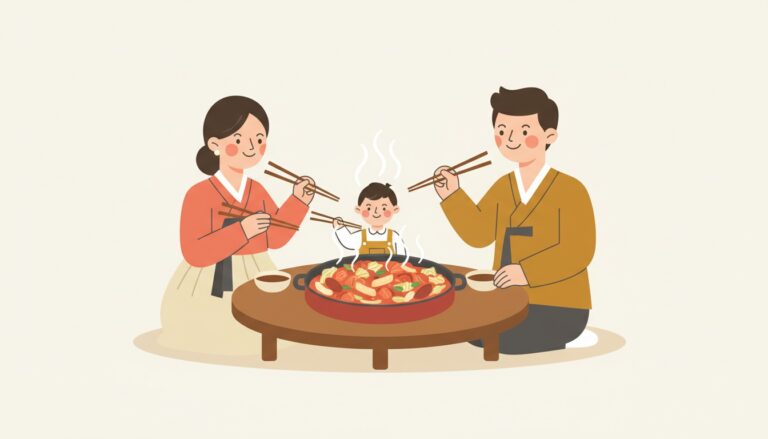
Lately in Korea, sharing big, communal dishes like dakgalbi (spicy stir-fried chicken) or jeongol (hot pot) is super popular for group meals. It’s all about eating and enjoying together! So, let’s learn the phrases you’ll need to jump into the conversation and pick the perfect meal.
Core Expressions
Here are the key phrases you need to know.
1. 뭐 먹을까? (What should we eat?)
- Pronunciation [Romanization]: Mwo meogeulkka?
- English Meaning: What should we eat?
- Detailed Explanation: This is the most natural and common way to start a food discussion with friends and family. The
-을까?ending is a friendly way to make a suggestion or ask for an opinion among people you’re close to. It carries the nuance of ‘I wonder what we should…’. - 💡 Pronunciation Tip: The double consonant
ㄲin까(kka)is a ‘tense’ sound. It’s like the ‘g’ in ‘sky’ but without any puff of air. Make the sound at the back of your throat, short and sharp!
2. 나는 아무거나 괜찮아. (Anything is fine with me.)
- Pronunciation [Romanization]: Naneun amugeona gwaenchana.
- English Meaning: Anything is fine with me.
- Detailed Explanation: This is your go-to phrase when you’re easygoing and happy to eat whatever the group decides.
아무거나 (amugeona)means ‘anything’ or ‘whichever’, and괜찮아 (gwaenchana)means ‘it’s okay/fine’. - 💡 Pronunciation Tip: In
괜찮아, the ‘ㅎ(h)’ sound is very weak and often silent when it’s in a final consonant position followed by a vowel. So, instead of saying ‘gwaen-chan-ha’, it sounds much more natural when you pronounce it as [괜차나/gwaenchana].
3. 이거 맵나요? (Is this spicy?)
- Pronunciation [Romanization]: Igeo maemnayo?
- English Meaning: Is this spicy?
- Detailed Explanation: An absolutely essential question for anyone exploring Korean food!
이거 (igeo)means ‘this’, and맵다 (maepda)is the verb ‘to be spicy’. The-나요?ending is a soft and polite way to ask a question, perfect for asking a server at a restaurant. - 💡 Pronunciation Tip: This one has a cool sound change called nasalization. The final consonant
ㅂ(b/p)in맵(maep)comes before the consonantㄴ(n)in나요(nayo). When this happens, theㅂ(p)sound changes to anㅁ(m)sound to make it easier to say. So,맵나요(maep-na-yo)is pronounced [맴나요/maemnayo].
4. 이거 주세요. (Please give me this.)
- Pronunciation [Romanization]: Igeo juseyo.
- English Meaning: Please give me this / I’ll have this.
- Detailed Explanation: This is the simplest way to order. You can point at a menu item and say
이거 주세요 (Igeo juseyo).주세요 (juseyo)is the polite form of ‘give me’, and it’s used everywhere from restaurants to shops. - 💡 Pronunciation Tip: The
ㅅ(s)in주세요(juseyo)is pronounced like a soft ‘sh’ sound when it’s followed by the vowel ‘ㅣ(i)’, ‘ㅑ(ya)’, ‘ㅕ(yeo)’, ‘ㅛ(yo)’, or ‘ㅠ(yu)’. Here, it’s followed byㅔ(e), so it’s a standard ‘s’ sound. But in a word like쇼핑 (syoping), it’s ‘sh’. Good to remember!
Example Dialogue
Let’s see how these phrases work in a real conversation between two friends, Minjun (A) and Sora (B).
- A (Minjun): 아, 배고프다. 우리 저녁 뭐 먹을까?
- A, baegopeuda. Uri jeonyeok mwo meogeulkka?
- Ah, I’m hungry. What should we eat for dinner?
- B (Sora): 흠… 나는 아무거나 괜찮아. 너 먹고 싶은 거 있어?
- Heum… Naneun amugeona gwaenchana. Neo meokgo sipeun geo isseo?
- Hmm… Anything is fine with me. Is there something you want to eat?
- A (Minjun): 저기 새로 생긴 닭갈비 식당 가볼까? (Pointing to a restaurant)
- Jeogi saero saenggin dakgalbi sikdang gabolkka?
- Should we try that new Dakgalbi restaurant over there?
- B (Sora): 좋아! 근데 이거 맵나요? 저 매운 거 잘 못 먹어요.
- Joa! Geunde igeo maemnayo? Jeo maeun geo jal mot meogeoyo.
- Sounds good! But is it spicy? I can’t handle spicy food well.
- A (Minjun): 괜찮아. ‘덜 맵게’ 해달라고 하면 돼. 저기요! 닭갈비 2인분 주세요!
- Gwaenchana. ‘Deol maepge’ haedallago hamyeon dwae. Jeogiyo! Dakgalbi i-inbun juseyo!
- It’s okay. We can just ask them to make it ‘less spicy’. Excuse me! We’ll have Dakgalbi for two, please!
Culture Tip & Trend Deep Dive
In Korea, a meal is often more about ‘we’ than ‘me’. The culture of sharing a single large dish from the middle of the table, like the dakgalbi in our dialogue, is very common. This act of eating from the same pot or grill is a way of building community and strengthening relationships. So, when someone asks ‘뭐 먹을까?’ (What should we eat?), they are inviting you into a shared experience, not just asking for your personal preference. Embracing this communal dining style is a great way to feel more connected to Korean culture!
Let’s Practice!
Time to check what you’ve learned!
- Fill in the Blank: You are at a restaurant and want to order Bulgogi. You point to it on the menu and say:
- 불고기 _________! (Bulgogi _______!)
- Your Turn: Your friend asks you, “뭐 먹을까?” but you don’t have a preference. What do you say?
Great job today! Try using these phrases the next time you eat Korean food. Don’t forget to leave a comment below telling us your favorite Korean dish to share with family or friends!
Frequently Asked Questions (FAQ)
Q: What does "'뭐 먹을까?'" mean in Korean and how do you pronounce it?
A: In Korean, "'뭐 먹을까?'" is pronounced [What should we eat?] and means: , they are inviting you into a shared experience, not just asking for your personal preference. Embracing this communal dining style is a great way to feel more connected to Korean culture!







