

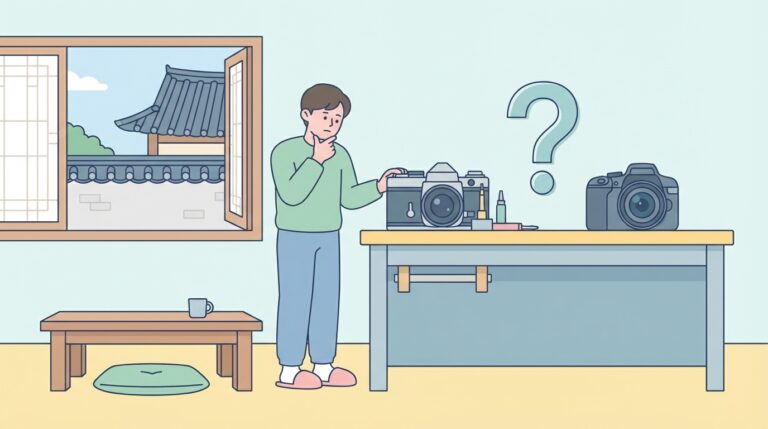
Repair or Replace? Korean Phrases for Smart Decisions!
Hello! This is Maeil Hangul, here to upgrade your Korean skills!
Have you ever had your favorite item break? You face a tough choice: should you repair it or just buy a new one? It’s a common dilemma! In Korea, with the recent trend of sustainability and retro aesthetics, many people are choosing to fix their old treasures. Today, let’s learn some essential Korean phrases to help you navigate this very situation. You’ll be able to ask for advice and state your decision like a pro!
Core Expressions You Need to Know
Here are the key phrases for today’s mission!
1. 수리하다 (surihada)
- Pronunciation [Romanized]: [su-ri-ha-da]
- English Meaning: to repair; to fix
- Detailed Description: This is the most common verb for fixing anything, from a broken phone to a leaky faucet. It’s a neutral word that can be used in both formal and informal situations.
- 💡 Pronunciation Tip: The pronunciation is quite straightforward. Just pronounce each syllable clearly: 수(su) – 리(ri) – 하(ha) – 다(da). Easy, right?
2. 새로 사다 (saero sada)
- Pronunciation [Romanized]: [sae-ro sa-da]
- English Meaning: to buy a new one
- Detailed Description: This phrase combines ‘새로’ (saero), which means ‘newly’ or ‘anew’, and ‘사다’ (sada), which means ‘to buy’. It’s the perfect phrase for when you decide repairing isn’t worth it.
- 💡 Pronunciation Tip: Be careful not to mix up ‘새로’ (saero) with ‘서로’ (seoro), which means ‘each other’. The first vowel is key: ㅐ (ae) in ‘새로’ is a brighter ‘eh’ sound, like in ‘apple’.
3. ~는 게 낫다 (~neun ge natda)
- Pronunciation [Romanized]: [~neun ge nat-da]
- English Meaning: It’s better to…
- Detailed Description: This is a crucial grammar pattern for expressing an opinion or giving advice. You attach it to a verb stem to suggest that one action is better than another. For example, ‘수리하는 게 낫다’ (surihaneun ge natda) means ‘It’s better to repair it.’
- 💡 Pronunciation Tip: The final consonant ‘ㅅ’ in ‘낫다’ is pronounced as a [t] sound when it’s at the end of a word or before another consonant. So, it sounds like [nat-da], not [nas-da]. This is a common rule for many final consonants in Korean!
4. 어떡하죠? (eotteokajyo?)
- Pronunciation [Romanized]: [eo-tteo-ka-jyo?]
- English Meaning: What should I do?
- Detailed Description: This is a fantastic phrase for asking for advice. It’s a contraction of ‘어떻게 하죠?’ (eotteoke hajyo?). It carries a nuance of being slightly worried or unsure, making it perfect for this kind of situation.
- 💡 Pronunciation Tip: This is a great example of Korean sound changes! The ‘ㅎ(h)’ sound at the end of ‘어떡’ (eotteok) merges with the ‘ㅈ(j)’ sound in ‘하죠’ (hajyo) to create a stronger ‘ㅊ(ch)’ sound. That’s why it’s pronounced [어떠카죠 / eo-tteo-ka-jyo], not [eotteok-hajyo]. Sounding more natural is all about these little changes!
Example Dialogue
Let’s see how these phrases work in a real conversation. Imagine two friends, A and B, talking about a broken vintage film camera.
- A: 내 필름 카메라가 고장났어. 어떡하죠?
- (Nae pilleum kameraga gojangnasseo. Eotteokajyo?)
- My film camera is broken. What should I do?
- B: 흠… 수리비가 비쌀 수도 있어. 그냥 새로 사는 게 나을 것 같아.
- (Heum… suribiga bissal sudo isseo. Geunyang saero saneun ge naeul geot gata.)
- Hmm… the repair cost might be expensive. I think it’s better to just buy a new one.
- A: 정말? 그래도 이 카메라가 정말 마음에 들어서… 일단 수리하러 가볼게.
- (Jeongmal? Geuraedo i kameraga jeongmal maeume deureoseo… Ildan surihareo gabolge.)
- Really? But I really love this camera… I’ll go to get it repaired first.
Culture Tip & Trend Deep Dive
In Korea, especially among the MZ generation (Millennials + Gen Z), there’s a growing ‘upcycling’ (업사이클링) and retro trend. Instead of throwing away old items, many people enjoy repairing and customizing them to give them new life. You can see this in popular areas like Seoul’s Hwanghak-dong Flea Market (황학동 벼룩시장), where people hunt for vintage electronics and furniture to repair.
So, when you use a phrase like “수리하는 게 낫다” (It’s better to repair), you’re not just speaking correct Korean, you’re also tapping into a cool, modern cultural trend! Mentioning that you enjoy fixing old things could be a great conversation starter with your Korean friends.
Let’s Practice!
Time to check your understanding! Fill in the blank with the most suitable phrase we learned today.
- Question: My laptop is very old and slow. I think it’s better to buy a new one than to fix it.
- 내 노트북이 너무 오래되고 느려요. 고치는 것보다 ______ 것 같아요.
- (Nae noteubugi neomu oraedoego neuryeoyo. Gochineun geotboda ______ geot gatayo.)
- (Answer: 새로 사는 게 나을 / saero saneun ge naeul)
Great job today! You’re now ready to make wise decisions in Korean. Try making your own sentence using one of today’s expressions in the comments below!
Frequently Asked Questions (FAQ)
Q: What does "수리하다 (surihada)" mean in Korean and how do you pronounce it?
A: In Korean, "수리하다 (surihada)" is pronounced [Romanized] and means: to repair; to fix
Q: What does "새로 사다 (saero sada)" mean in Korean and how do you pronounce it?
A: In Korean, "새로 사다 (saero sada)" is pronounced [Romanized] and means: to buy a new one
Q: What does "~는 게 낫다 (~neun ge natda)" mean in Korean and how do you pronounce it?
A: In Korean, "~는 게 낫다 (~neun ge natda)" is pronounced [Romanized] and means: It's better to...
Q: What does "어떡하죠? (eotteokajyo?)" mean in Korean and how do you pronounce it?
A: In Korean, "어떡하죠? (eotteokajyo?)" is pronounced [Romanized] and means: What should I do?







