

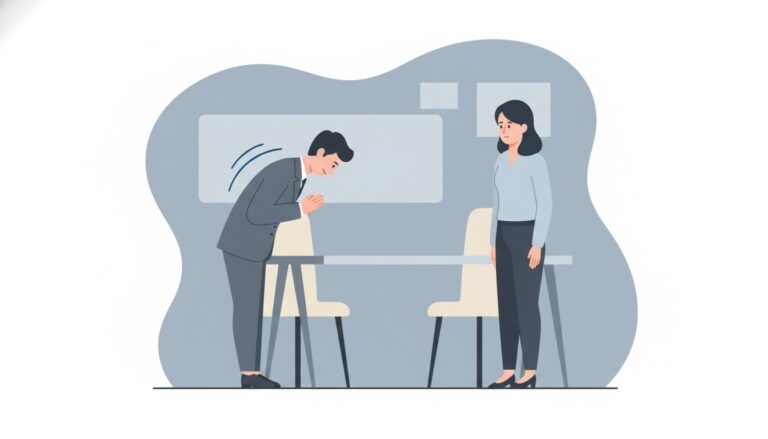
Oops! How to Apologize & Impress in Korean Workplaces
Hello! This is Maeil Hangul, here to upgrade your Korean skills!
Have you ever made a mistake at work or in a formal setting and worried about how to apologize properly in Korean? Just saying ‘미안해요’ (mianhaeyo) might not be enough. Today, we’re going to learn how to apologize sincerely, take responsibility, and explain what you’ll do differently—a crucial skill for building trust.
Lately, in many Korean workplace vlogs and dramas, you see this exact situation! A character makes a mistake, but the way they handle it with a sincere apology and a concrete plan for improvement often becomes a turning point that earns them respect. Let’s learn how you can do that too!
Key Expressions for a Sincere Apology
Here are some essential phrases that will make your apology sound professional and heartfelt.
1. 제 불찰입니다 (Je bulchalimnida)
- Pronunciation [Romanization]: [Je bulchalimnida]
- English Meaning: It is my fault / my oversight / my negligence.
- Detailed Explanation: This is a formal and professional way to take full responsibility for a mistake. It shows that you are not making excuses. ‘불찰’ (bulchal) means ‘carelessness’ or ‘oversight.’ Using this phrase immediately shows maturity and sincerity, especially in a business context.
- 💡 Pronunciation Tip: The final syllable ‘입니다’ is written as ‘-imnida’ but often sounds more like [imnida]. This is due to a pronunciation rule called nasalization, where the ‘ㅂ’ (b) sound changes to an ‘ㅁ’ (m) sound when it comes before ‘ㄴ’ (n). So, instead of ‘ip-ni-da’, it flows smoothly as ‘im-ni-da’.
2. 앞으로는 ~도록 하겠습니다 (Ap-euroneun ~dorok hagesseumnida)
- Pronunciation [Romanization]: [Apeuroneun ~dorok hagetseumnida]
- English Meaning: From now on, I will make sure to…
- Detailed Explanation: An apology is incomplete without a promise for the future. This pattern is the perfect way to state your plan for improvement. You attach it to a verb stem. For example, ‘확인하다’ (to check) becomes ‘확인하도록 하겠습니다’ (I will make sure to check).
- 💡 Pronunciation Tip: In ‘하겠습니다’ [hagetseumnida], the ‘겠’ (get) is followed by ‘습’ (seup). The ‘ㅅ’ (s) sound in ‘겠’ is often dropped, making it sound more like [hagesseumnida]. This is a common simplification in Korean pronunciation that makes the flow smoother.
3. 같은 실수를 반복하지 않겠습니다 (Gateun silsureul banbokhaji anketseumnida)
- Pronunciation [Romanization]: [Gateun silsureul banbokaji anketseumnida]
- English Meaning: I will not repeat the same mistake.
- Detailed Explanation: This is a direct and powerful statement that reinforces your commitment to change. It’s a classic phrase used in formal apologies that shows you have learned from the error. ‘반복하다’ (banbokhada) means ‘to repeat’.
- 💡 Pronunciation Tip: Notice the word ‘같이’ (gachi – together), which has a similar rule. In ‘같은’ [gateun], the ‘ㅌ’ (t) sound is pronounced clearly because it’s followed by a vowel in the next syllable within the same word. However, in ‘않겠습니다’ [anketsseumnida], the ‘ㅎ’ (h) in ‘않’ and the ‘ㄱ’ (g) in ‘겠’ combine to create a stronger, aspirated ‘ㅋ’ (k) sound. So it sounds like [안켇습니다 | anketseumnida]. It’s a subtle but important detail!
Example Dialogue
Let’s see these expressions in action. Imagine an office worker, Min-jun, apologizing to his manager, Su-jin.
- A (수진 – Su-jin): 민준 씨, 보고서에 있는 데이터가 지난 분기 자료와 같아요. 확인했어요? (Min-jun, the data in this report is the same as last quarter’s. Did you check it?)
- B (민준 – Min-jun): 아, 정말 죄송합니다. 제 불찰입니다. 제가 파일을 잘못 첨부한 것 같습니다. (Oh, I am truly sorry. It was my oversight. I think I attached the wrong file.)
- A (수진 – Su-jin): 알겠어요. 다음부터는 제출 전에 꼭 다시 확인해 주세요. (I see. Please make sure to double-check before submitting next time.)
- B (민준 – Min-jun): 네, 부장님. 앞으로는 최종 버전을 세 번씩 확인하도록 하겠습니다. 같은 실수를 반복하지 않겠습니다. (Yes, Manager. From now on, I will make sure to check the final version three times. I will not repeat the same mistake.)
Culture Tip: The Art of a Sincere Apology
In Korean culture, especially in the workplace, a good apology is not just about words; it’s about attitude. The key is showing 진심 (jinsim) – sincerity. A proper apology involves three steps:
- Acknowledge the Mistake Immediately: Use phrases like ‘제 불찰입니다’ to take ownership.
- Explain the Impact (Briefly): Show that you understand the consequences of your error.
- Provide a Solution & Prevention Plan: This is where ‘~도록 하겠습니다’ comes in. It proves you are proactive and reliable.
Handling a mistake gracefully can sometimes build more trust than not making a mistake at all! It shows your character and your commitment to your work.
Let’s Practice!
Now it’s your turn to try! How would you complete the following sentences?
- I’m sorry for being late. It was my fault.
늦어서 죄송합니다. 전부 ____ _________. -
You forgot to send an important email. How would you promise to be more careful in the future?
앞으로는 이메일을 보내기 전에 다시 확인___ __________.
Great job today! Don’t be afraid of making mistakes—they are a part of learning. Now you have the tools to handle them perfectly.
Try using one of today’s expressions to make a sentence in the comments below!
Frequently Asked Questions (FAQ)
Q: What does "제 불찰입니다 (Je bulchalimnida)" mean in Korean and how do you pronounce it?
A: In Korean, "제 불찰입니다 (Je bulchalimnida)" is pronounced [Romanization] and means: It is my fault / my oversight / my negligence.
Q: What does "앞으로는 ~도록 하겠습니다 (Ap-euroneun ~dorok hagesseumnida)" mean in Korean and how do you pronounce it?
A: In Korean, "앞으로는 ~도록 하겠습니다 (Ap-euroneun ~dorok hagesseumnida)" is pronounced [Romanization] and means: From now on, I will make sure to...
Q: What does "같은 실수를 반복하지 않겠습니다 (Gateun silsureul banbokhaji anketseumnida)" mean in Korean and how do you pronounce it?
A: In Korean, "같은 실수를 반복하지 않겠습니다 (Gateun silsureul banbokhaji anketseumnida)" is pronounced [Romanization] and means: I will not repeat the same mistake.







