

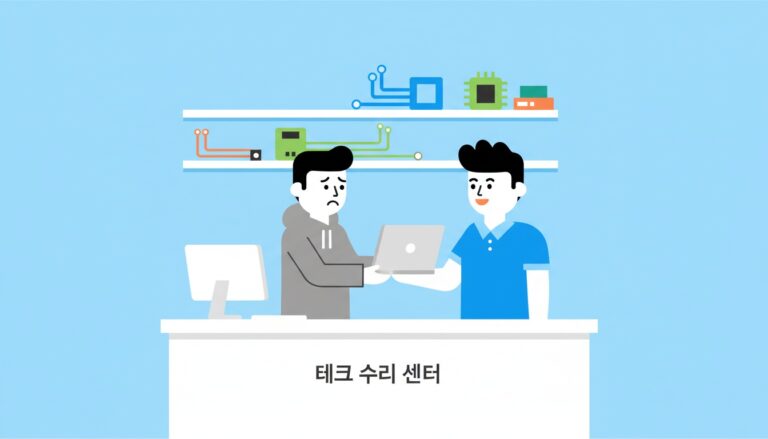
Tech Trouble in Seoul? How to Say “My Laptop Won’t Turn On” in Korean
Hello! Welcome to [Maeil Hangul], your daily boost for Korean skills!
Imagine this: you’re about to stream the finale of your favorite K-drama, or join an online fan meeting for a K-pop group, but your laptop suddenly goes black. Panic! Don’t worry, we’ve all been there. Today, we’ll learn essential Korean phrases to explain this exact problem at a repair shop. Especially these days in Korea, where a laptop is your gateway to everything from work to entertainment, knowing these phrases is a true lifesaver!
Key Expressions for Your Tech Emergency
Let’s dive into the phrases that will get you the help you need.
1. 전원이 안 켜져요.
* Pronunciation [Romanization]: Jeonwoni an kyeojyeoyo.
* English Meaning: The power won’t turn on.
* Detailed Explanation: This is the most direct and common way to describe the problem. ‘전원’ (jeonwon) means ‘power source,’ and ‘안 켜져요’ (an kyeojyeoyo) means ‘it doesn’t get turned on.’ It’s a polite and clear phrase perfect for any repair center.
* 💡 Pronunciation Tip: Notice how ‘전원이’ is pronounced [jeonwoni], not ‘jeonwon-i’. When a syllable ending in a consonant is followed by a syllable starting with ‘ㅇ’, the consonant sound ‘moves’ over to the next syllable. This is called ‘연음’ (yeoneum) or ‘linking,’ and it makes your Korean sound much more natural!
2. 화면이 안 나와요.
* Pronunciation [Romanization]: Hwamyeoni an nawayo.
* English Meaning: The screen isn’t coming on.
* Detailed Explanation: This is useful when you can hear the fan or see a power light, but the screen remains black. ‘화면’ (hwamyeon) means ‘screen,’ and ‘안 나와요’ (an nawayo) literally means ‘it doesn’t come out/appear.’
* 💡 Pronunciation Tip: Just like our first example, the ‘ㄴ’ (n) sound in ‘화면’ links to the next syllable, making ‘화면이’ sound like [hwamyeoni].
3. 갑자기 꺼졌어요.
* Pronunciation [Romanization]: Gapjagi kkeojyeosseoyo.
* English Meaning: It suddenly turned off.
* Detailed Explanation: Use this to explain that the laptop was working and then stopped unexpectedly. ‘갑자기’ (gapjagi) means ‘suddenly,’ and ‘꺼졌어요’ (kkeojyeosseoyo) is the past tense of ‘to be turned off.’
* 💡 Pronunciation Tip: The ‘ㄲ’ (kk) and ‘ㅆ’ (ss) are ‘tense consonants.’ You pronounce them with more force and a higher pitch than their regular counterparts, ‘ㄱ’ (g/k) and ‘ㅅ’ (s). Make a short, sharp sound with no puff of air. Think of the ‘sk’ in ‘sky’ for ‘ㄲ’!
4. 수리 맡기고 싶어요.
* Pronunciation [Romanization]: Suri matgigo sipeoyo.
* English Meaning: I’d like to leave it for repair.
* Detailed Explanation: This is your goal! ‘수리’ (suri) means ‘repair,’ ‘맡기다’ (matgida) means ‘to entrust’ or ‘to leave something with someone,’ and the grammar pattern ‘-고 싶어요’ (-go sipeoyo) means ‘I want to…’.
* 💡 Pronunciation Tip: The ‘ㄱ’ in ‘맡기고’ is pronounced as a soft [g] because it’s between two voiced sounds. It’s not a hard ‘k’ sound. Practice saying [matgigo] smoothly.
Example Dialogue at a Service Center
Let’s see how these phrases work in a real conversation.
- A (Technician): 어서 오세요. 무엇을 도와드릴까요? (Eoseo oseyo. Mueoseul dowadeurilkkayo? / Welcome. How may I help you?)
- B (You): 안녕하세요. 노트북 때문에 왔는데요, 어제 드라마를 보다가 갑자기 꺼졌어요. 그 후로 전원이 안 켜져요. (Annyeonghaseyo. Noteubuk ttaemune wanneundeyo, eoje deuramareul bodaga gapjagi kkeojyeosseoyo. Geu huro jeonwoni an kyeojyeoyo. / Hello. I’m here about my laptop. It suddenly turned off while I was watching a drama yesterday. Since then, the power won’t turn on.)
- A (Technician): 아, 그러시군요. 제가 한번 확인해 보겠습니다. (A, geureosigunyo. Jega hanbeon hwaginhae bogetseumnida. / Oh, I see. I will check it for you.)
- B (You): 네, 감사합니다. 수리 맡기고 싶어요. (Ne, gamsahamnida. Suri matgigo sipeoyo. / Yes, thank you. I’d like to leave it for repair.)
Culture Tip: The Speed of Korean Repairs!
Korea is famous for its ‘빨리빨리’ (ppalli-ppalli) or ‘hurry, hurry’ culture. This can be a huge advantage when it comes to tech repairs! Major companies like Samsung and LG have large, efficient service centers where you can often get same-day service for minor issues. For Z-Gens in Korea, whose lives revolve around their digital devices for everything from university lectures to social media, this speedy service isn’t just a convenience—it’s essential!
Let’s Practice!
Time to check your understanding! How would you complete the following sentence?
- Your laptop power light is on, but the screen is black. You should tell the technician: “_______이/가 안 나와요.” (The ______ won’t come on.)
Great job today! You’re now ready to handle a tech crisis like a pro in Korea. Try leaving a comment below using one of the phrases you learned today!
Frequently Asked Questions (FAQ)
Q: What does "'전원'" mean in Korean and how do you pronounce it?
A: In Korean, "'전원'" is pronounced [jeonwon] and means: means 'power source,' and
Q: What does "'안 켜져요'" mean in Korean and how do you pronounce it?
A: In Korean, "'안 켜져요'" is pronounced [an kyeojyeoyo] and means: means 'it doesn't get turned on.' It's a polite and clear phrase perfect for any repair center.
Q: What does "'연음'" mean in Korean and how do you pronounce it?
A: In Korean, "'연음'" is pronounced [yeoneum] and means: or 'linking,' and it makes your Korean sound much more natural!
Q: What does "'화면'" mean in Korean and how do you pronounce it?
A: In Korean, "'화면'" is pronounced [hwamyeon] and means: means 'screen,' and







