

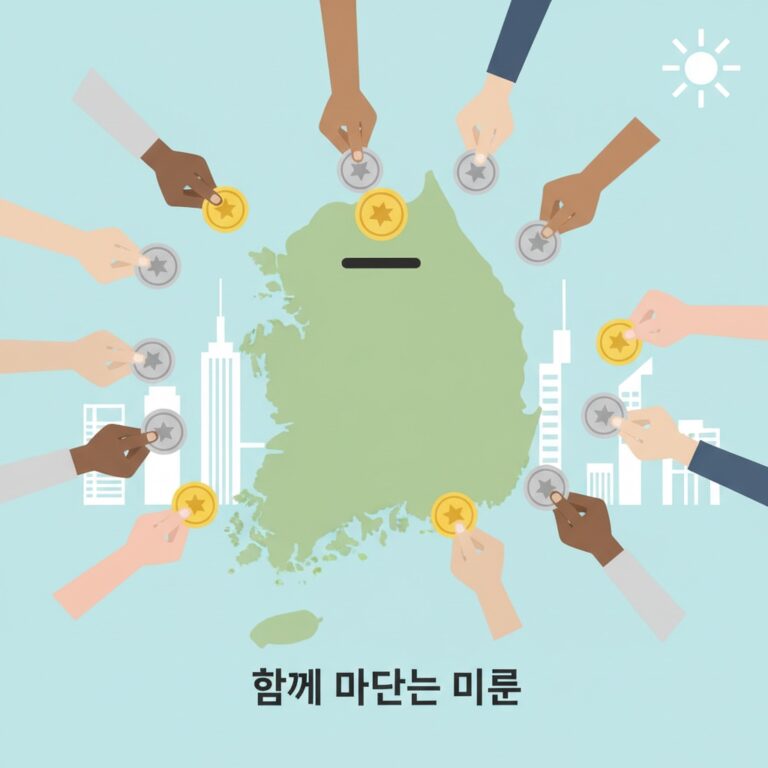
Powering Change: The Language of Korean Crowdfunding
Hello! Welcome back to [Maeil Hangeul], your go-to source for upgrading your Korean skills to the next level!
Today, we’re diving into a topic that’s at the very heart of modern Korean society: social movements and civic engagement. Specifically, we’ll explore the crucial language surrounding how these movements are funded. Ever wondered how grassroots campaigns in Korea gather support or what vocabulary is used to discuss financial transparency in non-profits? You’re in the right place!
Lately in Korea, from environmental protection initiatives to campaigns supporting public interest whistleblowers, citizen-led crowdfunding has become a powerful tool for social change. Understanding this vocabulary will not only deepen your comprehension of Korean news and social media but also empower you to participate in these important conversations. Let’s get started!
Core Expressions You Need to Know
Here are some essential terms that will help you sound like a well-informed native speaker when discussing social finance.
1. 십시일반 (十匙一飯)
- Pronunciation [Romanization]: Sipsiilban
- English Meaning: Many a little makes a mickle; pooling small contributions to make a big difference. (Literally: “Ten spoons make one bowl of rice.”)
- Detailed Explanation: This beautiful four-character idiom (사자성어), derived from Hanja, perfectly encapsulates the spirit of crowdfunding. It paints a picture of ten people each contributing one spoonful of rice to fill a bowl for someone in need. It’s used to emphasize the power of collective action, where even small, individual donations combine to create a significant impact. You’ll often hear this in campaign slogans or news reports to encourage public participation.
- 💡 Pronunciation Tip: The pronunciation is quite straightforward, but focus on the rhythm. It’s pronounced as four distinct blocks: Sip-si-il-ban. The final
ㅂin십is an unreleased stop, so your lips close but don’t release a strong ‘p’ sound before you move to시.
2. 공익 제보 (公益提報)
- Pronunciation [Romanization]: Gong-ik jebo
- English Meaning: Whistleblowing (for the public interest).
- Detailed Explanation: This is a critical term in conversations about social justice and corporate/governmental transparency. Let’s break down the Hanja: 공익 (公益) means “public interest,” and 제보 (提報) means “report” or “information.” A person who does this is a 공익 제보자 (gong-ik jeboja). Many crowdfunding campaigns are launched to provide legal and financial support for these whistleblowers, who often risk their careers to expose wrongdoing.
- 💡 Pronunciation Tip: The
ㅇat the end of공 (gong)is a velar nasal, just like the ‘ng’ in the English word “singing.” Make sure not to pronounce it like an ‘n’ or ‘m’. The rest of the phrase,익 제보 (ik jebo), is pronounced as written.
3. 후원금 정산 내역 (後援金精算內譯)
- Pronunciation [Romanization]: Huwon-geum jeongsan naeyeok
- English Meaning: Donation settlement details; a statement of accounts for donations.
- Detailed Explanation: Accountability is everything when handling public money. This phrase refers to the detailed financial report that shows exactly how donated funds (후원금) were spent. 정산 means “settlement of accounts,” and 내역 means “a detailed breakdown.” Any reputable campaign or non-profit in Korea is expected to release its
후원금 정산 내역to maintain public trust. - 💡 Pronunciation Tip: This phrase can be a mouthful! Break it down: Hu-won-geum / Jeong-san / Nae-yeok. Pay attention to the
ㄴ받침 (final consonant) in원and산, which should be clearly articulated. The역at the end is pronounced with a ‘k’ sound, likeyeok.
4. 투명하게 집행되다
- Pronunciation [Romanization]: Tumyeonghage jiphaengdoeda
- English Meaning: To be executed/managed transparently.
- Detailed Explanation: This is a verb phrase you’ll see constantly in relation to donations. 투명하게 is the adverbial form of
투명하다(to be transparent). 집행되다 is the passive form of집행하다(to execute or carry out). Together, they form the gold standard for handling funds: “The funds were managed transparently” (후원금이 투명하게 집행되었다). - 💡 Pronunciation Tip: Here’s a key Korean pronunciation rule! When a syllable ending in
ㅂ(like집) is followed by a syllable starting withㅎ(like행), they combine to create aㅍ(p) sound. This is called aspiration (거센소리되기). So,집행is not pronouncedjip-haeng, but rather [지팽 / jipaeng]. This small change will make you sound much more natural!
Example Dialogue
Let’s see how these expressions work in a real conversation between two friends, Minjun (A) and Sora (B).
A: 소라야, ‘푸른 한강 지키기’ 크라우드펀딩 결과 봤어? 목표 금액을 200%나 초과 달성했대!
Sora, did you see the results for the ‘Protect the Blue Han River’ crowdfunding campaign? They exceeded their goal by 200%!
B: 와, 정말? 역시 십시일반의 힘이 대단하네. 나도 소액이지만 참여하길 잘했다.
Wow, really? The power of sipsiilban is amazing. I’m glad I participated, even with a small amount.
A: 응, 그리고 웹사이트에 올라온 후원금 정산 내역도 아주 상세하더라. 모든 돈이 투명하게 집행될 거라는 믿음이 가.
Yeah, and the donation settlement details on their website are incredibly thorough. It gives me confidence that all the money will be managed transparently.
B: 맞아. 특히 일부 자금이 강에 폐수를 무단 방류한 기업을 고발한 공익 제보자를 지원하는 데 쓰인다니 더 의미 있는 것 같아.
Right. It feels even more meaningful that part of the funds will be used to support the whistleblower who exposed the company illegally dumping wastewater into the river.
Culture Tip & Trend Deep Dive
In Korea, online civic participation is incredibly dynamic. Crowdfunding platforms like Tumblbug (텀블벅) and Wadiz (와디즈) are not just for launching new gadgets; they are major hubs for funding independent films, social documentaries, and community-led campaigns.
The expectation for transparency is paramount. The public is highly critical of any perceived mismanagement of funds. A scandal involving opaque accounting can destroy a non-profit’s reputation overnight. This is why organizations go to great lengths to publish detailed 후원금 정산 내역 and constantly emphasize that all processes are 투명하게 집행되고 있다. Understanding this cultural context gives these phrases much deeper significance. When you use them, you’re not just using vocabulary; you’re tapping into a core value of modern Korean civic society.
Let’s Practice!
Ready to test your knowledge?
- Fill in the blank: To build trust with donors, a campaign leader must promise that all donations will be (___________________).
(Hint: Managed transparently) -
Scenario: You are trying to convince a friend to donate to a fundraiser for a new community library. How would you use the expression 십시일반 to persuade them that their small contribution matters?
Great job today! You’ve learned some incredibly relevant and advanced vocabulary that connects directly to the heartbeat of contemporary Korea.
Now, try using one of today’s expressions in a sentence in the comments below! We can’t wait to see what you come up with.
Frequently Asked Questions (FAQ)
Q: What does "공익" mean in Korean and how do you pronounce it?
A: In Korean, "공익" is pronounced [公益] and means: means "public interest," and
Q: What does "제보" mean in Korean and how do you pronounce it?
A: In Korean, "제보" is pronounced [提報] and means: means "report" or "information." A person who does this is a
Q: What does "공익 제보자" mean in Korean and how do you pronounce it?
A: In Korean, "공익 제보자" is pronounced [gong-ik jeboja] and means: . Many crowdfunding campaigns are launched to provide legal and financial support for these whistleblowers, who often risk their careers to expose wrongdoing.







