

Hello! Welcome to [Maeil Hangeul], your friendly guide to leveling up your Korean skills!
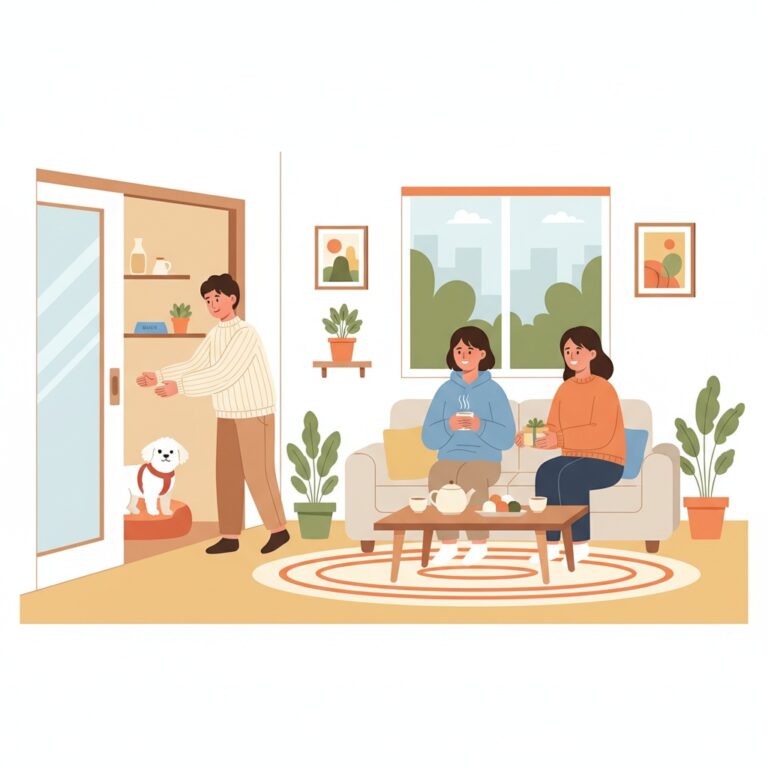
Have you ever invited a friend over, only to remember you have a furry family member they haven’t met? What if your friend is scared of animals? Don’t worry! Today, we’re going to learn some essential Korean phrases to handle this situation with kindness and care.
Lately in Korea, pets are more like family than ever before! From K-pop idols showing off their puppies on Instagram to the rise of “pet-friendly” cafes, companion animals (반려동물) are a huge part of daily life. Knowing these phrases will not only make you a more considerate friend but also help you understand modern Korean culture better. Let’s get started!
Core Expressions You Need to Know
Here are three key phrases to help you be the best pet-owning friend ever!
1. 혹시 강아지 무서워해? (Hoksi gangaji museowohae?)
- Romanization: Hoksi gangaji museowohae?
- English Meaning: By any chance, are you afraid of dogs?
- Detailed Explanation: This is the perfect way to gently ask about someone’s fears. 혹시 (hoksi) is a magic word that means “by any chance” or “perhaps.” Adding it to the beginning of a question makes your sentence much softer and more polite. 강아지 (gangaji) means “dog/puppy,” and 무서워해 (museowohae) means “to be scared of.” You can easily swap ‘강아지’ for ‘고양이’ (goyangi – cat)! This is a casual phrase for friends.
2. 괜찮아, 안 물어. (Gwaenchana, an mureo.)
- Romanization: Gwaenchana, an mureo.
- English Meaning: It’s okay, he/she doesn’t bite.
- Detailed Explanation: This is a classic phrase for reassuring a nervous friend. 괜찮아 (gwaenchana) means “It’s okay” or “I’m okay.” Here, it’s used to calm the other person. 안 물어 (an mureo) is a simple and direct way to say “doesn’t bite.” ‘안’ (an) is a negative prefix, and ‘물어’ (mureo) is the verb “to bite.”
- 💡 Pronunciation Tip:
Listen closely to 괜찮아 [gwaenchana]. The letter ‘ㅎ’ (h) is in the spelling (괜찮아), but you can barely hear it when spoken naturally. When ‘ㅎ’ is between two voiced sounds (like ‘ㄴ’ and ‘ㅏ’), it often becomes very weak or silent. So instead of saying “gwaen-chan-ha,” try to let it flow smoothly like “gwaen-cha-na.” It will make you sound much more like a native speaker!
3. 잠깐 방에 둘게. (Jamkkan bang-e dulge.)
- Romanization: Jamkkan bang-e dulge.
- English Meaning: I’ll put him/her in the room for a bit.
- Detailed Explanation: This phrase shows you are taking action to make your friend comfortable. 잠깐 (jamkkan) means “for a moment,” 방에 (bang-e) means “in the room,” and 둘게 (dulge) is the key grammar here. The -ㄹ/을게 (-l/eulge) ending is used to express the speaker’s intention or promise to do something for the listener. It’s a very considerate and friendly ending!
- 💡 Pronunciation Tip:
This is a super important tip! Even though 둘게 is written as [dulge], it’s actually pronounced [둘께 / dulkke]. When the grammar pattern ‘-ㄹ게’ follows a verb stem, the ‘ㄱ’ (g) sound tenses up and becomes a ‘ㄲ’ (kk) sound. This happens with other verbs too: ‘할게’ (halge → [할께/halkke] – I’ll do it) and ‘갈게’ (galge → [갈께/galkke] – I’ll go). Mastering this will make your Korean sound incredibly natural!
Example Dialogue
Let’s see these phrases in a real conversation! Imagine Minjun invited his friend, Chloe, to his apartment.
- 민준 (Minjun): 어서 와, 클로이! (Eoseo wa, Keulloi!)
- Welcome, Chloe!
- (A small dog runs to the door, barking happily: 멍멍! Meong-meong!)
- 클로이 (Chloe): (Looks surprised) 어머! 강아지 키웠네! (Eomeo! Gangaji kiwonne!)
- Oh! You have a dog!
- 민준 (Minjun): 아, 맞다! 우리 초코야. 혹시 강아지 무서워해? (A, matda! Uri Choco-ya. Hoksi gangaji museowohae?)
- Oh, right! This is Choco. By any chance, are you afraid of dogs?
- 클로이 (Chloe): 사실 조금… 어릴 때 크게 물린 적이 있어서. (Sasil jogeum… eoril ttae keuge mullin jeogi isseoseo.)
- Actually, a little… I was bitten badly when I was young.
- 민준 (Minjun): 정말? 미안, 내가 미리 말을 못 했네. 괜찮아, 안 물어. 그래도 혹시 모르니까, 잠깐 방에 둘게. (Jeongmal? Mian, naega miri mareul mot haenne. Gwaenchana, an mureo. Geuraedo hoksi moreunikka, jamkkan bang-e dulge.)
- Really? Sorry, I didn’t tell you beforehand. It’s okay, he doesn’t bite. But just in case, I’ll put him in the room for a bit.
- 클로이 (Chloe): 아니야, 고마워 민준아! 네 덕분에 편하게 있을 수 있겠다. (Aniya, gomawo Minjun-a! Ne deokbune pyeonhage isseul su itgetda.)
- No, it’s okay! Thanks, Minjun! I can relax now thanks to you.
Culture Tip: Understanding Korea’s “Petiquette” (펫티켓)
Did you notice how Minjun handled that situation? That’s a perfect example of good “펫티켓” (peticate)!
“Petiquette” is a Korean-English portmanteau (펫 Pet + 에티켓 Etiquette) that refers to the social manners required of pet owners. As more and more Koreans, especially the Z-generation, welcome pets into their families (they prefer the term 반려동물 [ballyeodongmul], “companion animal,” over 애완동물 [aewandongmul], “pet for amusement”), being a responsible owner is highly valued.
This includes cleaning up after your pet, using a leash, and being considerate of people who might be afraid or allergic, just like we learned today. So when you use these phrases, you’re not just speaking Korean—you’re participating in modern Korean culture and showing that you’re a thoughtful person!
Let’s Practice!
Great job today! Let’s quickly review.
- Fill in the blank: Your friend looks nervous around your cat. You want to reassure them that your cat doesn’t scratch. You could say:
Frequently Asked Questions (FAQ)
Q: What does "혹시" mean in Korean and how do you pronounce it?
A: In Korean, "혹시" is pronounced [hoksi] and means: is a magic word that means "by any chance" or "perhaps." Adding it to the beginning of a question makes your sentence much softer and more polite.
Q: What does "강아지" mean in Korean and how do you pronounce it?
A: In Korean, "강아지" is pronounced [gangaji] and means: means "dog/puppy," and
Q: What does "무서워해" mean in Korean and how do you pronounce it?
A: In Korean, "무서워해" is pronounced [museowohae] and means: means "to be scared of." You can easily swap '강아지' for '고양이' (goyangi - cat)! This is a casual phrase for friends.
Q: What does "괜찮아" mean in Korean and how do you pronounce it?
A: In Korean, "괜찮아" is pronounced [gwaenchana] and means: means "It's okay" or "I'm okay." Here, it's used to calm the other person.






