

Planning Your Next Hangout in Korean? Let’s Go!
Hello! Welcome to [Maeil Hangeul], here to upgrade your Korean skills! 😊
Have you ever wanted to ask your friend to grab coffee, see a movie, or go to a concert in Korean? Today, we’re going to learn the essential phrases for making plans with friends. It’s super useful and fun!
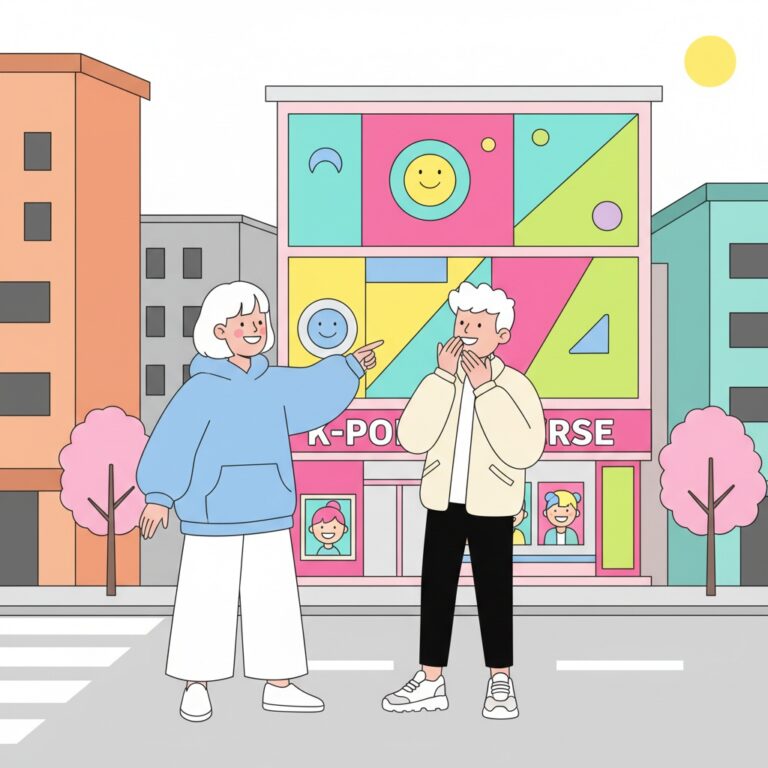
Lately in Korea, everyone is talking about the new pop-up stores for K-pop idols opening in Seoul. Imagine you want to invite your friend to the latest SEVENTEEN pop-up event. How would you do it? Let’s find out how you can sound like a natural when making plans!
Core Expressions for Making Plans
Here are the key phrases you absolutely need to know. Let’s break them down one by one!
1. ~(으)ㄹ 거예요? (Are you going to…?)
This is the most common way to ask about someone’s future plans.
- Korean Expression: 주말에 뭐 할 거예요?
- Pronunciation [Romanization]: Jumare mwo hal geoyeyo?
- English Meaning: What are you going to do this weekend?
- Detailed Explanation: This is the standard future tense in Korean. You attach -ㄹ 거예요 to verb stems ending in a vowel (like 가다 → 갈 거예요) and -을 거예요 to verb stems ending in a consonant (like 먹다 → 먹을 거예요). It’s perfect for asking “What are your plans?” or stating your own.
- 💡 Pronunciation Tip: The final part, 거예요 [geoyeyo], is often pronounced quickly and sounds more like [거에요 geoeyo] in casual conversation. Don’t stress too much about the ‘y’ sound; just let it flow smoothly!
2. 같이 ~(으)ㄹ래요? (Shall we… together?)
This is a sweet and friendly way to suggest doing something together.
- Korean Expression: 같이 영화 볼래요?
- Pronunciation [Romanization]: Gachi yeonghwa bollaeyo?
- English Meaning: Shall we watch a movie together?
- Detailed Explanation: Use this phrase to gently suggest an activity. It’s softer and more personal than the more direct
~ㅂ시다(Let’s…). It feels like you’re asking for your friend’s opinion, which is very polite! - 💡 Pronunciation Tip: Notice the word 같이 (gachi). It’s written as ‘gat-i’, but we don’t pronounce it that way! When the consonant
ㅌ (t)is followed by the vowelㅣ (i), it changes to aㅊ (ch)sound. This is called palatalization. So, instead of a harsh “gat-i,” you say a smooth [gachi]. It’s the same reason 굳이 (gud-i) is pronounced as [구지 guji]!
3. 좋아요! (Sounds good!)
The perfect, simple response to say “YES!” to a plan.
- Korean Expression: 좋아요!
- Pronunciation [Romanization]: Joayo!
- English Meaning: Good! / Sounds good! / I’d love to!
- Detailed Explanation: This is your go-to phrase for agreeing to a suggestion. It’s positive, enthusiastic, and can be used in almost any situation.
- 💡 Pronunciation Tip: Be careful! Even though it’s written with an ‘h’ sound (좋), the
ㅎ (h)is almost silent when it’s followed by a vowel. So, you don’t pronounce it as “jot-a-yo.” Instead, the sound flows together to become [조아요 joayo]. It makes your pronunciation much more natural.
4. 언제 만날까요? (When shall we meet?)
You’ve agreed on the plan, now it’s time to set a date and time!
- Korean Expression: 언제 만날까요?
- Pronunciation [Romanization]: Eonje mannalkkayo?
- English Meaning: When shall we meet?
- Detailed Explanation: The
~(으)ㄹ까요?ending is used to make a suggestion or ask for the listener’s opinion. So,언제 만날까요?literally means “When do you think is a good time for us to meet?”. It’s a collaborative way to make a decision. - 💡 Pronunciation Tip: The
ㄲ (kk)in 만날까요 [mannalkkayo] is a “tense consonant.” This means you should pronounce it with a bit more force and no puff of air, like the ‘k’ in the English word “sky.” It’s stronger than a regularㄱ (g/k).
Example Dialogue
Let’s see how these phrases work in a real conversation! Here, two friends, A and B, are planning to go to that trendy SEVENTEEN pop-up store.
A: 소미 씨, 이번 주말에 뭐 할 거예요?
(Somi, what are you going to do this weekend?)
B: 음… 특별한 계획 없어요. 왜요?
(Hmm… I don’t have any special plans. Why?)
A: 세븐틴 팝업스토어에 같이 갈래요?
(Shall we go to the SEVENTEEN pop-up store together?)
B: 우와, 좋아요! 너무 가고 싶었어요! 언제 만날까요?
(Wow, sounds good! I really wanted to go! When shall we meet?)
A: 토요일 오후 어때요?
(How about Saturday afternoon?)
B: 좋아요! 그때 만나요!
(Sounds good! Let’s meet then!)
See? Simple and effective!
Culture Tip & Trend Deep Dive
In Korea, especially among the younger generation (the Z-generation!), going to pop-up stores (팝업스토어) is a huge part of weekend culture. From K-pop groups like SEVENTEEN and NCT to webtoon characters and fashion brands, there’s always a new, exciting pop-up happening in trendy neighborhoods like Seongsu-dong or Hongdae.
When you use a phrase like “세븐틴 팝업스토어에 같이 갈래요?” (Shall we go to the SEVENTEEN pop-up store together?), you’re not just making a plan; you’re showing that you’re in touch with the latest Korean trends! It’s a fantastic way to connect with your Korean friends. So next time you plan a hangout, check what’s hot in Seoul and suggest it! It will definitely make you sound like a local.
Let’s Wrap It Up & Practice!
Great job today! We learned four amazing phrases for making plans with friends:
* 뭐 할 거예요? (What are you going to do?)
* 같이 ~ㄹ래요? (Shall we… together?)
* 좋아요! (Sounds good!)
* 언제 만날까요? (When shall we meet?)
Now it’s your turn to practice!
1. Fill in the blank:
You want to suggest drinking coffee together with a friend. What do you say?
같이 커피 ______? (Gachi keopi ______?)
2. Make a sentence:
How would you answer the question “주말에 뭐 할 거예요?” (What are you going to do this weekend?) if your plan is to “study Korean”?
한국어를 ______ 거예요. (Hangugeoreul ______ geoyeyo.)
Leave your answers in the comments below! And tell us, what are your plans for this weekend? 여러분, 주말에 뭐 할 거예요? Let us know using the phrases you learned today! 👇
Frequently Asked Questions (FAQ)
Q: What does "거예요" mean in Korean and how do you pronounce it?
A: In Korean, "거예요" is pronounced [geoyeyo] and means: , is often pronounced quickly and sounds more like
Q: What does "같이" mean in Korean and how do you pronounce it?
A: In Korean, "같이" is pronounced [gachi] and means: . It's written as 'gat-i', but we don't pronounce it that way! When the consonant
Q: What does "만날까요" mean in Korean and how do you pronounce it?
A: In Korean, "만날까요" is pronounced [mannalkkayo] and means: is a "tense consonant." This means you should pronounce it with a bit more force and no puff of air, like the 'k' in the English word "sky." It’s stronger than a regular







