

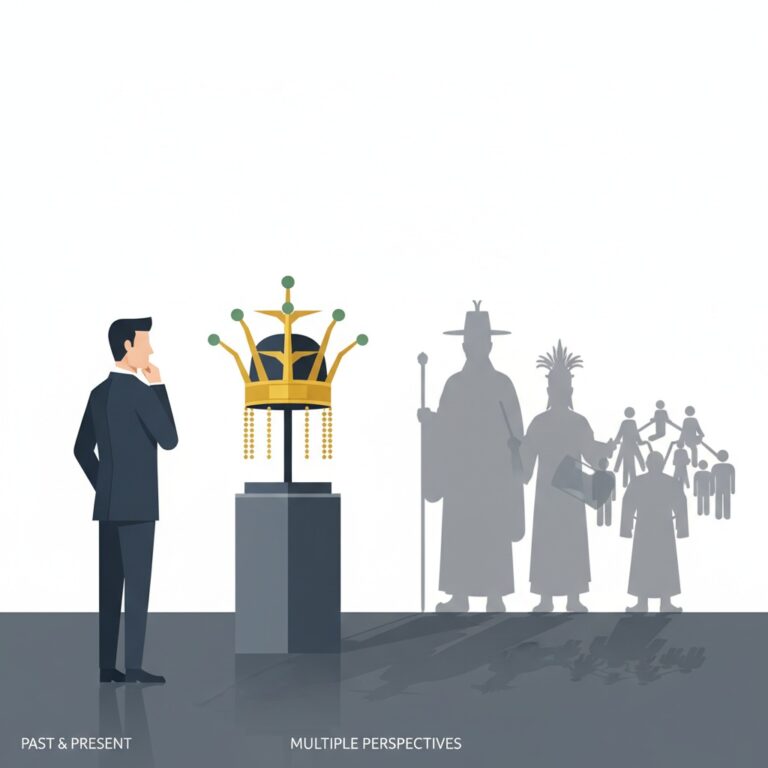
Gods, Power, and Sacrifice: An Anthropological Deep Dive into the Aztec Empire
Hello! Welcome to [Maeil Hangul], the place to upgrade your Korean proficiency to the next level!
Today, we’re venturing into a complex and fascinating topic: the anthropological interpretations of human sacrifice in the Aztec Empire. This isn’t your everyday conversation topic, but for advanced learners like you, it’s a perfect opportunity to master the sophisticated vocabulary and nuanced expressions needed for academic and intellectual discussions.
Lately in Korean academic circles, there’s a strong trend of re-examining historical events from various angles, moving beyond simplistic explanations. We’re going to do just that, using the Aztec Empire as our case study to learn how to discuss complex subjects with depth and precision in Korean. Ready to sound like a history professor? Let’s begin!
Core Expressions for In-Depth Analysis
Here are some essential terms you’ll need to discuss this topic like a pro.
1. 제정일치 (祭政一致)
- Pronunciation [Romanization]: Jejeong-ilchi
- English Meaning: The unity of religion and politics; theocracy.
- Detailed Explanation: This is a crucial concept for understanding many ancient civilizations. It’s a Sino-Korean term (Hanja: 祭 sacrifice, 政 politics, 一 one, 致 accord), literally meaning “sacrifice and politics are one.” It describes a state where the ruler is both the political leader and the chief religious figure. The Aztec Empire was a classic 제정일치 society, where political decisions and religious rituals were deeply intertwined. This term is essential for any high-level historical discussion.
- 💡 Pronunciation Tip: The final consonant ‘ㅊ’ (ch) in ‘일치’ is an aspirated sound. Make sure to release a puff of air, making it sound stronger than a simple ‘ㅈ’ (j). It’s [il-chi], not [il-ji].
2. 인신공양 (人身供養)
- Pronunciation [Romanization]: Insin-gongyang
- English Meaning: Human sacrifice (as a religious offering).
- Detailed Explanation: While you might know the general word for sacrifice, 희생 (huisaeng), 인신공양 is the specific, academic term for the ritual of human sacrifice. The Hanja (人 person, 身 body, 供 offer, 養 support/nurture) highlights the act of offering a human body to the gods. Using this term immediately elevates your language, showing you understand the formal and ritualistic context.
- 💡 Pronunciation Tip: Notice the two ‘ㅇ’ (ng/silent) characters. The first one in ‘인’ is silent (it’s just a placeholder), but the second one in ‘공양’ is a final consonant and is pronounced as [ng]. Practice distinguishing between ‘in’ and ‘gong-yang’.
3. 다각적으로 조망하다 (多角的으로 眺望하다)
- Pronunciation [Romanization]: Dagakjeogeuro jomanghada
- English Meaning: To view or examine from multiple perspectives.
- Detailed Explanation: This is a fantastic phrase for any advanced learner. 다각적 (多角的) means “multi-faceted” or “from various angles,” and 조망하다 (眺望하다) means “to view” or “to survey,” often from a high vantage point. Together, they form a sophisticated expression for “to analyze from multiple viewpoints.” It signals critical thinking and is frequently used in essays, debates, and academic papers.
- 💡 Pronunciation Tip: This phrase features a key pronunciation rule: tensing (경음화). The ‘ㄱ’ in ‘각’ meets the ‘ㅈ’ in ‘적’, causing the ‘ㅈ’ to become tense, like ‘ㅉ’. So, it’s pronounced [다각쩌그로 (dagak-jjeo-geuro)]. This small change will make you sound incredibly natural.
4. 사회 통제 기제 (社會 統制 機制)
- Pronunciation [Romanization]: Sahoe tongje gije
- English Meaning: A mechanism of social control.
- Detailed Explanation: This is a core concept in sociology and anthropology. It refers to the methods and systems used by a society or ruling class to maintain order and control over its population. Some scholars argue that large-scale 인신공양 was not just a religious act but also a powerful 사회 통제 기제—a way to intimidate subjects and rivals, reinforcing the power of the elite.
- 💡 Pronunciation Tip: The ‘통’ in ‘통제’ is an aspirated ‘ㅌ’ (t). Place your hand in front of your mouth; you should feel a strong puff of air when you say [tong]. This distinguishes it from the unaspirated ‘ㄷ’ (d/t).
Example Dialogue: At an Anthropology Seminar
Let’s see how these expressions work in a real academic conversation.
- A: 대학원생 (Graduate Student):
교수님, 아즈텍 제국의 인신공양은 태양신을 위한 순수한 종교적 행위였다고 보는 것이 타당하지 않을까요?
(Professor, wouldn’t it be reasonable to view the Aztec Empire’s human sacrifice as a purely religious act for the sun god?) -
B: 교수 (Professor):
그것도 중요한 측면이지만, 우리는 그 현상을 좀 더 다각적으로 조망할 필요가 있습니다. 아즈텍은 제정일치 사회였기에, 종교 의식은 강력한 사회 통제 기제로도 기능했음을 간과해서는 안 됩니다.
(That is an important aspect, but we need to examine the phenomenon from multiple perspectives. Since the Aztec was a theocratic society, we must not overlook the fact that religious rituals also functioned as a powerful mechanism of social control.)
Cultural Tip & Deeper Analysis
The act of “re-examining history” (역사 다시 보기) is a significant intellectual trend in modern Korea. Just as we are analyzing the Aztec empire, Korean scholars, documentarians, and the public are constantly debating and re-interpreting their own history—from ancient kingdoms to the turbulent 20th century.
When you watch a Korean historical documentary or read a critical article, you will frequently encounter phrases like “다각적으로 조망하다.” This approach, which values nuance over simple answers, is highly respected. By using these advanced expressions, you’re not just showing off your vocabulary; you’re demonstrating that you can participate in the kind of deep, critical thinking that is central to modern Korean intellectual life. Using a term like “사회 통제 기제” in a discussion about history or politics will instantly mark you as a truly advanced and thoughtful speaker of Korean.
Let’s Practice!
Time to put your new knowledge to the test!
- Fill in the Blank:
Some historians argue that public spectacles in the Roman Empire, like gladiator games, served as a powerful _______________ to keep the populace content and distracted.
(Hint: A mechanism for…) -
Make a Sentence:
Imagine you are discussing a controversial historical figure. Write one sentence in English using the concept of “viewing from multiple perspectives” (다각적으로 조망하다) to argue for a more balanced assessment.
Great job today! Delving into complex topics like this is the fastest way to achieve true fluency.
Now, I challenge you! Share your thoughts on today’s topic or try to answer the practice questions in the comments below using the new vocabulary. I can’t wait to read your insightful analyses!
Frequently Asked Questions (FAQ)
Q: What does "다각적" mean in Korean and how do you pronounce it?
A: In Korean, "다각적" is pronounced [多角的] and means: means "multi-faceted" or "from various angles," and
Q: What does "조망하다" mean in Korean and how do you pronounce it?
A: In Korean, "조망하다" is pronounced [眺望하다] and means: means "to view" or "to survey," often from a high vantage point. Together, they form a sophisticated expression for "to analyze from multiple viewpoints." It signals critical thinking and is frequently used in essays, debates, and academic papers.
Q: What does "A: 대학원생" mean in Korean and how do you pronounce it?
A: In Korean, "A: 대학원생" is pronounced [Graduate Student] and means: 교수님, 아즈텍 제국의
Q: What does "B: 교수" mean in Korean and how do you pronounce it?
A: In Korean, "B: 교수" is pronounced [Professor] and means: 그것도 중요한 측면이지만, 우리는 그 현상을 좀 더







