

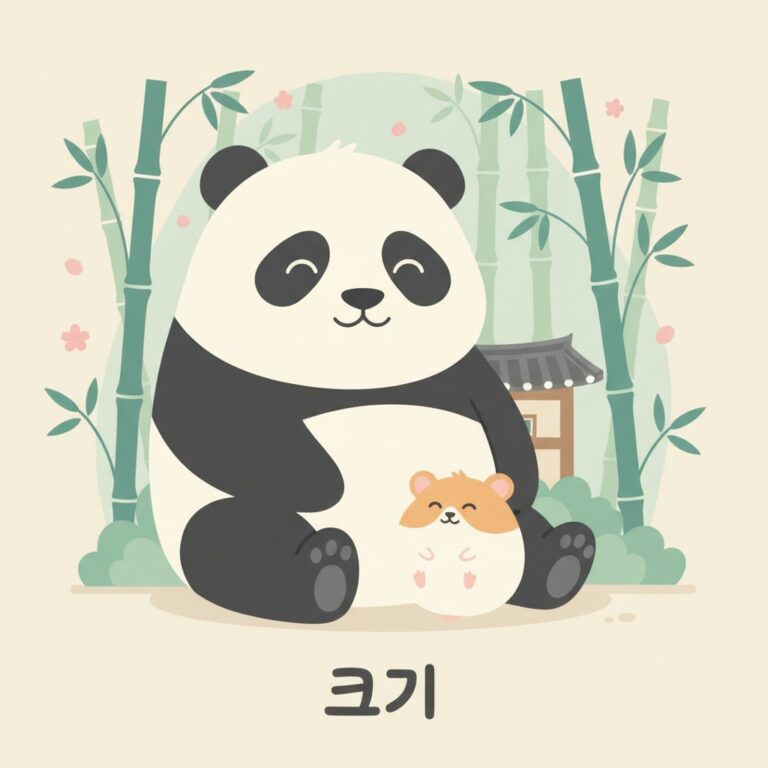
Hello! This is [Daily Hangul], here to upgrade your Korean skills!
Have you ever been to a zoo or watched a cute animal video online and wanted to say, “Aww, it’s so small!” or “Wow, that’s huge!” in Korean? Well, you’re in the right place! Today, we’re going to learn the essential words to describe the size of animals.
These days in Korea, everyone is obsessed with cute animal videos, especially of the giant panda, Fu Bao! When you scroll through social media, you’ll see thousands of comments like “너무 커요! (So big!)” or “정말 귀여워요! (So cute!)”. By the end of this lesson, you’ll be able to join in on the fun!
Let’s get started!
Core Expressions You Need to Know
Here are three simple but powerful expressions to describe animal sizes.
1. 커요 (keoyo) – It’s big
- Korean Expression: 커요
- Pronunciation [Romanized]: Keoyo
- English Meaning: It’s big / is big.
- Detailed Explanation: This comes from the basic verb 크다 (keuda), which means “to be big.” 커요 (keoyo) is the standard polite and friendly way to say it in conversation. You can use it for animals, objects, buildings—anything!
- 💡 Pronunciation Tip: The vowel ‘ㅓ’ (eo) can be tricky for English speakers. It’s not ‘ko’ or ‘kay’. Try to make the ‘uh’ sound in the word “sung.” So, it’s not “Ko-yo,” but more like [Kuh-yo]. Say it out loud: 커요!
2. 작아요 (jagayo) – It’s small
- Korean Expression: 작아요
- Pronunciation [Romanized]: Jagayo
- English Meaning: It’s small / is small.
- Detailed Explanation: This is the opposite of 커요! It comes from the verb 작다 (jakda), meaning “to be small.” Just like 커요, 작아요 (jagayo) is the standard polite form you can use in most daily situations.
- 💡 Pronunciation Tip: The first syllable ‘작’ has a 받침 (batchim), or final consonant, ‘ㄱ’ (g/k). When it’s followed by a vowel like ‘아’ (a), the sound links smoothly. Don’t pause between the syllables. It’s not “jak… ayo,” but a fluid [ja-ga-yo].
3. 아주 (aju) – Very
- Korean Expression: 아주
- Pronunciation [Romanized]: Aju
- English Meaning: Very / Really.
- Detailed Explanation: Want to add some emphasis? Use 아주 (aju)! You simply place it right before the adjective. It’s a super easy way to make your sentences more descriptive.
- 💡 Pronunciation Tip: This one is straightforward! The ‘아’ (a) sounds like the ‘a’ in “father,” and the ‘주’ (ju) sounds like the ‘ju’ in “June.” Put them together: [A-ju]. Perfect!
Example Conversation
Let’s see how these expressions are used in a real conversation. Imagine two friends, A and B, watching a video of Fu Bao the panda.
A: 와, 이 판다 좀 봐!
(Wa, i panda jom bwa!)
Wow, look at this panda!
B: 우와, 아주 커요!
(Uwa, aju keoyo!)
Whoa, it’s very big!
A: 맞아요. 그런데 아기 사자는 작아요.
(Majayo. Geureonde agi sajaneun jagayo.)
That’s right. But a baby lion is small.
B: 네, 정말 귀여워요.
(Ne, jeongmal gwiyeowoyo.)
Yes, it’s so cute.
See? Simple and natural!
Culture Tip & Trend Deep Dive
You learned 아주 (aju) for “very,” which is great! But if you want to sound even more like a native, especially like a young Korean, try using 너무 (neomu) or 정말 (jeongmal).
- 너무 (neomu): Means “so” or “too.” It’s incredibly common in casual speech. Watching a video of a tiny hamster, a Korean would likely exclaim, “너무 작아!” (Neomu jaga!) – “It’s so small!”
- 정말 (jeongmal): Means “really.” It shows genuine surprise or emphasis. “정말 커요!” (Jeongmal keoyo!) – “It’s really big!”
The panda we mentioned, Fu Bao, was the first giant panda born in Korea and became a national superstar. When she recently had to return to China, it was a huge news story, and many people were genuinely sad. Using what you learned today to talk about Fu Bao is a great way to connect with Korean culture and friends!
Let’s Wrap It Up & Practice!
Great job today! You’ve learned three essential expressions to describe size in Korean: 커요 (big), 작아요 (small), and the emphasis word 아주 (very). Now you can finally share your thoughts when you see that cute puppy or majestic elephant!
Ready for a quick quiz?
- How would you say “The elephant is very big” in Korean? (Elephant = 코끼리, kokkiri)
코끼리는 _______ ________. -
Look at a picture of a mouse (쥐, jwi). How would you describe it using one of today’s expressions?
Leave your answers and describe your favorite animal in the comments below using the expressions we learned today! We’d love to see what you come up with! 👇
Frequently Asked Questions (FAQ)
Q: What does "크다" mean in Korean and how do you pronounce it?
A: In Korean, "크다" is pronounced [keuda] and means: , which means "to be big."
Q: What does "커요" mean in Korean and how do you pronounce it?
A: In Korean, "커요" is pronounced [keoyo] and means: is the standard polite and friendly way to say it in conversation. You can use it for animals, objects, buildings—anything!
Q: What does "작다" mean in Korean and how do you pronounce it?
A: In Korean, "작다" is pronounced [jakda] and means: , meaning "to be small." Just like 커요,
Q: What does "작아요" mean in Korean and how do you pronounce it?
A: In Korean, "작아요" is pronounced [jagayo] and means: is the standard polite form you can use in most daily situations.







