

The 4-Day Workweek Debate: Argue Like a Pro in Korean!
Hello! Welcome back to [Maeil Hangeul], your go-to spot for upgrading your Korean skills!
Ever feel like the weekend is just too short? You’re not alone! Recently in Korea, the debate around the “주 4일 근무제” (the 4-day workweek) is one of the hottest topics in offices and on the news. Companies are experimenting, and everyone has an opinion.
Today, we’re diving deep into this discussion. You’ll learn the essential vocabulary and phrases to confidently share your own views on work-life balance and productivity, making you sound like a native speaker in any professional or academic debate. Let’s get started!
Core Expressions for the Debate
Here are the key terms you absolutely need to know to navigate this conversation.
1. 주 4일 근무제 (ju sa-il geunmuje)
- Pronunciation [ju sa-il geunmuje]
- English Meaning: The 4-day workweek system
- Detailed Explanation: This is the central term of the debate. It breaks down into 주 (ju) meaning ‘week’, 4일 (sa-il) meaning ‘4 days’, 근무 (geunmu) meaning ‘work’, and 제 (je) meaning ‘system’. It refers to a work model where employees work for four days a week instead of the traditional five, often with the same salary but longer hours on workdays.
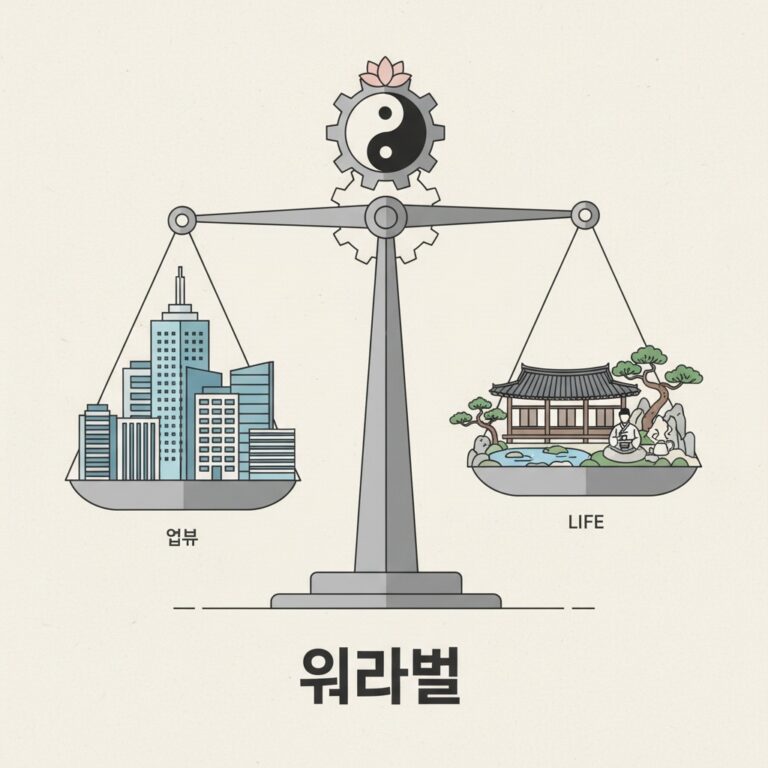
2. 워라밸 (worabel)
- Pronunciation [wo-ra-bael]
- English Meaning: Work-Life Balance
- Detailed Explanation: This is a crucial piece of modern Korean slang and a Konglish (Korean-style English) abbreviation of “Work-Life Balance.” The concept of ‘worabel’ is extremely important, especially to the younger MZ generation in Korea. It represents the desire for a fulfilling personal life outside of the demanding Korean work culture. This term is the primary argument for the 4-day workweek.
3. 업무 효율성 (eommu hyoyulseong)
- Pronunciation [eom-mu hyo-yul-sseong]
- English Meaning: Work efficiency / Productivity
- Detailed Explanation: This term is used by proponents of the 4-day workweek. 업무 (eommu) means ‘work’ or ‘duties’, and 효율성 (hyoyulseong) means ‘efficiency’. The argument is that with more rest, employees become more focused and creative, leading to an increase in work efficiency during their four days on the job.
- 💡 Pronunciation Tip: Notice how 효율성 is pronounced [효율썽 (hyoyulsseong)] with a tense ‘ss’ sound. In Korean, when a ‘ㅅ(s)’ follows a consonant, especially ‘ㄹ(l)’, it often becomes the tense consonant ‘ㅆ(ss)’. This is a common tensing rule that will make your pronunciation sound much more natural.
4. 생산성 저하 (saengsanseong jeoha)
- Pronunciation [saeng-san-sseong jeo-ha]
- English Meaning: A decrease in productivity
- Detailed Explanation: This is the main counter-argument. 생산성 (saengsanseong) means ‘productivity’, and 저하 (jeoha) means ‘a drop, decline, or fall’. Opponents worry that reducing workdays will inevitably lead to a drop in the total output and economic productivity, especially in manufacturing or service industries.
- 💡 Pronunciation Tip: Just like our previous example, the ‘ㅅ’ in 생산성 is pronounced as a tense [썽 (sseong)]. Practice this to master the rhythm of Korean compound nouns.
5. 시범 운영 (sibeom unyeong)
- Pronunciation [si-beom u-nyeong]
- English Meaning: Pilot program / Trial operation
- Detailed Explanation: Because the 4-day workweek is a major change, many companies aren’t adopting it fully right away. Instead, they conduct a 시범 운영. 시범 (sibeom) means ‘trial’ or ‘demonstration’, and 운영 (unyeong) means ‘operation’ or ‘management’. This allows a company to test the system’s effects on productivity and employee satisfaction before making a final decision.
Example Dialogue
Let’s see how these expressions play out in a real conversation between two colleagues, Minjun and Sora.
A: 민준 (Minjun)
요즘 뉴스에서 주 4일 근무제 얘기가 많이 나오더라고요. 우리 회사도 도입하면 좋겠어요. 워라밸이 훨씬 나아질 텐데요.
(Y즘 nyuseueseo ju sa-il geunmuje yaegi-ga mani naodeoragoyo. Uri hoesado doiphamyeon jokesseoyo. Worabel-i hwolssin naajil tendeyo.)
I’ve been seeing a lot about the 4-day workweek in the news lately. I wish our company would adopt it. Our work-life balance would improve so much.
B: 소라 (Sora)
글쎄요… 취지는 좋지만, 자칫하면 생산성 저하로 이어질까 봐 걱정돼요. 같은 일을 4일 만에 다 끝내야 한다는 압박감도 클 것 같고요.
(Geulsseyo… chwijineun jochiman, jachithamyeon saengsanseong jeoha-ro ieojilkka bwa geokjeongdwaeyo. Gateun ireul sa-il mane da kkeunnaeya handaneun apbakgamdo keul geot gatgoyo.)
I’m not so sure… The intention is good, but I’m worried it could lead to a decrease in productivity. And the pressure to finish the same amount of work in just four days seems intense.
A: 민준 (Minjun)
오히려 충분히 쉬면 업무 효율성이 더 오를 수도 있대요. 바로 결정하기보다는 몇 달간 시범 운영을 해보는 건 어떨까요?
(Ohiryeo chungbunhi swimyeon eommu hyoyulseong-i deo oreul sudo itdaeyo. Baro gyeoljeonghagibodaneun myeot dalgan sibeom unyeong-eul haeboneun geon eotteolkkayo?)
Actually, they say that with enough rest, work efficiency could even increase. Instead of deciding right away, how about we do a pilot program for a few months?
B: 소라 (Sora)
시범 운영이라면 괜찮은 생각이네요. 데이터를 보고 결정하는 게 합리적이죠.
(Sibeom unyeong-iramyeon gwaenchaneun saenggangnineyo. Deiteoreul bogo gyeoljeonghaneun ge hamnijeogijyo.)
A trial operation sounds like a good idea. It’s logical to make a decision based on the data.
Culture Tip & Trend Deep Dive
For decades, Korea was known for its grueling “ppalli-ppalli” (빨리빨리, hurry-hurry) work culture and some of the longest working hours among OECD countries. The rise of the 주 4일 근무제 debate signals a massive cultural shift.
The younger MZ Generation (Millennials + Gen Z) are prioritizing 워라밸 (worabel) over the traditional definition of success, which was often tied to sacrificing personal time for the company. They are actively questioning whether long hours truly equal high productivity.
Big tech companies like Kakao and the food delivery giant Woowa Brothers (배달의민족) have been pioneers, experimenting with flexible workweeks and reduced hours. Their trials are closely watched by the entire nation, and when these influential companies act, it sets a powerful precedent. So, when you discuss this topic, mentioning these companies will show you have a deep understanding of current Korean business trends!
Let’s Wrap It Up & Practice!
Today, we learned five essential terms to debate the 4-day workweek in Korean:
* 주 4일 근무제 (The 4-day workweek system)
* 워라밸 (Work-Life Balance)
* 업무 효율성 (Work efficiency)
* 생산성 저하 (A decrease in productivity)
* 시범 운영 (Pilot program)
Now it’s your turn to join the conversation!
Practice Question:
주 4일 근무제에 대해 찬성하십니까, 반대하십니까? 오늘 배운 표현을 최소 2개 이상 사용하여 여러분의 의견을 한국어로 2-3문장으로 작성해 보세요.
(Do you agree or disagree with the 4-day workweek? Using at least two of the expressions we learned today, write 2-3 sentences in Korean explaining your opinion.)
Share your thoughts in the comments below! We can’t wait to see your arguments
Frequently Asked Questions (FAQ)
Q: What does ""주 4일 근무제"" mean in Korean and how do you pronounce it?
A: In Korean, ""주 4일 근무제"" is pronounced [the 4-day workweek] and means: is one of the hottest topics in offices and on the news. Companies are experimenting, and everyone has an opinion.
Q: What does "주" mean in Korean and how do you pronounce it?
A: In Korean, "주" is pronounced [ju] and means: meaning 'week',
Q: What does "4일" mean in Korean and how do you pronounce it?
A: In Korean, "4일" is pronounced [sa-il] and means: meaning '4 days',
Q: What does "근무" mean in Korean and how do you pronounce it?
A: In Korean, "근무" is pronounced [geunmu] and means: meaning 'work', and







