

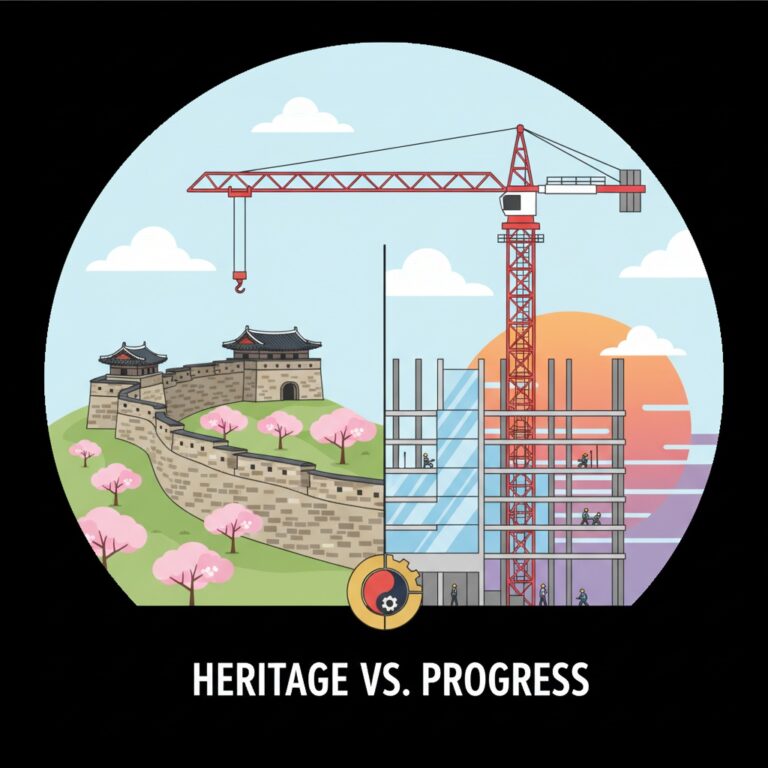
Save Our Heritage! Arguing for Preservation in Korean
Hello! Welcome to Maeil Hangeul, the place to upgrade your Korean skills!
Have you ever found yourself in a passionate discussion about protecting history and culture? Today, we’re diving into a fascinating and important topic: how to argue for the preservation of cultural heritage in Korean. This is perfect for when you want to share your opinion on more complex social issues.
Recently in Korea, there’s been a heated debate about a plan to build a huge, modern shopping mall right next to an ancient fortress wall. Some people are arguing it’s “development for preservation” (보존을 위한 개발), claiming it will bring more tourists and funding. But many others are worried. Let’s learn how to voice those concerns like a pro!
Core Expressions for Your Argument
Here are four powerful phrases to help you make a strong case for preservation.
1. ~다는 것은 어불성설입니다 (That ~ is absurd/illogical)
- Korean Expression: 보존을 위한 개발이라는 것은 어불성설입니다.
- Pronunciation [Romanization]: Bojoneul wihan gaebariraneun geoseun eobulseongseorimnida.
- English Meaning: The idea of “development for preservation” is illogical.
- Detailed Explanation: This is a strong, formal expression used to state that an argument makes no sense. 어불성설 (eobulseongseol) is a sophisticated four-character idiom (사자성어) meaning ‘illogical’ or ‘absurd’. Using this will make you sound very articulate and serious about your point. It’s perfect for debates, formal writing, or serious discussions.
-
💡 Pronunciation Tip:
The final consonantㅂin업 (eop)meets the vowel으 (eu)in을 (eul), so the sound links, making it sound like [어불/eo-bul]. Also, in입니다 (imnida), theㅂsound changes to anㅁsound because it’s followed by a nasal soundㄴ. This is called nasalization. So, you pronounce it as [임니다/im-ni-da], not [ip-ni-da].
2. 오히려 ~을/를 훼손할 수 있습니다 (On the contrary, it could damage ~)
- Korean Expression: 오히려 문화유산의 가치를 훼손할 수 있습니다.
- Pronunciation [Romanization]: Ohiryeo munhwayusanui gachireul hwesonhal su itseumnida.
- English Meaning: On the contrary, it could damage the value of the cultural heritage.
-
Detailed Explanation: 오히려 (ohiryeo) is a fantastic adverb that means ‘on the contrary’ or ‘rather’. It’s essential for introducing a counter-argument. 훼손하다 (hwesonhada) means ‘to damage’ or ‘to harm’, especially in the context of something valuable like reputation, nature, or heritage.
-
💡 Pronunciation Tip:
When the consonantㄹis followed byㅅ, theㅅbecomes a tense sound, likeㅆ. So,훼손할 수 (hwesonhal su)is pronounced smoothly as [훼소날 쑤/hwesonal ssu]. This consonant tensification (된소리되기) is very common and will make your Korean sound much more natural.
3. 장기적인 관점에서 봐야 합니다 (We must look at it from a long-term perspective)
- Korean Expression: 단기적인 이익이 아니라, 장기적인 관점에서 봐야 합니다.
- Pronunciation [Romanization]: Danggijeogin iigi anira, jangijeogin gwanjeomeseo bwaya hamnida.
- English Meaning: We must look at it from a long-term perspective, not short-term profit.
-
Detailed Explanation: This phrase is a classic in any debate. It contrasts 단기적 (danggijeok / short-term) with 장기적 (janggijeok / long-term). 관점 (gwanjeom) means ‘point of view’ or ‘perspective’. By using this, you’re elevating the conversation beyond immediate gains to consider the future consequences.
-
💡 Pronunciation Tip:
In관점 (gwanjeom), the finalㄴsound of the first syllable influences theㅈin the next syllable, making it tense. So, instead of [gwan-jeom], the natural pronunciation is [관쩜/gwan-jjeom]. Listen for this subtle but important change!
4. 원형 그대로 보존하는 것이 중요합니다 (It’s important to preserve it in its original form)
- Korean Expression: 문화유산은 원형 그대로 보존하는 것이 중요합니다.
- Pronunciation [Romanization]: Munhwayusaneun wonhyeong geudaero bojonhaneun geosi jungyohamnida.
- English Meaning: It is important to preserve cultural heritage in its original form.
-
Detailed Explanation: This is the heart of the preservationist argument. 원형 (wonhyeong) means ‘original form,’ and 그대로 (geudaero) means ‘as it is’ or ‘unchanged.’ Together, 원형 그대로 is a powerful phrase that emphasizes authenticity over artificial additions.
-
💡 Pronunciation Tip:
Just like in our first example, we see nasalization in중요합니다 (jungyohamnida). Theㅂ받침 is followed by the nasalㄴ, so it’s pronounced [중요함니다/jung-yo-ham-ni-da]. Mastering this rule will instantly improve your pronunciation of many formal verb endings!
Example Dialogue
Let’s see how these expressions work in a real conversation about that controversial shopping mall project.
- A: “Did you see the news about the new mall next to the Hanyang Fortress Wall? They’re calling it ‘development for preservation’.”
(한양도성 옆에 쇼핑몰 짓는다는 뉴스 봤어? ‘보존을 위한 개발’이라고 하더라.) - B: “I saw. But honestly, 보존을 위한 개발이라는 것은 어불성설입니다.”
(응, 봤어. 근데 솔직히, 보존을 위한 개발이라는 것은 어불성설이야.) - A: “I agree. 오히려 문화유산의 경관을 훼손할 수 있습니다. It could ruin the whole landscape.”
(나도 동의해. 오히려 문화유산의 경관을 훼손할 수 있어. 전체 풍경을 망칠 수도 있잖아.) - B: “Exactly. We shouldn’t just think about the immediate economic benefits. 장기적인 관점에서 봐야 합니다. That fortress has stood for hundreds of years. 원형 그대로 보존하는 것이 중요합니다.”
(맞아. 당장의 경제적 이익만 생각하면 안 돼. 장기적인 관점에서 봐야 해. 그 성벽은 수백 년을 버텨왔잖아. 원형 그대로 보존하는 것이 중요해.)
Culture Tip & Trend Deep Dive
In Korea, debates about development versus preservation are very real and passionate. When a project threatens a historical site, public opinion can be a powerful force.
- The Power of Social Media: Young Koreans (the MZ generation) are especially active in these discussions online. They create and share content with hashtags like #문화유산지킴이 (Cultural Heritage Guardian) or #개발절대반대 (Absolutely Against Development) to organize and raise awareness.
- Beyond Buildings: This conversation isn’t just about palaces or fortresses. It also applies to things like old neighborhoods with unique character (like Ikseon-dong in Seoul), natural landscapes, and even intangible cultural heritage like traditional arts.
- Show You Care: By using the phrases you learned today, you’re not just practicing Korean; you’re showing a deep respect and understanding of issues that are important to Korean people. It’s a great way to connect with them on a more meaningful level!
Let’s Review and Practice!
Great job today! We’ve learned some very useful and sophisticated expressions to voice our opinions on cultural preservation.
Now, it’s your turn to practice!
- Fill in the Blank: A friend suggests, “Let’s tear down this old, inconvenient market and build a modern apartment.” You want to argue that it’s important to preserve its original form.
“아니야, 이 시장은 _______ _______ 보존하는 것이 중요해.” (No, it’s important to preserve this market as it is.) -
Make a Sentence: Imagine a plan to build a highway through a national park. How would you say, “On the contrary, it could damage the natural environment”? Use the pattern 오히려 ~을/를 훼손할 수 있습니다.
What are your thoughts on development and preservation? Try using one of today’s expressions to leave a comment below! We’d love to hear your opinion in Korean
Frequently Asked Questions (FAQ)
Q: What does "어불성설" mean in Korean and how do you pronounce it?
A: In Korean, "어불성설" is pronounced [eobulseongseol] and means: is a sophisticated four-character idiom (사자성어) meaning 'illogical' or 'absurd'. Using this will make you sound very articulate and serious about your point. It's perfect for debates, formal writing, or serious discussions.
Q: What does "오히려" mean in Korean and how do you pronounce it?
A: In Korean, "오히려" is pronounced [ohiryeo] and means: is a fantastic adverb that means 'on the contrary' or 'rather'. It's essential for introducing a counter-argument.
Q: What does "훼손하다" mean in Korean and how do you pronounce it?
A: In Korean, "훼손하다" is pronounced [hwesonhada] and means: means 'to damage' or 'to harm', especially in the context of something valuable like reputation, nature, or heritage.
Q: What does "단기적" mean in Korean and how do you pronounce it?
A: In Korean, "단기적" is pronounced [danggijeok / short-term] and means: with







