

Hello! This is Daily Korean, here to upgrade your Korean skills!
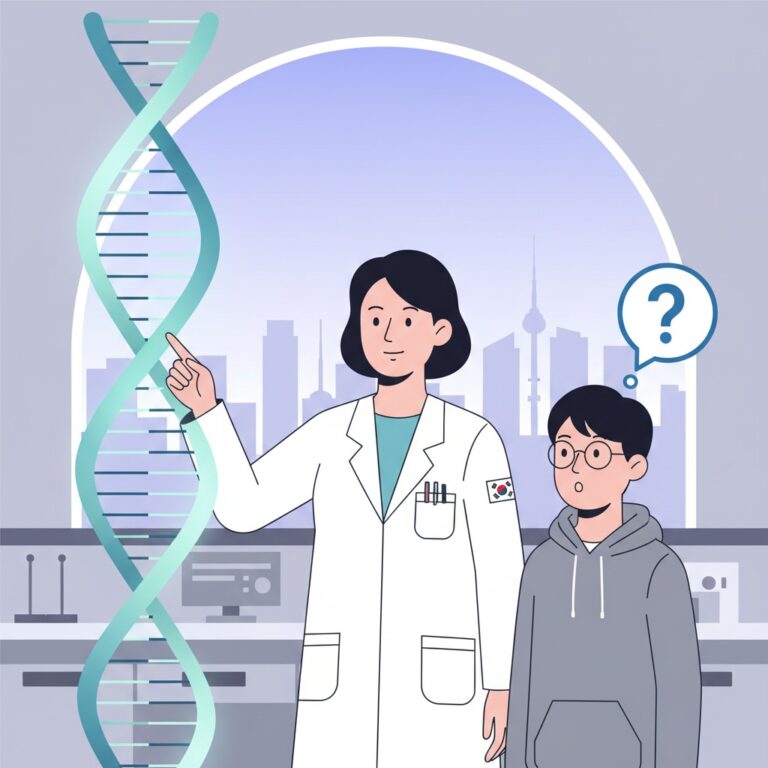
Have you ever been watching a medical or sci-fi K-drama and wished you could ask the super-smart doctor on screen a question? Today, we’re going to learn how to do just that! We’ll focus on how to ask experts questions about complex topics, specifically genetic technology.
Lately in Korea, the drama “The Gene of Tomorrow” (미래의 유전자) has become a huge hit, sparking conversations everywhere about the future of medicine and bioethics. With the phrases you learn today, you’ll not only understand these discussions better but also be able to participate in them. Let’s get started!
Core Expressions for Your Expert Interview
Here are some essential phrases you can use when talking to a doctor, researcher, or any expert in a formal setting.
1. …에 대해 자세히 설명해 주시겠어요? (…e daehae jasehi seolmyeonghae jusigesseoyo?)
- English Meaning: Could you please explain in detail about…?
- Detailed Explanation: This is a very polite and formal way to ask for a detailed explanation. It’s perfect for situations where you want to show respect to the expert.
-에 대해means “about” or “regarding.”자세히means “in detail.”설명해 주시겠어요?is a polite combination of설명하다(to explain) + the polite request form-어/아 주시다and the polite questioning form-시겠어요?.
- 💡 Pronunciation Tip:
Theㅎ (h)sound in설명해 (seolmyeonghae)is very soft and aspirated. When명 (myeong)and해 (hae)combine, it sounds like one smooth word: [seolmyeonghae]. Don’t put a hard stop between the syllables.
2. -(으)ㄹ 가능성이 있나요? (-(eu)l ganeungseong-i innayo?)
- English Meaning: Is there a possibility of/that…?
- Detailed Explanation: This phrase is used to ask about the probability or possibility of something happening. It’s crucial when discussing potential outcomes, risks, or benefits.
- Use
-ㄹ 가능성after a verb stem ending in a vowel (e.g.,치료되다->치료될 가능성). - Use
-을 가능성after a verb stem ending in a consonant (e.g.,낳다->낳을 가능성).
- Use
- 💡 Pronunciation Tip:
When가능성 (ganeungseong)is followed by the particle이 (i), the final consonantㅇ (ng)links to the next syllable. So, you don’t say “ganeungseong / i.” Instead, it flows together smoothly as [ganeungseongi]. This is a very common Korean pronunciation rule called 연음 (yeon-eum) or liaison.
3. 궁금한 점이 있는데요. (Gunggeumhan jeom-i inneundeyo.)
- English Meaning: I have something I’m curious about… / I have a question.
- Detailed Explanation: This is a wonderfully polite and natural way to introduce a question. Instead of directly saying “I have a question!” (
질문 있어요!), this phrase softens the approach. It implies, “A point of curiosity has come up, and I’d like to ask about it.” The-는데요ending is key here, as it makes the statement gentle and leads into the question you’re about to ask. - 💡 Pronunciation Tip:
In the word있는데요 (inneundeyo), theㅆ (ss)sound changes before the consonantㄴ (n). Theㅆbecomes aㄷ (d)sound, which then assimilates to theㄴ (n)sound. This results in a pronunciation that sounds like [인는데요 / inneundeyo], with a clear ‘n’ sound.
4. 윤리적인 문제는 없나요? (Yullijeogin munjeneun eomnayo?)
- English Meaning: Aren’t there any ethical issues?
- Detailed Explanation: This is a direct and important question for any bioethics discussion.
윤리적인 (yullijeogin)means “ethical.”문제 (munje)means “problem” or “issue.”없나요? (eomnayo?)is a gentle way of asking “Is there not…?” or “Isn’t there…?”
- 💡 Pronunciation Tip:
In없나요 (eomnayo), theㅂ (b)sound in the final position of없comes before a nasal soundㄴ (n). In this case, theㅂassimilates and is pronounced asㅁ (m). So, instead of “eop-nayo,” the natural pronunciation is [엄나요 / eomnayo]. This is called 비음화 (bi-eumhwa) or nasalization.
Example Dialogue
Let’s see how these expressions work in a conversation inspired by the K-drama “The Gene of Tomorrow”!
- A (Sumin): 안녕하세요, 박사님. 드라마 ‘미래의 유전자’를 보고 궁금한 점이 있는데요. 산전 유전자 검사에 대해 자세히 설명해 주시겠어요?
(Hello, Dr. Park. I watched the drama ‘The Gene of Tomorrow’ and have a question. Could you please explain in detail about prenatal genetic testing?) - B (Dr. Park): 네, 물론입니다. 산전 유전자 검사는 태아의 유전적 질환 여부를 미리 확인하는 기술입니다.
(Yes, of course. Prenatal genetic testing is a technology that checks for genetic diseases in a fetus in advance.) - A (Sumin): 그렇군요. 혹시 검사로 발견하지 못할 가능성이 있나요? 그리고 윤리적인 문제는 없나요?
(I see. Is there a possibility that the test might miss something? And aren’t there any ethical issues?) - B (Dr. Park): 정확도가 매우 높지만 100%는 아닙니다. 윤리적인 부분은 저희도 항상 신중하게 접근하고 있는 중요한 문제입니다.
(The accuracy is very high, but it’s not 100%. The ethical aspect is an important issue that we always approach with great caution.)
Culture Tip & Trend Deep Dive
In Korea, education and technology are highly valued, so it’s no surprise that dramas like “The Gene of Tomorrow” become hot topics. These shows reflect real-life public interest and anxieties about new technologies like CRISPR gene editing and artificial intelligence.
When you use phrases like 윤리적인 문제 (ethical issue), you’re not just practicing Korean; you’re tapping into a significant ongoing conversation in Korean society. Koreans often discuss the pros and cons of technological advancement in great detail. Being able to ask thoughtful questions shows that you have a deep interest not just in the language, but in the culture and society as well. You’ll sound less like a textbook and more like an informed, thoughtful speaker!
Let’s Wrap Up & Practice!
Great job today! You’ve learned four key expressions to help you discuss complex, expert-level topics politely and intelligently in Korean.
- …에 대해 자세히 설명해 주시겠어요? (Could you explain in detail about…?)
- -(으)ㄹ 가능성이 있나요? (Is there a possibility that…?)
- 궁금한 점이 있는데요. (I have a question…)
- 윤리적인 문제는 없나요? (Aren’t there any ethical issues?)
Now, it’s your turn to be the expert!
Practice Problems:
- Fill in the blank: You want to ask a doctor about a new treatment (
새로운 치료법). How would you ask for a detailed explanation?
이 ____ ____에 대해 자세히 설명해 주시겠어요?
- Make a sentence: Using
-(으)ㄹ 가능성이 있나요?, ask if there’s a possibility of side effects (부작용이 생기다).
Try to answer the practice questions in the comments below. We’d love to see you use your new skills
Frequently Asked Questions (FAQ)
Q: What does "연음" mean in Korean and how do you pronounce it?
A: In Korean, "연음" is pronounced [yeon-eum] and means: or liaison.
Q: What does "비음화" mean in Korean and how do you pronounce it?
A: In Korean, "비음화" is pronounced [bi-eumhwa] and means: or nasalization.







