

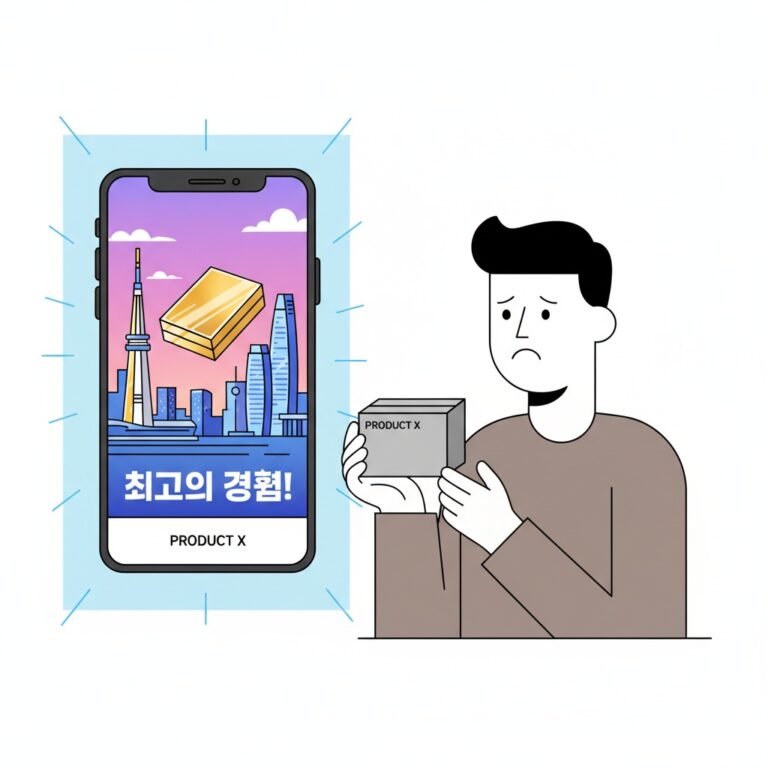
That Ad Lied? How to Fight Back in Korean!
Hello! This is [Maeil Hangeul], here to upgrade your Korean skills!
Have you ever bought something online because of an amazing ad, only to be totally disappointed? You’re not alone! In Korea these days, with so much online shopping and influencer marketing, sometimes the reality doesn’t match the hype.
Today, we’re learning some powerful Korean phrases to use when you feel tricked by an advertisement. This is a super useful skill for any smart shopper in Korea. Let’s learn how to stand up for your rights and sound like a confident consumer!
Core Expressions You Need to Know
Here are the essential phrases to express your frustration and take action.
1. 허위/과장 광고 (Heowi/Gwajang gwanggo)
- Romanization: [Heo-wi/Gwa-jang gwang-go]
- English Meaning: False/Exaggerated Advertisement
- Detailed Explanation: This is the key noun you need. 허위 (heowi) means “false” or “untrue,” while 과장 (gwajang) means “exaggeration.” You can use them together or separately. If an ad for a face cream claims to make you look 10 years younger overnight, that’s a classic 과장 광고!
- 💡 Pronunciation Tip: The first word, 허위, is pronounced just as it looks. For 과장 광고, pay attention to the first consonant ‘ㄱ’ (g). In Korean, the ‘ㄱ’ at the beginning of a word is a soft sound, somewhere between a ‘g’ and a ‘k’. Don’t make it a hard “g” like in “go.” Practice a light, gentle sound: [Gwa-jang gwang-go].
2. 속은 것 같아요 (Sogeun geot gatayo)
- Romanization: [So-geun geot ga-ta-yo]
- English Meaning: I think I was tricked/deceived.
- Detailed Explanation: This phrase perfectly captures that feeling of being fooled. 속다 (sokda) is the verb “to be deceived.” The grammar
-(으)ㄴ 것 같다means “it seems like…” or “I think that…” It’s a slightly softer, more natural way to state your feeling than saying “I was tricked!” directly. It’s polite and can be used in almost any situation. - 💡 Pronunciation Tip: Listen closely! Although it’s written as ‘gat-ayo’ (같아요), we pronounce it as [ga-ta-yo]. The final consonant ‘ㅌ’ (t) from ‘같’ moves over to the next syllable because it’s followed by a vowel ‘아’ (a). This sound-linking rule is called 연음 (yeon-eum), and it makes Korean flow beautifully. So instead of a hard stop, let the sounds connect: [ga-ta-yo].
3. 효과가 전혀 없어요 (Hyogwaga jeonhyeo eopseoyo)
- Romanization: [Hyo-gwa-ga jeon-hyeo eop-seo-yo]
- English Meaning: It has no effect at all.
- Detailed Explanation: This is your go-to phrase when a product simply doesn’t work. 효과 (hyogwa) means “effect,” and 전혀 (jeonhyeo) is a powerful adverb meaning “at all” or “completely.” It’s always used with a negative verb, like 없어요 (eopseoyo), which means “to not exist/have.”
- 💡 Pronunciation Tip: The pronunciation of 없어요 is tricky! It’s pronounced [eop-sseo-yo]. The ‘ㅂ’ (b) sound from the first block links to the next syllable, but the ‘ㅆ’ (ss) that follows is a strong, tense sound. So, you make a clear [eop] sound, followed immediately by a sharp [sseo-yo]. Practice this to sound much more natural!
4. 신고하고 싶어요 (Singohago sipeoyo)
- Romanization: [Shin-go-ha-go shi-peo-yo]
- English Meaning: I want to report it.
- Detailed Explanation: Time to take action! 신고하다 (singohada) means “to report” something to an official authority (like the police or a consumer agency). The grammar
-고 싶어요means “I want to…” This is a clear and direct phrase to state your intention. - 💡 Pronunciation Tip: The ‘싶’ in 싶어요 has a ‘ㅍ’ (p) sound. This is an “aspirated” sound, meaning you should feel a strong puff of air when you say it. Hold your hand in front of your mouth and say [shi-peo-yo]. You should feel the air! This is different from the ‘ㅃ’ (pp) sound, which is tense and has no air puff.
Example Dialogue
Let’s see how these phrases work in a real conversation. Imagine two friends, Minjun (A) and Sora (B), talking about a “miracle” hair growth shampoo Sora bought online.
A (Minjun): 소라야, 새로 산 샴푸 어때? 효과 좋아?
(Soraya, saero san syampu eottae? Hyogwa joa?)
Sora, how’s that new shampoo you bought? Is it effective?
B (Sora): 아, 말도 마. 효과가 전혀 없어요. 완전 허위/과장 광고였어.
(A, maldo ma. Hyogwaga jeonhyeo eopseoyo. Wanjeon heowi/gwajang gwanggoyeosseo.)
Ugh, don’t even ask. It has no effect at all. It was a total false/exaggerated ad.
A (Minjun): 진짜? 광고에서는 엄청 좋아 보였는데!
(Jinjja? Gwanggo-eseoneun eomcheong joa boyeonneunde!)
Really? It looked so good in the ad!
B (Sora): 그러니까. 완전히 속은 것 같아요. 너무 화나서 신고하고 싶어요.
(Geureonikka. Wanjeonhi sogeun geot gatayo. Neomu hwanaseo singohago sipeoyo.)
I know. I feel completely tricked. I’m so angry, I want to report it.
Culture Tip & Trend Deep Dive
In Korea, consumer rights are taken very seriously. The 한국소비자원 (Hanguk Sobijawon – Korea Consumer Agency) is a government organization where people can report issues like false advertising.
Recently, there was a huge controversy around “뒷광고” (dwit-gwanggo), which means “backdoor” or undisclosed advertising by YouTubers and social media influencers. Because of this, people are now more aware and critical of online ads than ever.
Using a phrase like “허위/과장 광고인 것 같아요” (It seems like a false/exaggerated ad) in a product review or a conversation shows that you are an informed consumer. It makes you sound not just like a Korean speaker, but like someone who really understands modern Korean consumer culture!
Let’s Practice!
Ready to test your new skills?
- You bought a vitamin that the ad said would give you energy, but you still feel tired. How would you complain?
이 비타민은 ________________. (This vitamin has no effect at all.)
- Imagine you bought a travel package that looked luxurious in the photos, but the hotel was terrible. What could you say to your friend?
A) I want to report it.
B) I was tricked, I think.
C) Both are correct.
Great job today! You’ve learned some incredibly useful phrases for navigating the world of Korean shopping.
Now it’s your turn! Have you ever been disappointed by a product? Try leaving a comment below using the phrases we learned today! We’d love to see you practice.
Frequently Asked Questions (FAQ)
Q: What does "허위" mean in Korean and how do you pronounce it?
A: In Korean, "허위" is pronounced [heowi] and means: means "false" or "untrue," while
Q: What does "과장" mean in Korean and how do you pronounce it?
A: In Korean, "과장" is pronounced [gwajang] and means: means "exaggeration." You can use them together or separately. If an ad for a face cream claims to make you look 10 years younger overnight, that's a classic
Q: What does "속다" mean in Korean and how do you pronounce it?
A: In Korean, "속다" is pronounced [sokda] and means: is the verb "to be deceived." The grammar
Q: What does "연음" mean in Korean and how do you pronounce it?
A: In Korean, "연음" is pronounced [yeon-eum] and means: , and it makes Korean flow beautifully. So instead of a hard stop, let the sounds connect:







