

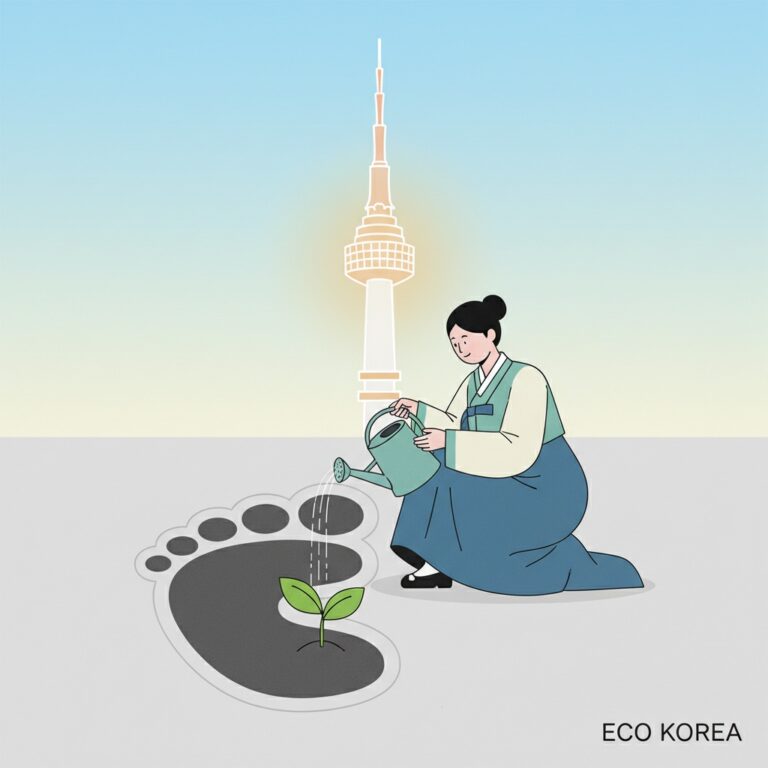
Go Green in Korean: Talk About Your Carbon Footprint Like a Pro!
Hello! Welcome to Maeil Hangul (매일한글), your daily stop for upgrading your Korean skills!
Today, we’re diving into a topic that’s on everyone’s mind globally: sustainability and our environmental impact. Have you ever wanted to discuss climate change or how to be more eco-friendly with your Korean friends or colleagues? You’re in the right place! These days in Korea (요즘 한국에서는), conversations around ESG (Environmental, Social, and Governance) management and sustainable living are everywhere. From cafes offering discounts for using tumblers to major companies launching green campaigns, this is a timely and essential topic. Let’s learn how to talk about calculating and reducing our carbon footprint in fluent, natural Korean!
Core Expressions You Need to Know
Here are some key phrases that will help you participate in any eco-conscious conversation.
1. 탄소 발자국 (Tanso baljaguk)
- Pronunciation [Romanization]: [Tan-so bal-jja-guk]
- English Meaning: Carbon footprint
- Detailed Explanation: This is the direct translation and the most common term used in Korea.
탄소(tanso) means “carbon,” and발자국(baljaguk) means “footprint.” You can use this term in both casual and formal settings when talking about the environmental impact of an individual, organization, or product. You often use it with the verb줄이다(jurida), which means “to reduce.” - 💡 Pronunciation Tip:
- The
ㅈin발자국is pronounced with a tense sound, like the “j” in “jeep” but stronger, almost like “jj.” This is because it follows a consonant (ㄹ). Listen for the difference between자 (ja)and짜 (jja). This is called tensification (경음화). So, it’s notbal-ja-gukbut closer to[bal-jja-guk].
- The
2. 기후 변화에 대응하다 (Gihu byeonhwa-e dae-eunghada)
- Pronunciation [Romanization]: [Gi-hu byeon-hwa-e dae-eung-ha-da]
- English Meaning: To respond to / combat / tackle climate change
- Detailed Explanation: This is a slightly more formal and sophisticated phrase perfect for C1 learners.
기후 변화(gihu byeonhwa) means “climate change,” and대응하다(dae-eunghada) is a versatile verb meaning “to respond,” “to cope with,” or “to counter.” It’s a great phrase for presentations, reports, or serious discussions about environmental policy. - 💡 Pronunciation Tip:
- The
ㅎ(h) in변화 (byeonhwa)is a light, aspirated sound. Make sure you release a puff of air. The tricky part is the particle에. When you say it quickly, the sounds link together smoothly:byeonhwa-esounds like one continuous flow, not two separate words.
- The
3. 일회용품 사용을 줄이다 (Ilhoeyongpum sayong-eul jurida)
- Pronunciation [Romanization]: [Il-hoe-yong-pum sa-yong-eul ju-ri-da]
- English Meaning: To reduce the use of single-use/disposable items
- Detailed Explanation: This is an extremely practical phrase for everyday life.
일회용품(ilhoeyongpum) literally means “one-time-use items” (disposables) like paper cups, plastic cutlery, and plastic bags.사용(sayong) means “use,” and줄이다(jurida) means “to reduce.” You will hear and use this phrase constantly in Korea. - 💡 Pronunciation Tip:
- Korean is read in syllable blocks. Notice how
일회용품is made of four characters, but the pronunciation flows smoothly. Theㄹ(l) at the end of일links to the vowelㅗ(oe) in회, creating a smooth[ilhoe]sound. Practice saying the full word slowly at first, then speed up:일-회-용-품->[ilhoeyongpum].
- Korean is read in syllable blocks. Notice how
4. 자원을 절약하다 (Jawon-eul jeoryakada)
- Pronunciation [Romanization]: [Ja-won-eul jeo-rya-ka-da]
- English Meaning: To conserve resources
- Detailed Explanation: This is a fundamental phrase in sustainability discussions.
자원(jawon) means “resources” (like water, electricity, etc.), and절약하다(jeoryakada) means “to conserve” or “to save.” It’s a slightly formal but widely understood term. - 💡 Pronunciation Tip:
- This is a fantastic example of a common Korean sound change rule called aspiration (격음화). The final consonant
ㄱ(g/k) in약meets theㅎ(h) in하다. Instead of being pronounced separately, they merge to create a strong, airyㅋ(k) sound. So,절약 + 하다is not pronounced[jeoryak-hada]but rather[저랴카다/jeoryakada]. This will make your pronunciation sound much more natural!
- This is a fantastic example of a common Korean sound change rule called aspiration (격음화). The final consonant
Example Dialogue
Let’s see how these expressions work in a real conversation between two colleagues, Sujin and Brian.
A (Brian): 수진 씨, 텀블러 사용하면 여기서 할인해 주네요. 요즘 한국은 친환경에 정말 진심인 것 같아요.
Sujin, they give a discount here if you use a tumbler. It seems like Korea is really serious about being eco-friendly these days.
B (Sujin): 맞아요. 저도 제 탄소 발자국을 줄이려고 노력 중이에요. 작은 실천이지만 중요하잖아요.
That’s right. I’m also trying to reduce my carbon footprint. It’s a small action, but it’s important.
A (Brian): 동의해요. 우리 모두가 기후 변화에 대응해야 하니까요. 저는 일회용품 사용을 줄이는 것부터 시작했어요.
I agree. It’s because we all have to combat climate change. I started by reducing my use of single-use items.
B (Sujin): 좋은 생각이네요! 저도 안 쓰는 전자제품 플러그를 뽑아두면서 자원을 절약하려고 해요.
That’s a great idea! I also try to conserve resources by unplugging electronics I’m not using.
Culture Tip & Trend Deep Dive
- The “Zero Waste” (제로 웨이스트) Movement: In trendy Seoul neighborhoods like Mangwon-dong and Yeonnam-dong, “zero waste” shops have become popular. These stores encourage customers to bring their own containers to refill everything from grains to shampoo. Mentioning you’ve been to one is a great way to show you’re in tune with modern Korean culture.
- Corporate ESG is a Huge Deal: The term ESG 경영 (ESG gyeongyeong), or ESG Management, is a major buzzword in the Korean business world. Companies are now heavily evaluated on their environmental and social efforts. Knowing phrases like
기후 변화에 대응하다is not just for casual chats; it’s business-level Korean that can be used in professional settings. - Idols as Eco-Warriors: Many K-pop idols, like BTS’s RM and BLACKPINK, have used their platforms to advocate for environmental causes. This has made being eco-conscious “cool” and aspirational for the Korean Z generation. You’ll often see fans initiating recycling or forest-planting projects in their favorite idol’s name. Using these expressions shows you share a value that is important to many young Koreans.
Let’s Wrap Up & Practice!
Great job today! We learned four key expressions to confidently discuss sustainability and our carbon footprint: 탄소 발자국, 기후 변화에 대응하다, 일회용품 사용을 줄이다, and 자원을 절약하다.
Now, it’s your turn to practice!
- Fill in the Blank:
- To reduce my carbon footprint, I try to conserve electricity.
- 제 ________을/를 줄이기 위해, 저는 전기를 ___________(으)려고 노력해요.
- Your Turn!
- In your daily life, what do you do to reduce the use of disposable items? Try to write a sentence in Korean using the expression 일회용품 사용을 줄이다.
Leave your answers and your own eco-friendly tips in the comments below using the phrases we learned today! We’d love to see them. See you next time at Maeil Hangul
Frequently Asked Questions (FAQ)
Q: What does "ESG 경영" mean in Korean and how do you pronounce it?
A: In Korean, "ESG 경영" is pronounced [ESG gyeongyeong] and means: , or ESG Management, is a major buzzword in the Korean business world. Companies are now heavily evaluated on their environmental and social efforts. Knowing phrases like







