

From “Kamsahamnida” to Karrot: Thanking Like a True Korean!
Hello! This is Maeil Hangul, here to upgrade your Korean skills!
Have you ever received a small act of kindness from a stranger or a friend in Korea and felt that a simple “thank you” wasn’t enough? Today, we’re going to level up your gratitude game! We’ll learn how to express thanks for help received, not just politely, but with real heart.
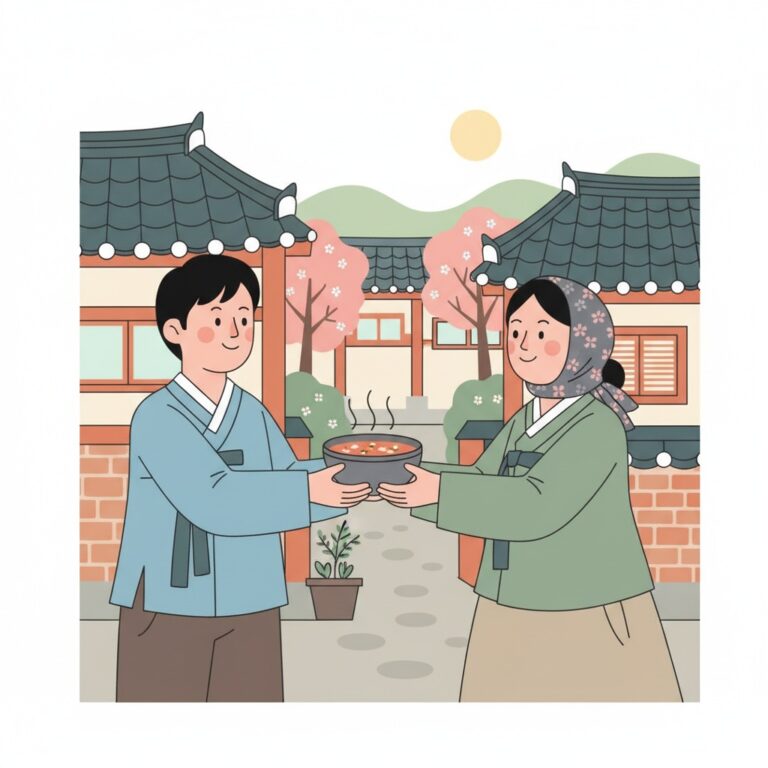
Lately in Korea, there’s a huge trend of using neighborhood community apps like Karrot (당근마켓). People aren’t just selling things; they’re lending tools, sharing groceries, and helping each other out with small favors. In these situations, knowing how to express your gratitude sincerely is key to building great relationships. Let’s dive in!
Core Expressions: More Than Just “Thank You”
Here are three essential phrases that will make you sound like a natural when someone lends you a hand.
1. 덕분에 (deokbune)
- Pronunciation [deok-bu-ne]: deok-bu-ne
- English Meaning: Thanks to you… / Because of you…
- Detailed Explanation: This is a fantastic and versatile expression! It directly connects a positive outcome to the other person’s help. You use it at the beginning of a sentence to explain what good thing happened because of their assistance. It’s polite and can be used in both formal and informal situations.
- 💡 Pronunciation Tip: The first syllable ‘덕’ ends with a ‘ㄱ’ (k) consonant. In Korean, when a syllable ends in ‘ㄱ’, ‘ㄷ’, or ‘ㅂ’ and is followed by a syllable that starts with ‘ㄴ’ or ‘ㅁ’, its sound can change to ‘ㅇ’, ‘ㄴ’, or ‘ㅁ’ respectively. However, in “덕분에,” the ‘ㄱ’ sound is followed by ‘ㅂ’, so this specific rule (nasalization) doesn’t apply here. Just remember to make a clear but soft [k] sound at the end of ‘덕’ (deok), almost like you’re stopping the air in your throat. It’s not a hard “kuh” sound.
2. 신세 졌어요 (sinse jyeosseoyo)
- Pronunciation [sin-se jyeo-sseo-yo]: shin-se jyeo-sseo-yo
- English Meaning: I’m indebted to you. / I owe you one.
- Detailed Explanation: This phrase carries a deeper nuance than a simple “thank you.” It acknowledges that you’ve received a significant favor that you feel you should repay someday. It shows deep appreciation and is very common among colleagues and neighbors. It’s polite and carries a sense of wanting to return the kindness in the future. For a casual version with a close friend, you can say 신세 졌다 (sinse jyeotda).
- 💡 Pronunciation Tip: The ‘졌’ in ‘졌어요’ is a combination of ‘지(ji)’ and ‘었(eot)’. The ‘j’ sound is similar to the ‘j’ in “jeans.” The double ‘ㅆ’ (ss) in ‘어요’ creates a tensed, sharp ‘s’ sound. Make sure to pronounce it with more force than a regular ‘ㅅ’ (s). It’s the difference between “s” and “ss” in “miss.”
3. 고마워 죽겠어 (gomawo jukgesseo)
- Pronunciation [go-ma-wo juk-ge-sseo]: go-ma-wo juk-get-sseo
- English Meaning: I’m so grateful, I could die! / Thanks a million!
- Detailed Explanation: This is a very casual and emphatic way to show immense gratitude to close friends. The grammar pattern “-어/아 죽겠다” literally means “to death” and is used to exaggerate feelings (e.g., 배고파 죽겠어 – I’m starving to death, 보고 싶어 죽겠어 – I miss you like crazy). It’s a trendy and friendly expression that shows you’re bursting with thankfulness!
- 💡 Pronunciation Tip: The final consonant in ‘죽겠어’ is ‘ㅆ’, but when it’s in the final position of a syllable block (받침), it’s pronounced as a ‘ㄷ’ [t] sound. So, ‘겠’ is pronounced as [get], not [ges]. This is a fundamental rule in Korean pronunciation! Many final consonants simplify to a [k], [n], [t], [l], [m], [p], or [ng] sound.
Example Dialogue: A Karrot App Favor!
Let’s see how these phrases work in a real-life conversation. Imagine Person A borrowed a hammer from their neighbor, Person B, through the Karrot app.
A: (Returning the hammer) 안녕하세요! 당근에서 빌렸던 망치 돌려드리러 왔어요.
(Annyeonghaseyo! Danggeun-eseo billyeotdeon mangchi dollyeodeurireo wasseoyo.)
Hello! I’m here to return the hammer I borrowed on Karrot.
B: 아, 네! 잘 쓰셨어요?
(A, ne! Jal sseusyeosseoyo?)
Oh, yes! Did it work well for you?
A: 네! 덕분에 선반을 겨우 다 달았어요. 정말 신세 졌어요.
(Ne! Deokbune seonban-eul gyeou da darasseoyo. Jeongmal sinse jyeosseoyo.)
Yes! Thanks to you, I finally managed to put up my shelf. I really owe you one.
B: 아니에요. 이웃끼리 돕고 살아야죠.
(Anieyo. Iutkkiri dopgo sarayajyo.)
Not at all. Neighbors should help each other out!
Culture Tip & Trend Deep Dive
The trend of community help on apps like Karrot is a modern expression of a deep-rooted Korean concept called 정 (jeong). Jeong is a hard-to-translate word that signifies a deep feeling of connection, attachment, and community bonding.
When you use a phrase like 신세 졌어요 (I owe you one), you’re doing more than just saying thank you. You’re participating in this culture of jeong. You are acknowledging the relationship and implying that you’ll be there for them in the future, strengthening the community bond.
Meanwhile, you’ll see young Koreans on Instagram or KakaoTalk using 고마워 죽겠어! when a friend helps them get a ticket to a sold-out K-pop concert or sends them a coffee coupon when they’re studying late. It’s a perfect example of how language evolves to express strong emotions in a fun, modern way! Using these phrases at the right time will definitely make you seem more like a local!
Let’s Practice!
Ready to test your new skills? Fill in the blank with the most appropriate expression from today’s lesson (덕분에, 신세 졌어요, 고마워 죽겠어).
Scenario: Your Korean friend spent hours helping you prepare for your Korean language test, and you passed! You send them a text message.
You: 나 시험 합격했어! 네가 도와준 _______. 진짜 ________! 다음에 내가 맛있는 거 살게!
(Na siheom hapgyeokaesseo! Nega dowajun _______. Jinjja ________! Daeume naega masinneun geo salge!)
I passed the test! It was all _______ you helping me. I really _______! I’ll buy you something delicious next time!
(Answer: 덕분에, 신세 졌어)
Great job today, everyone! Now it’s your turn.
Try leaving a comment below using one of the expressions we learned today! I’ll be waiting to read them
Frequently Asked Questions (FAQ)
Q: What does "신세 졌어요" mean in Korean and how do you pronounce it?
A: In Korean, "신세 졌어요" is pronounced [I owe you one] and means: , you're doing more than just saying thank you. You're participating in this culture of







