

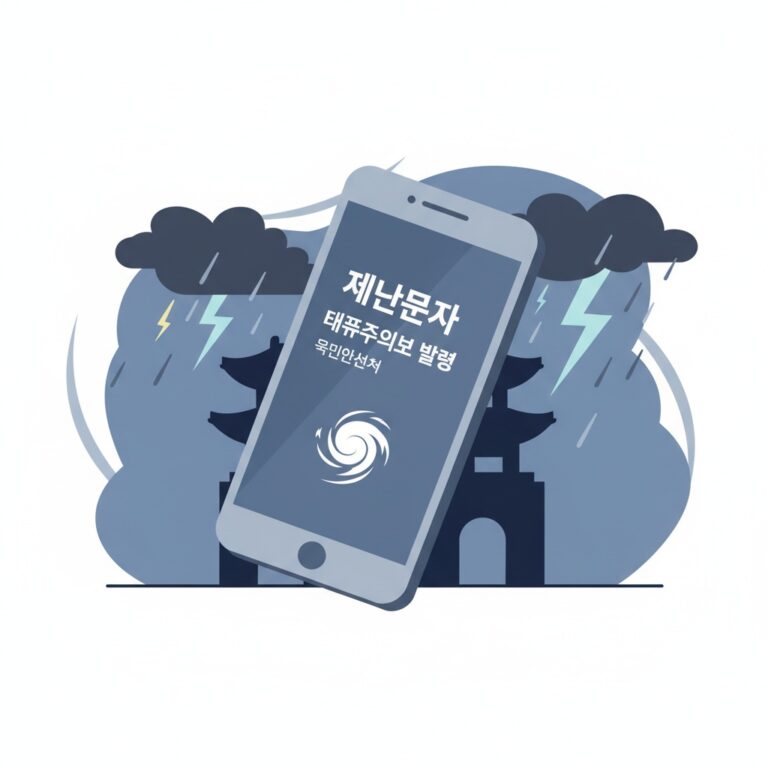
Earthquake in Seoul? Typhoon in Jeju? Your Korean Guide to Staying Safe!
Hello! Welcome to [Daily Hangul], your go-to blog for upgrading your Korean skills!
Imagine you’re enjoying your dream trip in Korea. Suddenly, your phone blares with an alert, and the ground begins to shake. What do you do? While Korea is a very safe country, it’s not immune to natural disasters. Recently in Korea, there has been a growing awareness of earthquake and typhoon preparedness, making it a crucial topic for both residents and travelers.
Today, we’re going to learn essential C1-level Korean phrases and vocabulary that could be life-savers during an emergency. Mastering these will help you understand official announcements and navigate to safety like a local. Let’s get started!
Core Expressions for Emergencies
Here are some key phrases you’ll hear in public announcements or need to use when seeking help.
1. 신속히 대피하시기 바랍니다 (Sinsokhi daepihasigi baramnida)
- Romanization: Sinsokhi daepihasigi baramnida
- English Meaning: Please evacuate immediately.
- Detailed Explanation: This is a very formal and direct instruction you will hear in official broadcasts (재난 방송) or see in emergency text alerts (재난문자).
- 신속히 (sinsokhi) means “swiftly” or “promptly.”
- 대피하다 (daepihada) is the verb “to evacuate.”
- -시기 바랍니다 (-sigi baramnida) is a formal, polite way of saying “I hope you will…” or “Please do…” It’s a classic example of public announcement language.
- 💡 Pronunciation Tip: The phrase ends with
-바랍니다. A common mistake is to pronounce theㅂ(b) sound clearly. However, due to a pronunciation rule called nasalization, when a consonant likeㅂ(b/p) comes before a nasal sound likeㄴ(n) orㅁ(m), it changes toㅁ(m). Therefore,바랍니다is not pronounced [barabnida] but rather [baramnida]. This small change will make you sound much more natural!
2. 여진에 주의하십시오 (Yeojine juuuihasipsio)
- Romanization: Yeojine juuuihasipsio
- English Meaning: Please be cautious of aftershocks.
- Detailed Explanation: This is a critical warning following an earthquake.
- 여진 (yeojin) means “aftershock.”
- 주의하다 (juuihada) means “to be careful” or “to pay attention to.”
- -(으)십시오 (-(eu)sipsio) is a formal imperative ending, like a very polite “Do this.”
- 💡 Pronunciation Tip: The word
주의[ju-ui] contains the diphthong의(ui). While its official pronunciation is a glide from ‘u’ to ‘i’, in everyday speech, especially when it’s not the first syllable of a word, it is often simplified. So, you’ll frequently hear주의pronounced more like [주이/jui]. Listening for this simplified sound will help your comprehension of spoken Korean.
3. 비상 대피 장소는 어디입니까? (Bisang daepi jangsoneun eodiimnikka?)
- Romanization: Bisang daepi jangsoneun eodiimnikka?
- English Meaning: Where is the emergency evacuation shelter?
- Detailed Explanation: This is the question you need to ask to find a safe place.
- 비상 (bisang) means “emergency.”
- 대피 장소 (daepi jangso) means “evacuation place” or “shelter.”
- 어디입니까? (eodiimnikka?) is the formal way to ask “Where is it?”
- 💡 Pronunciation Tip: Let’s look at
어디입니까?. Due to a pronunciation rule called liaison (or 연음, yeoneum), a final consonant in a syllable block moves to the next syllable if that syllable starts with a vowel. Here, theㅂ(b) at the end of입moves over, so it’s pronounced [어디임니까/eodiimnikka], not [eodi-ib-nikka]. It’s a smooth, connected sound.
4. 재난문자 (Jaenanmunja)
- Romanization: Jaenanmunja
- English Meaning: Emergency alert text message
- Detailed Explanation: This isn’t a phrase, but a vital piece of vocabulary.
재난(jaenan) means “disaster,” and문자(munja) means “text message.” The Korean government has an advanced system that sends these alerts to all mobile phones in an affected area, often with a loud, distinct alarm. Recognizing this word is the first step to understanding the situation. - 💡 Pronunciation Tip: Notice the pronunciation of
문자. It’s romanized asmunja, but you’ll hear it pronounced as [문짜/munjja]. This is due to tensing (or 경음화, gyeongeumhwa). When a plain consonant likeㅈ(j) follows a nasal consonant likeㄴ(n), it often becomes a tensed consonant,ㅉ(jj).
Example Dialogue
Let’s see how these expressions work in a real-life situation. Two travelers, A and B, are in their hotel room in Busan during typhoon season.
(A loud alarm sounds from both of their phones)
- A: 어? 이게 무슨 소리지? 재난문자가 왔어!
(Huh? What’s that sound? We got an emergency alert text!) - B: 뭐라고 쓰여 있어?
(What does it say?) - A: “태풍 북상 중. 강풍과 폭우에 대비하여 해안가 접근을 삼가고, 신속히 대피하시기 바랍니다.”
(It says, “Typhoon moving north. In preparation for strong winds and heavy rain, refrain from approaching the coastline and please evacuate immediately.”) - B: 큰일이다. 그럼 비상 대피 장소는 어디입니까? 호텔 직원에게 물어봐야겠어.
(This is serious. Then where is the emergency evacuation shelter? I should ask the hotel staff.) - A: 맞아. 그리고 창문에서 떨어져 있는 게 좋겠어. 안내 방송에서도 계속 “주의하십시오“라고 하고 있어.
(Right. And we should stay away from the windows. The announcement keeps saying “please be cautious” too.)
Culture Tip & Trend Deep Dive
In Korea, disaster preparedness is taken very seriously. The 재난문자 (emergency alert system) is one of the world’s fastest and most comprehensive. These alerts are sent via Cell Broadcast Service (CBS), so you’ll receive them even without a data connection.
After significant earthquakes in Gyeongju (2016) and Pohang (2017), the government and public have become much more proactive. You’ll now see evacuation route signs in subways and public buildings more frequently.
Pro Tip: For travelers, I highly recommend downloading the “Emergency Ready App” (안전디딤돌) from the Korean Ministry of the Interior and Safety. It’s available in English and provides real-time disaster information, a map of shelters, and emergency action guidelines. Having this app is like having a safety expert in your pocket!
Let’s Review & Practice!
Great job today! We’ve learned some advanced but crucial vocabulary for handling emergencies in Korea. You now know how to understand evacuation orders (신속히 대피하시기 바랍니다), warnings (여진에 주의하십시오), and how to ask for help (비상 대피 장소는 어디입니까?).
Now, let’s test your knowledge!
- Fill in the blank: You’re in a mountainous area and receive an alert about a landslide risk (산사태). The message says: “산사태 위험이 있으니 즉시 안전한 곳으로 ___________.” (There is a risk of a landslide, so immediately _______ to a safe place.)
(Hint: Use the formal form of “evacuate.”) -
Make a sentence: You want to ask a building manager, “Is this building earthquake-resistant?” How would you phrase this question formally? The word for “earthquake-resistant design” is 내진 설계 (naejin seolgye).
Leave your answers in the comments below using the phrases and grammar you learned today! Stay safe, and happy learning
Frequently Asked Questions (FAQ)
Q: What does "신속히" mean in Korean and how do you pronounce it?
A: In Korean, "신속히" is pronounced [sinsokhi] and means: means "swiftly" or "promptly."
Q: What does "대피하다" mean in Korean and how do you pronounce it?
A: In Korean, "대피하다" is pronounced [daepihada] and means: is the verb "to evacuate."
Q: What does "-시기 바랍니다" mean in Korean and how do you pronounce it?
A: In Korean, "-시기 바랍니다" is pronounced [-sigi baramnida] and means: is a formal, polite way of saying "I hope you will..." or "Please do..." It's a classic example of public announcement language.
Q: What does "여진" mean in Korean and how do you pronounce it?
A: In Korean, "여진" is pronounced [yeojin] and means: means "aftershock."







