

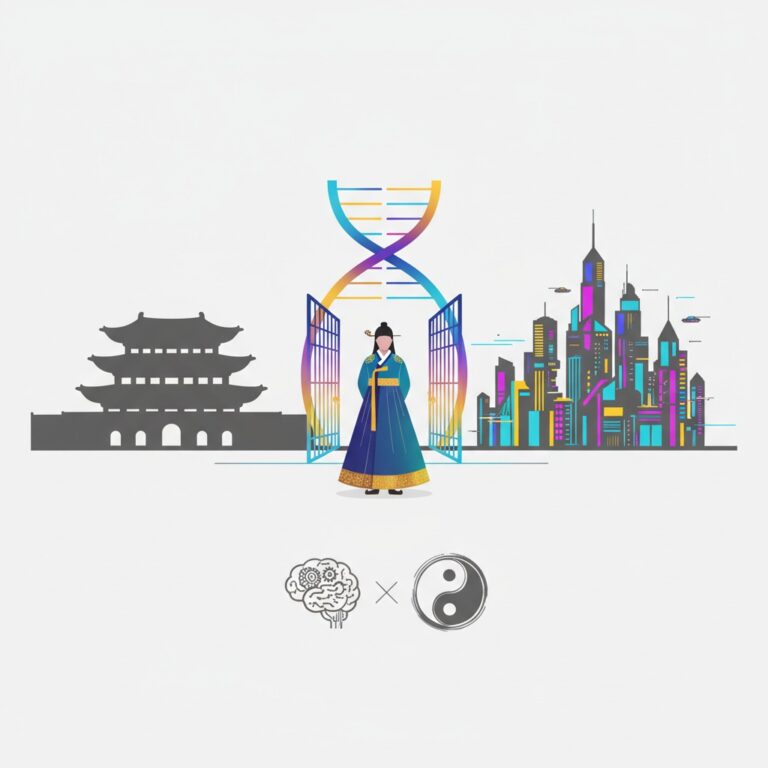
Hello! Welcome to [Maeil Hangul], your partner in upgrading your Korean skills to the highest level!
Today, we’re diving deep into a topic that feels like it’s straight out of science fiction but is becoming increasingly relevant: transhumanism. We’ll be exploring how to critically discuss the future it envisions, using sophisticated Korean expressions. Lately in Korea, a global leader in technology and biotech, conversations about human enhancement, AI, and bioengineering are moving from webtoons and dramas into mainstream public discourse. Mastering this vocabulary will not only allow you to understand these high-level discussions but also to articulate your own nuanced opinions on one of the 21st century’s most pressing ethical debates.
Core Expressions for the Debate
Here are three essential phrases you’ll need to discuss the future of humanity like a pro.
1. 인류의 존엄성 (Illyu-ui joneomseong)
- English Meaning: The dignity of humanity / human dignity
- Detailed Explanation: This is a cornerstone concept in any ethical discussion. ‘인류’ (illyu) means ‘humanity’ or ‘mankind,’ and ‘존엄성’ (joneomseong) means ‘dignity.’ This phrase carries significant weight and is used in formal, academic, or legal contexts to argue for the intrinsic value of human life against technological or commercial objectification. It’s the perfect term to use when questioning whether certain technological advancements might undermine what it means to be human.
- 💡 Pronunciation Tip:
The pronunciation is quite straightforward, but focus on the smooth connection. In ‘존엄성’ [조넘썽/joneomsseong], the final consonant ‘ㅁ’ (m) of ‘엄’ flows directly into the next syllable. Also, note the tensification of ‘성’. While written as ‘seong’, it is often pronounced as [sseong] after a noun, making the sound stronger and more emphatic.
2. 기술적 특이점 (Gisuljeok teugijeom)
- English Meaning: Technological Singularity
- Detailed Explanation: This is a direct translation of the term popularized by futurist Ray Kurzweil. ‘기술적’ (gisuljeok) means ‘technological,’ and ‘특이점’ (teugijeom) means ‘singularity’ or ‘a singular point.’ It refers to the hypothetical point in the future where technological growth becomes uncontrollable and irreversible, resulting in unforeseeable changes to human civilization—most notably, the advent of artificial superintelligence. This term is essential for any serious discussion about the long-term goals and potential risks of AI and transhumanism.
- 💡 Pronunciation Tip:
Pay close attention to ‘기술적’. It is pronounced [기술쩍/gisuljjeok], not [gisuljeok]. In Korean, when the suffix ‘-적 (-jeok)’ is attached to some nouns, the initial ‘ㅈ’ sound becomes the tensed consonant ‘ㅉ’ [jj]. This is a common phonological rule called ‘된소리되기’ (doensori doegi), or tensification, which adds emphasis and clarity.
3. 윤리적 딜레마에 봉착하다 (Yullijeok dillema-e bongchakhada)
- English Meaning: To face an ethical dilemma
- Detailed Explanation: This is a highly sophisticated and formal phrase perfect for essays or debates. Let’s break it down: ‘윤리적’ (yullijeok) means ‘ethical,’ ‘딜레마’ (dillema) is ‘dilemma,’ and ‘봉착하다’ (bongchakhada) is a formal verb meaning ‘to encounter’ or ‘to be confronted with’ a difficult situation. Using ‘봉착하다’ instead of a simpler verb like ‘만나다’ (to meet) elevates your language and shows a high level of proficiency.
- 💡 Pronunciation Tip:
The key here is the consonant assimilation in ‘봉착하다’. It is pronounced [봉차카다/bongchakhada]. The final consonant ‘ㄱ’ (k) of ‘착’ and the initial consonant ‘ㅎ’ (h) of ‘하’ merge to create an aspirated ‘ㅋ’ [kh] sound. This rule is called ‘거센소리되기’ (geosensori doegi), or aspiration, and it makes the pronunciation flow more smoothly.
Example Dialogue
Here’s how these expressions might be used in a conversation between two university students discussing a new sci-fi drama.
A: 요즘 새로 시작한 드라마 ‘코드 제네시스’ 봤어? 인공지능이 인간을 넘어서는 미래를 그렸는데, 기술적 특이점이 정말 멀지 않은 것 같아.
(A: Have you seen the new drama ‘Code Genesis’? It depicts a future where AI surpasses humans. It feels like the technological singularity isn’t far off.)
B: 응, 보고 있어. 기술 발전은 놀랍지만 한편으로는 걱정돼. 유전자를 편집해서 ‘맞춤형 아기’를 만드는 장면을 보면서 인류의 존엄성은 어떻게 되는 걸까 싶더라.
(B: Yeah, I’m watching it. The technological progress is amazing, but it also worries me. Seeing the scene where they create ‘designer babies’ by editing genes made me wonder what happens to human dignity.)
A: 맞아. 그런 기술이 상용화된다면 우리는 심각한 윤리적 딜레마에 봉착하게 될 거야. 치료와 강화의 경계가 모호해지니까.
(A: Exactly. If that kind of technology is commercialized, we will face a serious ethical dilemma. The line between therapy and enhancement becomes so blurry.)
B: 그래서 사회적인 합의가 무엇보다 중요한 것 같아. 기술이 우리를 잠식하지 않도록 말이야.
(B: That’s why social consensus is more important than anything. To ensure technology doesn’t consume us.)
Culture Tip & Trend Analysis
In Korea, a hyper-competitive society obsessed with “specs” (스펙 – qualifications and specifications), the concept of transhumanism holds a unique and often unsettling power. The desire for self-improvement is deeply ingrained, making the idea of technological or biological enhancement both incredibly tempting and profoundly frightening.
This tension is a recurring theme in modern Korean cultural content. Webtoons and dramas frequently explore dystopian futures where genetic modification creates a new class system, or where AI integration challenges the very definition of consciousness. When you see characters in these stories debating the morality of their technologically advanced world, you’ll now recognize they are grappling with ‘인류의 존엄성’ and the ‘윤리적 딜레마’ brought on by the relentless march toward the ‘기술적 특이점’. Engaging with these themes is a way to understand the contemporary anxieties and aspirations of modern Korea.
Wrap-up & Practice
Today, we’ve equipped ourselves with the high-level vocabulary needed to critically examine the future envisioned by transhumanism. You learned about 인류의 존엄성 (human dignity), the 기술적 특이점 (technological singularity), and how to say you’re 윤리적 딜레마에 봉착하다 (facing an ethical dilemma).
Now, it’s your turn to practice!
- Sentence Building: Using the phrase ‘윤리적 딜레마에 봉착하다’, write one sentence in Korean about a potential challenge of human cloning.
- Your Opinion: 기술 발전이 인류의 존엄성을 위협할 수 있다고 생각하십니까? 왜 그렇게 생각하시나요? (Do you think technological advancement can threaten human dignity? Why or why not?)
Leave your answers in the comments below using the expressions we learned today. We look forward to reading your insightful perspectives
Frequently Asked Questions (FAQ)
Q: What does "'인류'" mean in Korean and how do you pronounce it?
A: In Korean, "'인류'" is pronounced [illyu] and means: means 'humanity' or 'mankind,' and
Q: What does "'존엄성'" mean in Korean and how do you pronounce it?
A: In Korean, "'존엄성'" is pronounced [joneomseong] and means: means 'dignity.' This phrase carries significant weight and is used in formal, academic, or legal contexts to argue for the intrinsic value of human life against technological or commercial objectification. It's the perfect term to use when questioning whether certain technological advancements might undermine what it means to be human.
Q: What does "'존엄성'" mean in Korean and how do you pronounce it?
A: In Korean, "'존엄성'" is pronounced [조넘썽/joneomsseong] and means: , the final consonant 'ㅁ' (m) of '엄' flows directly into the next syllable. Also, note the tensification of '성'. While written as 'seong', it is often pronounced as
Q: What does "'기술적'" mean in Korean and how do you pronounce it?
A: In Korean, "'기술적'" is pronounced [gisuljeok] and means: means 'technological,' and







