

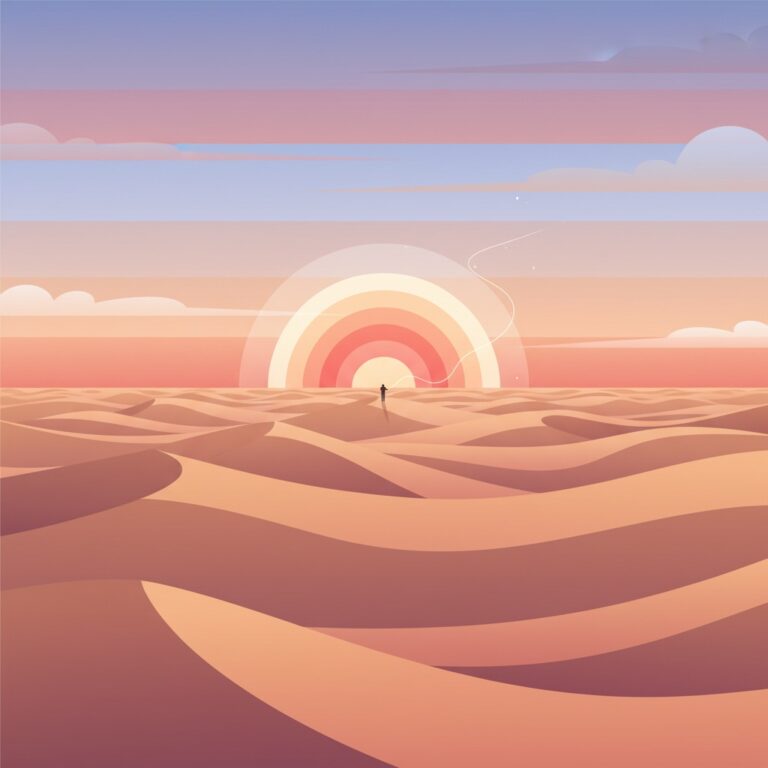
Describe Desert Scenery Like a K-Drama Pro!
Hello! Welcome to Maeil Hangeul, the place to upgrade your Korean skills!
Have you ever been so amazed by a beautiful landscape that you were at a loss for words? Today, we’re going to learn how to describe magnificent scenery in Korean, so you can sound just like a native speaker.
And we have the perfect theme! Lately in Korea, everyone is obsessed with the new hit K-drama, “Echoes of the Sand” (모래의 메아리). The show is famous for its absolutely stunning desert scenes. So, let’s learn the exact expressions you need to talk about these breathtaking views!
Core Expressions
Here are three key phrases to describe a desert landscape, inspired by “Echoes of the Sand”.
1. 끝없이 펼쳐지다 (kkeuteopsi pyeolchyeojida)
- English Meaning: To stretch out endlessly; to be spread out without end.
- Detailed Explanation: This is a beautiful, descriptive phrase perfect for vast landscapes like the ocean, a field of flowers, or a desert. 끝없이 (kkeuteopsi) means “endlessly,” and 펼쳐지다 (pyeolchyeojida) means “to be spread out” or “to unfold.” Use this when you want to emphasize the immense scale of what you’re seeing. It’s a slightly literary and very expressive phrase.
- 💡 Pronunciation Tip:
The word 끝없이 is pronounced [끄덥씨 / kkeudeopssi], not [kkeut-eop-si]. This is because of a Korean pronunciation rule called 연음 (yeon-eum) or liaison. The final consonant of a syllable (like the ‘ㅌ’ in ‘끝’) moves to the next syllable if it starts with a vowel (like the ‘ㅇ’ in ‘없’). Also, the ‘ㅌ’ (t) sound softens to a ‘ㄷ’ (d) sound in this position before it moves. It makes the pronunciation flow much more smoothly!
2. 황홀하다 (hwangholhada)
- English Meaning: To be enchanting, mesmerizing, ecstatic.
- Detailed Explanation: This word goes beyond just “beautiful” (아름답다). 황홀하다 describes a beauty that is so captivating it feels almost magical or dreamlike. It’s the perfect word for a stunning desert sunset or a sky full of stars. You can use it for experiences as well, like listening to an amazing piece of music.
- 💡 Pronunciation Tip:
The ‘ㅎ’ (h) sound in Korean can be tricky. In 황홀하다 [hwangholhada], make sure the ‘ㅎ’ is a soft, airy sound, like a sigh. It’s not a hard ‘h’ like in the English word “hat.” Practice by breathing out gently as you say “hwang” and “hol.”
3. 삭막하다 (sakmakada)
- English Meaning: To be bleak, desolate, barren.
- Detailed Explanation: The desert can be beautiful, but it can also be harsh and empty. 삭막하다 perfectly captures this feeling of emptiness or loneliness. It describes a landscape that lacks warmth and life. You can also use this word metaphorically to describe a bleak situation or a cold, impersonal city.
- 💡 Pronunciation Tip:
The first syllable ‘삭’ starts with ‘ㅅ’ (s) but the feeling is closer to a tense sound because of the final ‘ㄱ’ (k) consonant. When you pronounce 삭막하다 [sakmakada], make sure the ‘ㄱ’ at the end of ‘삭’ is a crisp, unreleased stop. You form the ‘k’ sound but don’t release a puff of air. This gives it a sharper, more distinct sound.
Example Dialogue
Let’s see how these expressions are used in a real conversation about the K-drama, “Echoes of the Sand”.
A: 어제 ‘모래의 메아리’ 봤어? 사막 장면 진짜 대박이었어!
(eoje ‘morae-ui meari’ bwasseo? samak jangmyeon jinjja daebagieosseo!)
A: Did you watch ‘Echoes of the Sand’ yesterday? The desert scene was incredible!
B: 응! 모래가 끝없이 펼쳐지는 거 보고 완전 감동했잖아.
(eung! morae-ga kkeuteopsi pyeolchyeojineun geo bogo wanjeon gamdonghaetjana.)
B: Yes! I was so moved when I saw the sand stretching out endlessly.
A: 맞아. 특히 해질 때 노을은 정말 황홀하더라.
(maja. teuki haejil ttae noeureun jeongmal hwangholhadeora.)
A: I know. The sunset, in particular, was truly enchanting.
B: 근데 한편으로는 좀 삭막해 보이기도 했어. 혼자 있으면 무서울 것 같아.
(geunde hanpyeoneuroneun jom sakmakhae boigido haesseo. honja isseumyeon museoul geot gata.)
B: But on the other hand, it also looked a bit desolate. I think I’d be scared if I were there alone.
Culture Tip & Trend Deep Dive
In many recent Korean dramas and music videos, the desert isn’t just a location; it’s a character. In “Echoes of the Sand”, the 삭막하다 (desolate) landscape often represents the main character’s loneliness and struggles. But at the same time, the 황홀하다 (enchanting) sunsets symbolize hope and the beauty they find amidst hardship.
Korean creators love this duality. When you see a desert in Korean media, it often signifies a journey of self-discovery in a vast, challenging world. So, when you use these words, you’re not just describing the view—you’re also tapping into a deeper, emotional meaning that Korean audiences immediately understand. Using 삭막하다 to describe modern city life (삭막한 도시 생활) is a very common way to use this metaphor!
Let’s Practice!
Time to check what you’ve learned.
- Fill in the blank:
The view from the top of the mountain was so beautiful it was almost magical.
산 정상에서 본 풍경은 정말 _______________. (enchanting) -
Your Turn!
Think of a vast place you have seen (an ocean, a huge city, a field). Try to make a sentence using 끝없이 펼쳐지다.
Great job today! You’re now ready to describe amazing scenery with the poetic flair of a K-drama character.
Why not try it now? Leave a comment below using one of the expressions you learned today!
Frequently Asked Questions (FAQ)
Q: What does "끝없이" mean in Korean and how do you pronounce it?
A: In Korean, "끝없이" is pronounced [kkeuteopsi] and means: means "endlessly," and
Q: What does "펼쳐지다" mean in Korean and how do you pronounce it?
A: In Korean, "펼쳐지다" is pronounced [pyeolchyeojida] and means: means "to be spread out" or "to unfold." Use this when you want to emphasize the immense scale of what you're seeing. It’s a slightly literary and very expressive phrase.
Q: What does "황홀하다" mean in Korean and how do you pronounce it?
A: In Korean, "황홀하다" is pronounced [hwangholhada] and means: , make sure the 'ㅎ' is a soft, airy sound, like a sigh. It's not a hard 'h' like in the English word "hat." Practice by breathing out gently as you say "hwang" and "hol."
Q: What does "삭막하다" mean in Korean and how do you pronounce it?
A: In Korean, "삭막하다" is pronounced [sakmakada] and means: , make sure the 'ㄱ' at the end of '삭' is a crisp, unreleased stop. You form the 'k' sound but don't release a puff of air. This gives it a sharper, more distinct sound.







