

Hello! Welcome to [Daily Hangul], here to upgrade your Korean skills!
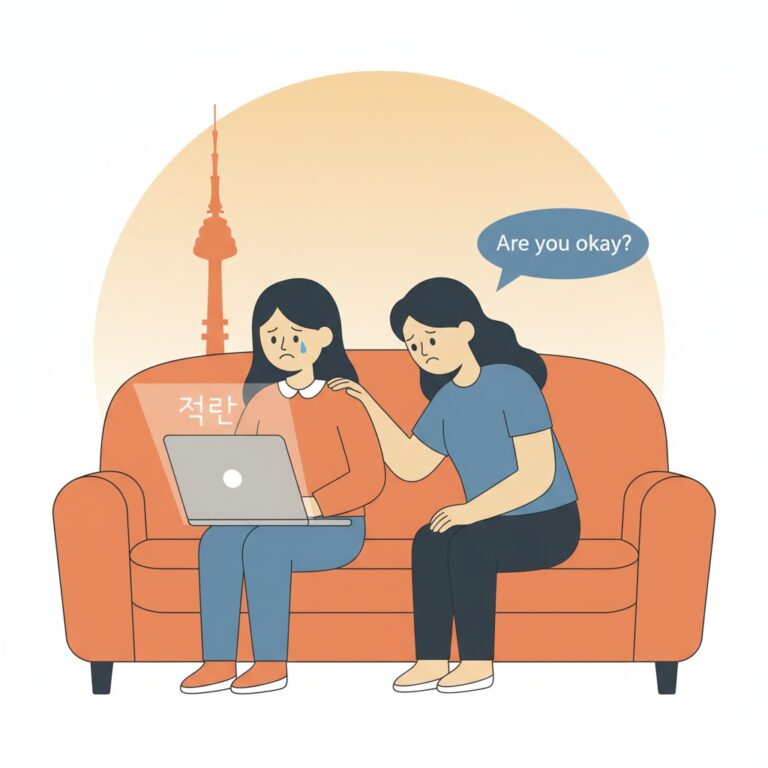
Have you ever seen a friend looking a little down and wanted to ask them what’s wrong in Korean, but all you could think of was “Annyeonghaseyo?”? Don’t worry, we’ve all been there! Today, we’re going to learn how to show you care and ask about someone’s feelings like a true friend.
Especially these days in Korea, with hit K-dramas like ‘City of Stars’ making everyone cry with its emotional finale, knowing how to check in on a friend is a super useful skill! In Korea, showing concern for others’ feelings is a huge part of the culture. So let’s learn how to do it naturally!
Core Expressions: Show You Care!
Here are three essential phrases to ask someone how they are feeling.
1. 괜찮아? (Gwaenchana?)
- Korean Expression: 괜찮아?
- Pronunciation [Romanization]: Gwaenchana?
- English Meaning: Are you okay? / Is it okay?
- Detailed Explanation: This is the most common and versatile phrase! It’s an informal, friendly way to ask a friend, a younger person, or someone you’re close to if they are okay. You can use it when they seem sad, sick, or have just tripped and fallen. It’s the go-to expression for showing general concern.
- 💡 Pronunciation Tip:
The letter ‘ㅎ’ (h) in ‘찮’ is tricky! When it’s sandwiched between two other sounds like this (ㄴ and ㅏ), it often becomes very weak or silent. So, instead of saying “gwaen-chan-ha,” Koreans pronounce it smoothly as [괜차나 | gwaen-cha-na]. It makes the flow much more natural.
2. 무슨 일 있어? (Museun il isseo?)
- Korean Expression: 무슨 일 있어?
- Pronunciation [Romanization]: Museun il isseo?
- English Meaning: What’s wrong? / Is something the matter? / What happened?
- Detailed Explanation: This phrase is a bit more direct than “괜찮아?”. You use this when it’s pretty clear that something is up with your friend. The literal meaning is “Is there some event/matter?”. It invites the other person to share what’s on their mind. It’s also informal and used with friends.
- 💡 Pronunciation Tip:
This is a fantastic example of a Korean pronunciation rule called linking (연음, yeon-eum). The final consonant of a syllable, in this case, the ‘ㄹ’ (l) in ‘일’, moves to the next syllable if it starts with a vowel. So, you don’t pronounce ‘il isseo’ as two separate words. Instead, you link them together smoothly to sound like [이리써 | i-ris-seo]. This one tip will make you sound so much more like a native speaker!
3. 기분이 안 좋아 보여요. (Gibuni an joa boyeoyo.)
- Korean Expression: 기분이 안 좋아 보여요.
- Pronunciation [Romanization]: Gibuni an joa boyeoyo.
- English Meaning: You seem to be in a bad mood. / You don’t look well.
- Detailed Explanation: This is your best choice for more formal or polite situations. You can use it with a co-worker, an older acquaintance, or someone you don’t know very well. It’s a gentle observation (“You look/seem…”) rather than a direct question, which can feel softer and more respectful. ‘기분’ (gibun) means ‘feeling’ or ‘mood’.
- 💡 Pronunciation Tip:
Just like in ‘괜찮아’, the ‘ㅎ’ (h) in ‘좋아’ (joa) is silent because it’s followed by a vowel. So, you don’t pronounce it as “jo-ha.” It’s simply [조아 | jo-a]. Easy, right?
Example Dialogue
Let’s see how these expressions work in a real conversation! Min-jun sees his friend Su-jin looking sad after watching the finale of their favorite K-drama, ‘City of Stars’.
- Min-jun (A): 수진아, 표정이 안 좋다. 무슨 일 있어?
(Sujin-a, pyojeong-i an jota. Museun il isseo?)
Hey Su-jin, you don’t look so good. What’s wrong? -
Su-jin (B): 응… 방금 드라마 마지막 회 봤어. 너무 슬퍼.
(Eung… banggeum deurama majimak hoe bwasseo. Neomu seulpeo.)
Yeah… I just watched the final episode of the drama. It’s so sad. -
Min-jun (A): 아, 그 드라마! 주인공 괜찮대? 너는 괜찮아?
(A, geu deurama! Ju-ingong gwaenchanttae? Neoneun gwaenchana?)
Ah, that drama! Is the main character okay? Are *you okay?* -
Su-jin (B): 아니, 안 괜찮아… ㅠㅠ
(Ani, an gwaenchana…)
No, I’m not okay… ㅠㅠ
Culture Tip: The Art of Nunchi (눈치)
When you use today’s phrases, you’re doing more than just speaking Korean—you’re practicing nunchi (눈치)!
Nunchi is the subtle art of sensing someone’s mood or “reading the room.” It’s a very important social skill in Korea. Instead of waiting for someone to say “I’m sad,” a person with good nunchi will notice their friend’s quietness or sad expression and ask, “무슨 일 있어?” first.
You’ll see this all the time in K-dramas! The most caring and thoughtful characters are always the ones with the best nunchi. By learning to use these expressions, you’re showing that you are an observant and empathetic friend. It’s a beautiful way to connect more deeply with Korean people!
Wrap-up & Let’s Practice!
Awesome work today! You learned three fantastic ways to ask about someone’s feelings: the friendly “괜찮아?”, the direct “무슨 일 있어?”, and the polite “기분이 안 좋아 보여요.”
Now, let’s test your knowledge!
- Fill in the blank: You see your close friend looking sad. What would you ask them?
“너 표정이 왜 그래? ______?” (Neo pyojeong-i wae geurae? _______?)
- Scenario Quiz: Your Korean boss, Mr. Park, seems very stressed after a long meeting. Which phrase is more appropriate to use?
a) 무슨 일 있어?
b) 기분이 안 좋아 보여요.
Great job! You’re now equipped to be an even more caring friend in Korean.
Why not try it out? Leave a comment below making a sentence with one of today’s expressions! See you next time at [Daily Hangul]







