

Unlock Lower Rates! Your Ultimate Guide to ‘Dae-chul Gal-a-ta-gi’ (대출 갈아타기) in Korea
Hello! It’s your favorite Korean language booster, [Everyday Hangul], here to upgrade your skills!
Today, we’re diving into a topic you’ll hear everywhere in Korea right now, from the evening news to K-dramas set in sleek Seoul offices: personal finance. Specifically, we’re going to master how to talk about loan refinancing.
Lately in Korea, with interest rates constantly changing, the term ‘대출 갈아타기’ (daechul garatagi) has become a massive buzzword. It’s a key strategy for smart financial planning. Understanding these expressions won’t just expand your C1-level vocabulary; it will give you a fascinating window into the economic conversations happening in Korea today. Ready to sound like a financial pro? Let’s go! 💰
Core Expressions You Need to Know
Here are the essential phrases for discussing loan refinancing like a native speaker.
1. 대출 갈아타기 (Dae-chul Gal-a-ta-gi)
- Pronunciation [Romanization]: Dae-chul gal-a-ta-gi
- English Meaning: Loan Refinancing (literally, “to transfer a loan”)
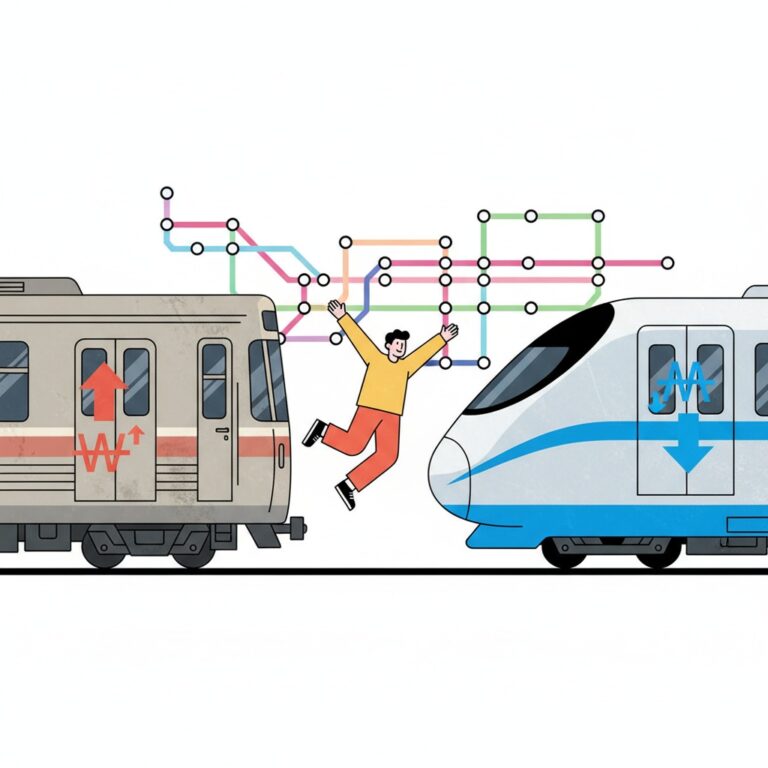
- Detailed Explanation: This is the key phrase of the day! ‘대출’ means ‘loan’, and ‘갈아타다’ is a verb that means ‘to transfer,’ most commonly used when you transfer subway lines or buses. In a financial context, it cleverly describes the action of switching your existing loan from one bank to another, usually to secure better terms. It’s a very common, everyday expression.
- 💡 Pronunciation Tip: The magic is in the smooth connection! The
ㄹ(l/r) at the end of갈(gal) links directly to the아(a) that follows it. This phenomenon is called ‘연음’ (yeon-eum), or liaison. So, instead of a choppy “gal / a / ta / gi,” you should pronounce it as one fluid phrase: [ga-ra-ta-gi]. This will instantly make you sound more natural.
2. 금리 인하 (Geum-ri In-ha)
- Pronunciation [Romanization]: Geum-ri in-ha
- English Meaning: Interest rate cut / reduction
- Detailed Explanation: This is a crucial term made of Hanja (Sino-Korean characters). ‘금리’ (金利) means ‘interest rate’, and ‘인하’ (引下) means ‘reduction’ or ‘to pull down’. You’ll constantly see this term in financial news. Its opposite, ‘금리 인상’ (geum-ri in-sang), means ‘interest rate hike’. Knowing both will make you sound highly proficient.
- 💡 Pronunciation Tip: Pay attention to the
ㄴandㅎsounds together. When a syllable ending inㄴ(n) is followed by a syllable starting withㅎ(h), theㅎsound often becomes very weak or disappears entirely. So, while written asin-ha, the natural pronunciation sounds closer to [i-na]. This is a form of assimilation that makes the word flow better.
3. 장단점을 따져보다 (Jang-dan-jeom-eul Tta-jyeo-bo-da)
- Pronunciation [Romanization]: Jang-dan-jeom-eul tta-jyeo-bo-da
- English Meaning: To weigh the pros and cons
- Detailed Explanation: This is an incredibly versatile phrase for any decision-making process. Let’s break it down: ‘장점’ (長點) means ‘pros’ or strong points, ‘단점’ (短點) means ‘cons’ or weak points, and ‘따져보다’ is a verb that means to weigh, consider, or scrutinize carefully. You can use this for anything from refinancing a loan to choosing what to eat for dinner!
- 💡 Pronunciation Tip: The key here is the tense consonant
ㄸ(tt). This is a ‘ssang-jieut’ and it’s pronounced with more tension in your vocal cords and without the puff of air you’d use forㅌ(t). It’s a sharp, strong sound. To practice, try saying “DDA” forcefully. Mastering this distinguishes words like 달 (dal – moon) from 딸 (ttal – daughter) and makes your pronunciation precise.
4. 중도상환수수료 (Jung-do-sang-hwan-su-su-ryo)
- Pronunciation [Romanization]: Jung-do-sang-hwan-su-su-ryo
- English Meaning: Prepayment penalty / Early repayment fee
- Detailed Explanation: This is a very specific, advanced term that will truly show off your skills. It refers to the fee a bank charges if you pay off your loan earlier than the agreed-upon term. It’s a critical factor when considering refinancing. Let’s look at the Hanja: 중도 (中途) = midway, 상환 (償還) = repayment, 수수료 (手数料) = fee/commission. Understanding this term is essential for making a smart financial decision.
- 💡 Pronunciation Tip: Don’t be intimidated by its length! The best way to tackle long Korean words is to break them into smaller, manageable parts: 중도 (jung-do) + 상환 (sang-hwan) + 수수료 (su-su-ryo). Practice each component slowly, then string them together. There are no complex sound changes here, just a series of clear syllables.
Example Dialogue
See how these phrases come alive in a natural conversation between two colleagues, Sarah and Min-jun.
A (Sarah): 민준 씨, 요즘 금리가 많이 변동돼서 대출 갈아타기를 고민 중이에요.
* Min-jun, with interest rates fluctuating so much lately, I’m considering refinancing my loan.
B (Min-jun): 아, 좋은 생각이에요. 잘하면 금리 인하 혜택을 크게 볼 수 있죠.
* Ah, that’s a great idea. If you do it right, you can really benefit from an interest rate reduction.
A (Sarah): 맞아요. 그런데 은행마다 조건이 달라서 장단점을 따져보는 게 쉽지 않네요. 특히 중도상환수수료가 걱정돼요.
* Exactly. But each bank has different conditions, so it’s not easy to weigh the pros and cons. I’m especially concerned about the prepayment penalty.
B (Min-jun): 정부에서 지원하는 대환대출 플랫폼도 있으니 한번 알아보세요. 수수료 면제 혜택이 있을 수도 있어요.
* You should check out the government-supported refinancing platforms. There might be benefits like fee waivers.
Cultural Tip & Trend Deep Dive
In Korea, where real estate (부동산) prices and financial planning are major topics of daily conversation, being able to discuss loans is a practical skill.
Recently, the financial landscape has been transformed by technology. The Korean government and various fintech companies have launched online platforms and mobile apps that allow users to compare refinancing options from multiple banks in minutes. This digital shift has made ‘대출 갈아타기’ more accessible and a hotter topic than ever before. Mentioning that you’re aware of these platforms in a conversation will show that you’re not just learning the language, but you’re also in tune with modern Korean life. Your Korean friends and colleagues will be seriously impressed!
Let’s Review!
Great work today! We’ve covered some advanced but highly relevant Korean phrases for discussing personal finance, from the main concept of ‘대출 갈아타기’ to the critical details like ‘중도상환수수료’.
Now, let’s put your knowledge to the test!
1. Fill in the blank:
You’re telling a friend your goal is to get a better deal on your mortgage.
“I want to get a(n) __________, so I’m looking for a new bank.”
(저는 __________를 받으려고 새로운 은행을 알아보고 있어요.)
* Hint: A reduction in your interest rate!
2. Create a sentence:
You’re thinking of moving to a new apartment. Using the expression we learned today, how would you say, “I need to weigh the pros and cons carefully”?
Leave your answers in the comments below! We’d love to see how you use these new expressions. Keep up the fantastic work! 👍
Frequently Asked Questions (FAQ)
Q: What does "'대출 갈아타기'" mean in Korean and how do you pronounce it?
A: In Korean, "'대출 갈아타기'" is pronounced [daechul garatagi] and means: has become a massive buzzword. It's a key strategy for smart financial planning. Understanding these expressions won't just expand your C1-level vocabulary; it will give you a fascinating window into the economic conversations happening in Korea today. Ready to sound like a financial pro? Let's go! 💰
Q: What does "'연음'" mean in Korean and how do you pronounce it?
A: In Korean, "'연음'" is pronounced [yeon-eum] and means: , or liaison. So, instead of a choppy "gal / a / ta / gi," you should pronounce it as one fluid phrase:
Q: What does "'금리'" mean in Korean and how do you pronounce it?
A: In Korean, "'금리'" is pronounced [金利] and means: means 'interest rate', and
Q: What does "'인하'" mean in Korean and how do you pronounce it?
A: In Korean, "'인하'" is pronounced [引下] and means: means 'reduction' or 'to pull down'. You'll constantly see this term in financial news. Its opposite,






