

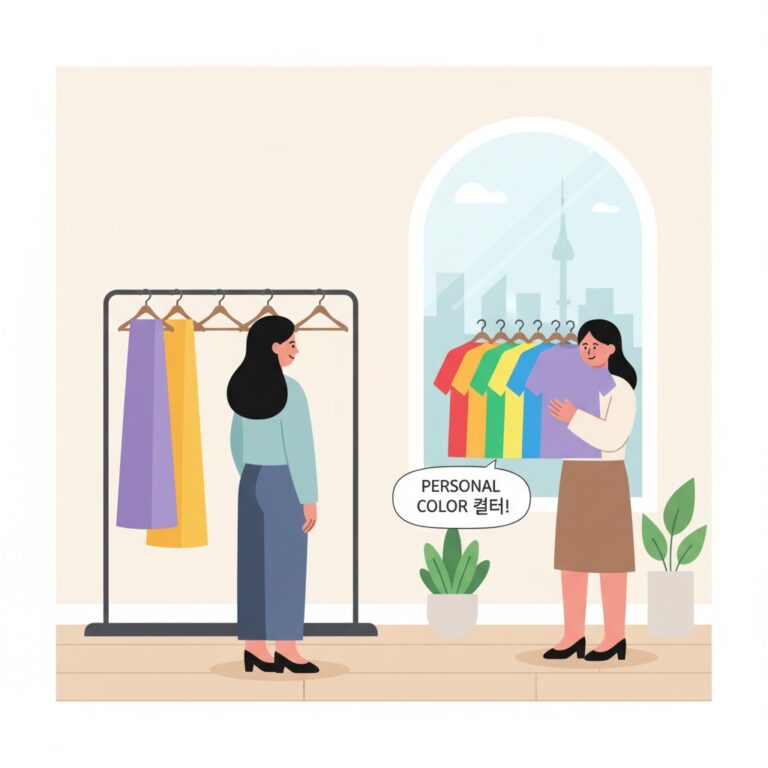
Shopping in Korea? How to Ask: “Does this come in another color?” 🛍️
Hello! Welcome to [Maelel Hangeul], here to upgrade your Korean skills!
Ever been shopping in a trendy Seoul boutique, found the perfect T-shirt, but wished it came in a different color? You’re not alone! Today, we’re going to solve that problem.
You know how K-pop idols are rocking all those amazing, vibrant colors lately? Recently in Korea, finding your “personal color” (퍼스널 컬러) is a huge trend! It’s all about discovering which shades make you shine. So, let’s learn the essential Korean phrases you need to find your perfect color while shopping in places like Hongdae or Myeongdong. Let’s go!
✨ Core Expressions You Need to Know
Here are three simple but powerful expressions to help you navigate any clothing store in Korea.
1. 이거 다른 색깔도 있어요? (Do you have this in other colors?)
- Korean: 이거 다른 색깔도 있어요?
- Pronunciation [Romanization]: Igeo dareun saekkaldo isseoyo?
- English Meaning: Do you have this in other colors?
- Detailed Explanation: This is your go-to phrase! Let’s break it down:
이거(igeo) = This (thing)다른(dareun) = Different / Other색깔(saekkal) = Color도(do) = Also / Too있어요?(isseoyo?) = Do you have…? / Is there…?
It’s a polite and universally understood question you can use with any store staff.
- 💡 Pronunciation Tip:
Theㄲ(kk) in색깔[saekkal] is a “tensed consonant.” It’s stronger and sharper than a regular ‘k’ sound in English. To make this sound, try saying “sky” but put extra force on the “k” part without letting out a puff of air. It’s notsaek-kal, but a sharp [saekkal]!
2. [Color]으로 보여주세요. (Please show me in [Color].)
- Korean: 파란색으로 보여주세요.
- Pronunciation [Romanization]: Paransaeg-euro boyeojuseyo.
- English Meaning: Please show it to me in blue.
-
Detailed Explanation: Use this when you have a specific color in mind. The structure is [Color Name] + -으로/로 (-euro/ro) + 보여주세요 (boyeojuseyo).
- Use
-으로(euro) after a word ending in a consonant (e.g.,까만색– kkamansaek). - Use
-로(ro) after a word ending in a vowel. 보여주세요(boyeojuseyo) means “Please show me.”- Common Colors:
- Black:
까만색(kkamansaek) - White:
하얀색(hayansaek) - Red:
빨간색(ppalgansaek) - Blue:
파란색(paransaek)
- Black:
- Use
- 💡 Pronunciation Tip:
When a syllable ending in a consonant is followed by a vowel, the consonant sound often “links” to the next syllable. For example,파란색으로is written asParansaek-euro, but the finalㄱ(k) sound of색(saek) moves over, making it sound like [파란새그로 (paransae-geuro)]. This linking rule, called 연음 (yeoneum), makes your Korean sound much smoother and more natural!
3. 혹시 (By any chance…?)
- Korean: 혹시
- Pronunciation [Romanization]: Hoksi
- English Meaning: By any chance / Excuse me, but…
-
Detailed Explanation:
혹시(hoksi) is a magic word! Adding it to the beginning of your question makes you sound incredibly polite and considerate. It shows you understand that they might not have what you’re asking for.- Example: 혹시 이거 다른 색깔도 있어요? (Hoksi igeo dareun saekkaldo isseoyo?)
- 💡 Pronunciation Tip:
In혹시, theㄱ(k) at the end of혹(hok) meets theㅅ(s) in시(si). In Korean, this combination often results in theㅅ(s) sound becoming tensed. So, instead of [hok-si], it’s pronounced more like [혹씨 (hokssi)].
💬 Example Dialogue
Here’s how these phrases work in a real conversation at a shop in Seoul.
- A (You): 이 티셔츠 너무 예뻐요! 혹시 이거 다른 색깔도 있어요?
- (I ti-sheo-cheu neomu yeppeoyo! Hoksi igeo dareun saekkaldo isseoyo?)
- This T-shirt is so pretty! By any chance, do you have this in other colors?
- B (Staff): 네, 잠시만요. 까만색하고 하얀색이 있습니다.
- (Ne, jamsimanyo. Kkamansaek-hago hayansaek-i itseumnida.)
- Yes, just a moment. We have it in black and white.
- A (You): 아, 그렇군요. 하얀색으로 보여주세요.
- (A, geureokunyo. Hayansaeg-euro boyeojuseyo.)
- Oh, I see. Please show me the white one.
- B (Staff): 네, 여기 있습니다.
- (Ne, yeogi itseumnida.)
- Yes, here you are.
🇰🇷 Culture Tip & Trend Deep Dive
Sound Like a Local: Mention Your “Personal Color”!
As we mentioned, “personal color” (퍼스널 컬러 – peoseoneol keolleo) analysis is a massive trend in Korea, especially among the younger generation. It’s all about finding the palette of colors that best complements your natural skin tone, hair, and eye color, often categorized into types like “Spring Warm,” “Summer Cool,” “Autumn Warm,” and “Winter Cool.”
If you want to really impress the store staff and sound like you’re in the know, you could try saying:
“저는 쿨톤인데, 어울리는 색깔 있어요?”
(Jeoneun kulton-inde, eoullineun saekkal isseoyo?)
“I have a cool skin tone, do you have any colors that would suit me?”
Using a phrase like this shows you’re not just a tourist; you’re clued into modern Korean culture!
✍️ Let’s Practice!
Time to check what you’ve learned.
- Fill in the blank: You found a beautiful dress and want to see it in red. What do you say?
이 드레스, _______________ 보여주세요. (i deuresseu, _______________ boyeojuseyo.)
- Sentence Building: You see a nice hat. How would you politely ask the staff, “By any chance, do you have this hat in other colors?”
Great job today! You’re now ready to confidently ask for exactly what you want while shopping in Korea.
Now it’s your turn! Try making a sentence in the comments below using today’s phrases. What item would you buy and in what color? We can’t wait to read them!
Frequently Asked Questions (FAQ)
Q: What does "연음" mean in Korean and how do you pronounce it?
A: In Korean, "연음" is pronounced [yeoneum] and means: , makes your Korean sound much smoother and more natural!







