

Hello! Welcome to [Maeil Hangeul], here to upgrade your Korean skills to the next level!
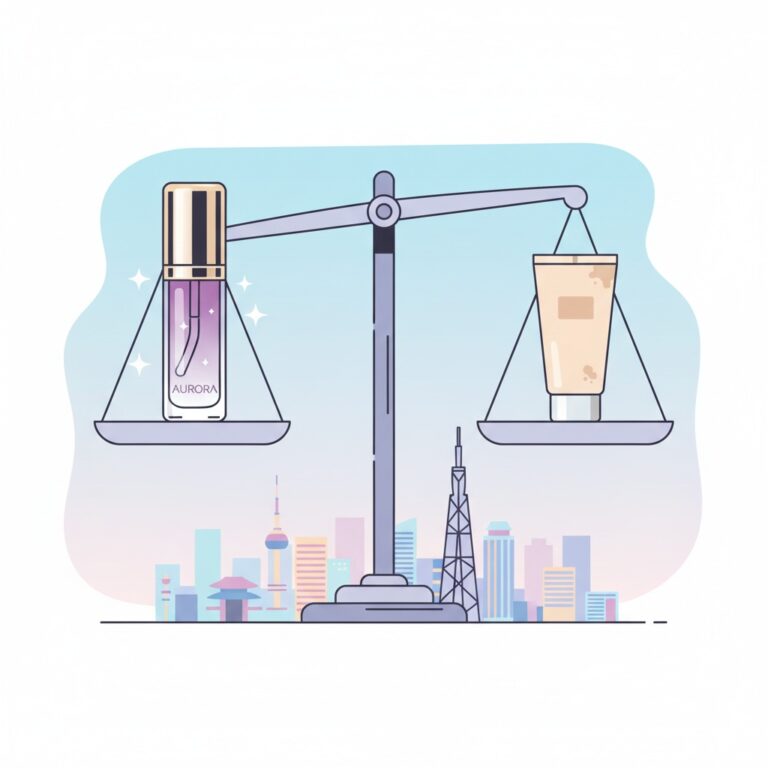
Today, we’re diving into a topic you’ll definitely encounter in business meetings, academic discussions, or even just critically analyzing the world around you: the ethics of advertising. Ever seen an ad and thought, “Is that really true?” We’ll give you the advanced Korean vocabulary to articulate that exact thought.
Especially recently in Korea, there has been a huge public discussion around “뒷광고” (undisclosed ads by influencers) and exaggerated claims for health supplements. This makes knowing how to discuss the fine line between clever marketing and outright deception more relevant than ever! Let’s get started.
Core Expressions for Your Ethical Toolkit
Here are four key phrases that will make you sound like a pro when discussing advertising.
1. 과장 광고 (Gwajang gwanggo)
- Pronunciation [Gwajang gwanggo]
- English Meaning: Exaggerated advertising; hype.
- Detailed Explanation: This term refers to ads that “puff up” or embellish the features of a product without telling an outright lie. It’s about making something sound much better than it actually is. Think of a fast-food burger that looks magnificent in the ad but a bit sad in real life. This is a very common term you’ll see in news articles and consumer reports.
- 💡 Pronunciation Tip: The ‘광’ in ‘광고’ is a tense sound. It’s not ‘gwang’ but [ggwang]. Try making the ‘gg’ sound at the back of your throat with a bit more force, as if you’re holding your breath for a split second before releasing it.
2. 허위 광고 (Heowi gwanggo)
- Pronunciation [Heowi gwanggo]
- English Meaning: False advertising; deceptive ad.
- Detailed Explanation: This is a step beyond 과장. 허위 (heowi) means falsehood or fabrication. This type of advertising makes claims that are factually untrue and can be proven false. For example, claiming a drink is “100% sugar-free” when it contains sugar. This is illegal and carries serious consequences for the company. The distinction between 과장 (exaggeration) and 허위 (falsehood) is central to any ethical debate on this topic.
- 💡 Pronunciation Tip: The Korean ‘허 (heo)’ is similar to the ‘hu’ in ‘huh’. The vowel ‘위 (wi)’ is pronounced like the English word “we.” So, it’s [heo-wi].
3. 소비자를 기만하다 (Sobijareul gimanhada)
- Pronunciation [Sobijareul gimanhada]
- English Meaning: To deceive consumers.
- Detailed Explanation: This is a powerful and formal verb phrase used to accuse an entity of deception. 기만하다 (gimanhada) is a stronger, more formal word than the everyday verb ‘속이다’ (to trick). You would use this phrase in a formal complaint, a news report, or a serious discussion about corporate responsibility. It implies a deliberate and unethical act of misleading the public.
- 💡 Pronunciation Tip: Notice the linking sound (연음)! The final consonant ‘ㄹ(l)’ in ‘소비자를’ smoothly connects to the next syllable, making it sound like [so-bi-ja-reul]. This is a key feature of natural Korean pronunciation.
4. 윤리적 경계가 모호하다 (Yullijeok gyeongyega mohohada)
- Pronunciation [Yullijeok gyeongyega mohohada]
- English Meaning: The ethical boundary is ambiguous/blurry.
- Detailed Explanation: This is a fantastic C1-level phrase for expressing nuance. It’s used when the line between acceptable marketing and unethical deception isn’t clear-cut. It shows you can see both sides of an argument. Let’s break it down: 윤리적 (yullijeok) means ‘ethical,’ 경계 (gyeongye) means ‘boundary,’ and 모호하다 (mohohada) means ‘to be vague or ambiguous.’
- 💡 Pronunciation Tip: In ‘경계가’, the final vowel ‘ㅖ(ye)’ is often simplified in conversation to ‘ㅔ(e)’. So while the standard is [gyeong-ye-ga], you’ll often hear it pronounced as [gyeong-ge-ga], which is perfectly natural.
Example Dialogue
Let’s see how these expressions work in a real conversation. Two colleagues, A and B, are discussing a popular new product.
A: 요즘 SNS에서 화제인 그 콜라겐 젤리 광고 봤어요? 먹기만 하면 피부가 10년은 젊어진다고 하던데요.
(Have you seen the ad for that collagen jelly that’s trending on social media? It says just eating it will make your skin look 10 years younger.)
B: 아, 봤어요. 근데 그건 전형적인 과장 광고 같아요. 효과를 입증할 만한 신뢰성 있는 자료는 없더라고요.
(Ah, I’ve seen it. But that seems like a classic case of exaggerated advertising. There’s no reliable data to prove its effects.)
A: 맞아요. 저런 건 거의 허위 광고 수준이죠. 명백히 소비자를 기만하는 행위라고 생각해요.
(Exactly. That’s almost at the level of false advertising. I think it’s a clear act of deceiving consumers.)
B: 글쎄요, 법적으로는 어떨지 모르겠네요. ‘피부 건강에 도움을 줄 수 있음’ 같은 문구를 작게 써 놨을 거예요. 이런 부분이 바로 윤리적 경계가 모호한 지점인 것 같아요.
(Well, I’m not sure about the legality. They probably wrote “may help with skin health” in small print somewhere. I think this is exactly where the ethical boundary is ambiguous.)
Culture Tip: The “Nae-don-nae-san” (내돈내산) Generation
In Korea, consumer trust is a huge deal. The MZ Generation (Millennials + Gen Z) is particularly sensitive to authenticity in advertising. This has given rise to the popular hashtag and concept of 내돈내산 (nae-don-nae-san), which is a shortened form of “내 돈으로 내가 산 후기” (A review of something I bought with my own money).
When famous YouTubers were caught in “뒷광고” (undisclosed sponsorship) scandals, there was massive public backlash. People felt they were being deceived. Therefore, when you use a phrase like 소비자를 기만하다, you’re not just using advanced vocabulary; you’re tapping into a very current and important social sentiment in Korea about corporate transparency and responsibility. Knowing this context will make your argument even more powerful!
Let’s Wrap It Up & Practice!
Today, we learned four essential phrases for discussing the complex world of advertising ethics:
- 과장 광고 (Exaggerated ad)
- 허위 광고 (False ad)
- 소비자를 기만하다 (To deceive consumers)
- 윤리적 경계가 모호하다 (The ethical boundary is ambiguous)
Now it’s your turn to practice!
1. Fill in the blank:
A company claimed its new phone was “completely waterproof,” but it broke after being in the rain. This is a clear example of ___________.
(회사가 새 휴대폰이 ‘완전 방수’라고 주장했지만 비를 맞고 고장 났다. 이것은 명백한 ___________의 사례이다.)
2. Your Turn!
Think of an ad you’ve seen recently. In your opinion, was it just 과장 광고, or did it cross the line into deceiving consumers? Try to write a sentence using one of today’s phrases.
Leave your answers in the comments below! We’d love to see you put your new skills to use. Keep up the great work
Frequently Asked Questions (FAQ)
Q: What does "허위" mean in Korean and how do you pronounce it?
A: In Korean, "허위" is pronounced [heowi] and means: means falsehood or fabrication. This type of advertising makes claims that are factually untrue and can be proven false. For example, claiming a drink is "100% sugar-free" when it contains sugar. This is illegal and carries serious consequences for the company. The distinction between 과장 (exaggeration) and 허위 (falsehood) is central to any ethical debate on this topic.
Q: What does "기만하다" mean in Korean and how do you pronounce it?
A: In Korean, "기만하다" is pronounced [gimanhada] and means: is a stronger, more formal word than the everyday verb '속이다' (to trick). You would use this phrase in a formal complaint, a news report, or a serious discussion about corporate responsibility. It implies a deliberate and unethical act of misleading the public.
Q: What does "윤리적" mean in Korean and how do you pronounce it?
A: In Korean, "윤리적" is pronounced [yullijeok] and means: means 'ethical,'
Q: What does "경계" mean in Korean and how do you pronounce it?
A: In Korean, "경계" is pronounced [gyeongye] and means: means 'boundary,' and







