

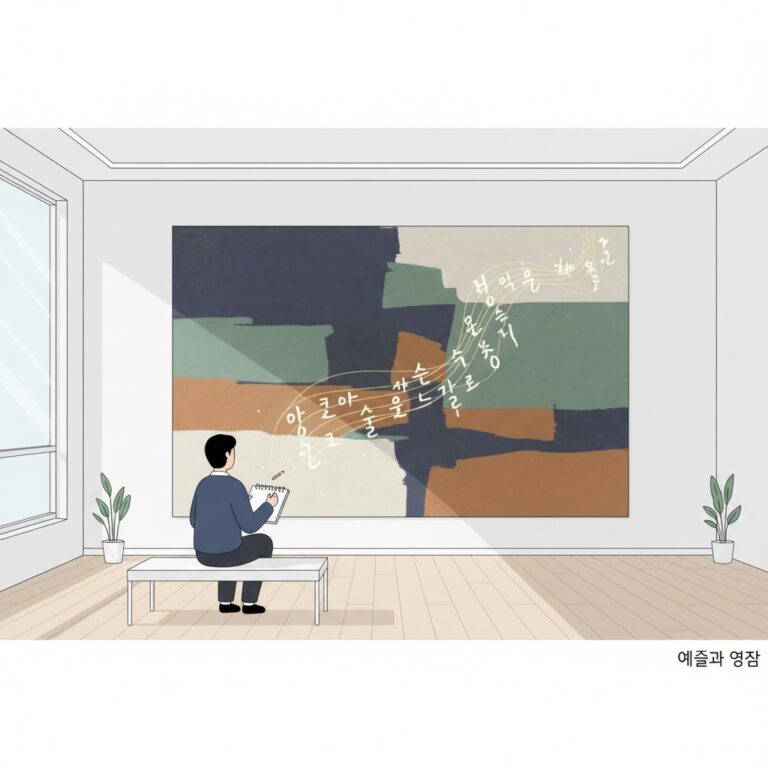
From Canvas to Verse: The Art of Ekphrasis in Korean Poetry
Hello! Welcome to [Daily Hangul], where we upgrade your Korean skills to the next level!
Have you ever looked at a painting, a sculpture, or a photograph and felt an overwhelming wave of emotion or a story brewing in your mind? What if you could capture that feeling in words? Today, we’re diving into a sophisticated and beautiful topic perfect for advanced learners: 엑프라시스 (Ekphrasis), the art of writing poetry inspired by other works of art.
Lately, the art scene in Korea has been buzzing, with major retrospectives of artists like Edward Hopper and innovative exhibitions at the MMCA drawing huge crowds. People aren’t just looking; they’re feeling, thinking, and creating. This is the perfect environment to learn how to transform visual inspiration into powerful Korean verse. Let’s learn the language to do just that!
Core Expressions for Your Inner Poet
Here are some key expressions that will help you discuss and write ekphrastic poetry.
1. 영감을 주다/받다 (yeonggameul juda/batda)
- English Meaning: To give/receive inspiration.
- Detailed Explanation: This is the foundational phrase for any creative work.
영감(yeonggam) means ‘inspiration,’ and you can pair it with주다(to give) or받다(to receive). It’s used in both casual and formal contexts to talk about the source of your creative spark.- Example: 이 그림은 저에게 새로운 시에 대한 영감을 줬어요. (i geurimeun jeo-ege saeroun si-e daehan yeonggameul jwosseoyo.) – This painting gave me inspiration for a new poem.
- 💡 Pronunciation Tip:
When감(gam) is followed by the particle을(eul), theㅁ(m) sound naturally carries over to the next syllable, making it sound like [영가믈, yeong-ga-meul]. This is called 연음 (yeon-eum) or liaison, and mastering it is key to a fluid, natural accent.
2. 구체화하다 (guchehwahada)
- English Meaning: To give concrete form to; to embody; to materialize.
- Detailed Explanation: This verb is perfect for describing the process of turning an abstract feeling or idea into something tangible, like a poem.
구체(guche) means ‘concrete’ or ‘tangible,’ and-화하다(-hwahada) is a suffix that means ‘to make’ or ‘to become.’ You’re literally “making an abstract feeling concrete.”- Example: 그림을 보고 느낀 복잡한 감정을 시로 구체화하고 싶어요. (Geurimeul bogo neukkin bokjapan gamjeongeul siro guchehwahago sipeoyo.) – I want to give concrete form to the complex emotions I felt from the painting through a poem.
- 💡 Pronunciation Tip:
The syllable화(hwa) is an aspirated sound. Make sure you release a strong puff of air, almost like a ‘wha’ sound in English. It’s not a soft ‘wa’ but a breathy [hwa].
3. 재해석하다 (jaehaeseokada)
- English Meaning: To reinterpret.
- Detailed Explanation: Ekphrasis is not mere description; it’s an act of reinterpretation. The prefix
재-(jae-) means ‘re-‘ or ‘again,’ and해석하다(haeseokada) means ‘to interpret.’ This word perfectly captures how a poet brings their own perspective and story to an existing piece of art.- Example: 시인은 반 고흐의 ‘별이 빛나는 밤’을 자신만의 방식으로 재해석했다. (Si-ineun ban goheu-ui ‘byeori binnaneun bam’-eul jasinman-ui bangsigeuro jaehaeseokaetda.) – The poet reinterpreted Van Gogh’s ‘Starry Night’ in their own way.
- 💡 Pronunciation Tip:
In해석했다(haeseokaetda), the final consonantㄱ(k) of석moves to the next syllable, which starts with a vowel sound. So, instead ofhaeseok-haetda, the sound becomes [재해서캗따, jae-hae-seo-kaet-tta]. The final다also becomes tense [ㄸ] due to the preceding consonant. This is a combination of liaison and consonant tensification.
4. 심상 (simsang)
- English Meaning: Imagery; mental image.
- Detailed Explanation: This is a crucial literary term.
심상refers to the images, sensations, and feelings that a poem evokes in the reader’s mind. When writing an ekphrastic poem, you are essentially translating visual imagery into linguistic심상.- Example: 이 시는 차갑고 날카로운 심상을 통해 고독을 표현한다. (I si-neun chagapgo nalkaroun simsang-eul tonghae godogeul pyohyeonhanda.) – This poem expresses loneliness through cold and sharp imagery.
- 💡 Pronunciation Tip:
The pronunciation is straightforward: [심상, sim-sang]. Just remember to clearly pronounce both theㅁ(m) andㅇ(ng) sounds at the end of each syllable.
Example Dialogue: At the Art Gallery
Let’s see these words in action at a modern art gallery in Seoul.
A: 와, 이 김환기 화백의 작품은 볼 때마다 새로운 느낌을 줘. 색감이 정말 압도적이야.
(Wa, i gimhwan-gi hwabaeg-ui jakpumeun bol ttaemada saeroun neukkimeul jwo. saekgami jeongmal apdojeogiya.)
Wow, this piece by artist Kim Whanki gives me a new feeling every time I see it. The use of color is just overwhelming.
B: 맞아. 특히 저 푸른색은 우주 같기도 하고, 깊은 바다 같기도 해. 네게 영감을 주니?
(Maja. teuki jeo pureunsaegeun uju gatgido hago, gipeun bada gatgido hae. nege yeonggameul juni?)
I agree. That blue, in particular, looks like outer space or the deep sea. Does it give you inspiration?
A: 응. 이 추상적인 아름다움을 언어로 구체화해보고 싶다는 생각이 들어. 내면의 풍경을 그려낸 것 같아.
(Eung. i chusangjeogin areumdaumeul eoneoro guchehwahaebogo sipdaneun saenggagi deureo. naemyeon-ui punggyeong-eul geuryeonaen geot gata.)
Yeah. It makes me want to try and give concrete form to this abstract beauty with language. It’s like he painted an internal landscape.
B: 좋은데! 작품을 너만의 심상으로 재해석해서 시를 써보는 거야? 그거야말로 진정한 엑프라시스네.
(Joeunde! Jakpumeul neoman-ui simsang-euro jaehaeseokaeseo si-reul sseoboneun geoya? Geugeoyamallo jinjeonghan ekpeurasiseune.)
That’s a great idea! You’re going to write a poem, reinterpreting the artwork with your own imagery? That’s true ekphrasis.
Culture Tip: Korean Poets and Ekphrasis
Ekphrasis is not just a Western concept; it has a rich tradition in modern Korean poetry. A fantastic example is the poet 오규원 (Oh Gyu-won). He wrote a series of poems inspired by the works of the Swiss-German artist Paul Klee.
In his poem “A Klee Painting – Angelus Novus” (클레의 그림 「신천사」), Oh Gyu-won doesn’t just describe the angel; he reinterprets it, imbuing it with his own philosophical reflections on history and modernity. He translates Klee’s visual language into a uniquely Korean linguistic 심상.
Looking up poets like Oh Gyu-won or how contemporary poets interact with visual art at places like the National Museum of Modern and Contemporary Art (국립현대미술관) can give you a deeper understanding of how inter-artistic dialogue shapes Korean culture today. When you use these expressions, you’re not just speaking Korean; you’re participating in a rich, ongoing artistic conversation!
Let’s Wrap It Up & Practice!
Today, we’ve explored the fascinating world of 엑프라시스 and learned four key expressions to help you talk about art and poetry like a native intellectual:
- 영감을 받다/주다 (to receive/give inspiration)
- 구체화하다 (to embody, give concrete form to)
- 재해석하다 (to reinterpret)
- 심상 (imagery)
Now it’s your turn to be the poet!
Practice Prompt:
Choose any piece of art you love (a painting, sculpture, etc.). In the comments below, write one or two sentences in Korean explaining how it inspires you, using at least two of the expressions we learned today.
For example:
모네의 ‘수련’ 연작은 제게 평화로운 영감을 줘요. 그 빛의 떨림을 저만의 언어적 심상으로 구체화하고 싶어요.
(Monet’s ‘Water Lilies’ series gives me peaceful inspiration. I want to embody the trembling of that light with my own linguistic imagery.)
I can’t wait to read your beautiful interpretations! Keep creating
Frequently Asked Questions (FAQ)
Q: What does "엑프라시스" mean in Korean and how do you pronounce it?
A: In Korean, "엑프라시스" is pronounced [Ekphrasis] and means: , the art of writing poetry inspired by other works of art.
Q: What does "연음" mean in Korean and how do you pronounce it?
A: In Korean, "연음" is pronounced [yeon-eum] and means: or liaison, and mastering it is key to a fluid, natural accent.
Q: What does "오규원" mean in Korean and how do you pronounce it?
A: In Korean, "오규원" is pronounced [Oh Gyu-won] and means: . He wrote a series of poems inspired by the works of the Swiss-German artist Paul Klee.







